

Quoting building work accurately is the practice of producing a detailed, itemised, and realistic price document that reflects the true scope, labour, and material costs of a construction project. In the industry, this process is known as cost estimation or tender pricing, and getting it right separates profitable builders from those who constantly absorb losses. A well-constructed quote protects both you and your client. It sets clear expectations, reduces the risk of disputes, and gives your project budget a solid foundation from day one. Tools like Tradewisehq and platforms such as QuoteSmith exist specifically to help UK builders produce estimates that hold up under scrutiny.
What are the essential components of an accurate building work quote?

A quote that wins work and protects your business must contain far more than a single lump sum. Detailed scope, itemised costs, and clear terms are the minimum standard for any professional building quote in the UK.
Every accurate quote should include the following elements:
- Scope of works: A phase-by-phase description covering groundworks, first fix, second fix, and finishes. State explicitly what is included and what is not, such as disposal of waste, landscaping, or building control fees.
- Itemised labour and material costs: Break these out separately so the client can see where their money goes. Labour often represents 40 to 50% of total cost, making it the single largest line item in most residential projects.
- Assumptions and exclusions: Write these in plain language so a neutral third party could interpret them without ambiguity. This is your primary defence against variation creep and "extra work" arguments.
- Quote validity period: Standard trade quotes are valid for 30 to 60 days, after which material price changes may require a revision. State this clearly.
- Payment terms: Define your deposit requirement (commonly 10 to 25% depending on job size), staged payment milestones, and final payment conditions. Linking these to construction contract types protects your cash flow throughout the project.
- VAT status: State whether your prices are inclusive or exclusive of VAT and at what rate. Ambiguity here causes real problems at invoice stage.
- Provisional sums and prime cost sums: Use provisional sums for scope uncertainty and prime cost sums where material selection is still undecided. Both must be clearly labelled so the client understands they are subject to change.
Pro Tip: Always include a unique quote reference number and a dated acceptance section. When a client signs and returns the quote, it becomes a binding contract. That reference number is your paper trail if a dispute arises later.
How to prepare accurately measured and priced quotes
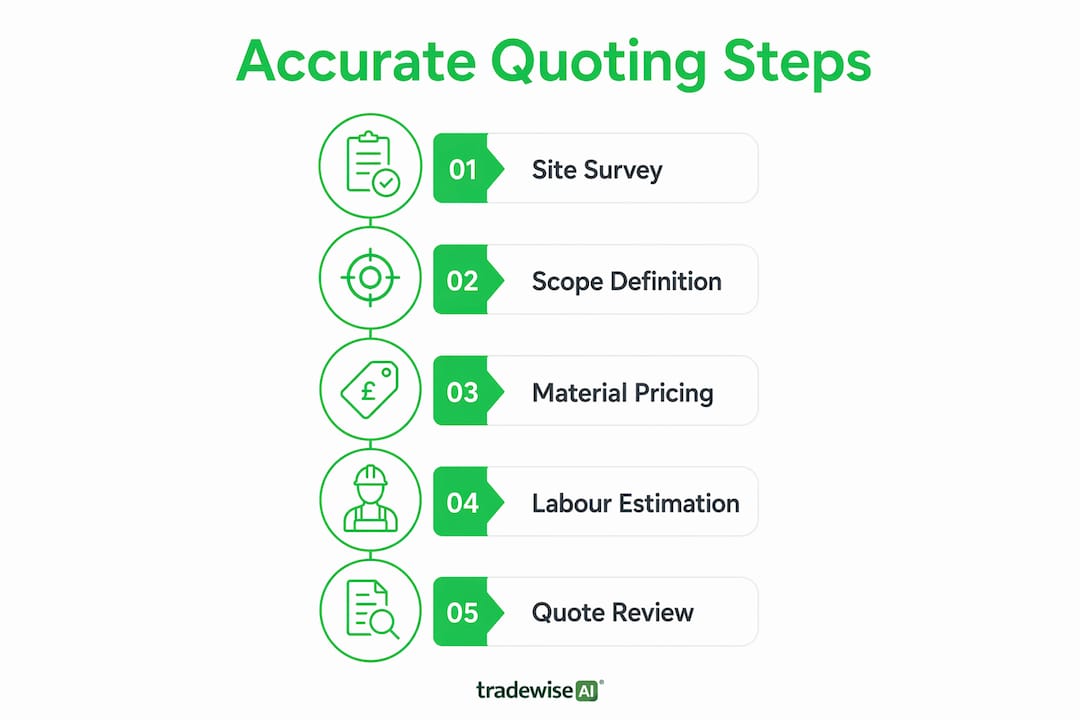
Producing a reliable estimate follows a repeatable process. Skipping any step increases the risk of underpricing or overpricing, both of which cost you money.
-
Conduct a thorough site survey. Visit the site before writing a single figure. Take physical measurements, photograph existing conditions, and note any access constraints, asbestos risks, or structural unknowns. A quote written from a phone call is not a quote. It is a guess.
-
Source current material prices from merchants. Live pricing from suppliers is the only reliable basis for accurate quote generation in 2026. Price books published even six months ago may be significantly out of date given ongoing material price volatility. Call your merchant or check their trade portal directly.
-
Apply realistic waste allowances. Material waste allowances vary from 5 to 15% depending on the material. Use 10 to 15% for general materials such as timber and plasterboard, and 5 to 10% for expensive items such as tiles or bespoke joinery. Ignoring waste is one of the fastest ways to erode your margin.
-
Estimate labour with honest day counts. Typical builder and labourer rates run £25 to £35 per hour, with bricklayers at £30 to £45 per hour. Count the actual days each trade will be on site rather than applying a blanket percentage. Underestimating labour is the most common cause of quotes that lose money.
-
Apply overhead and profit margins systematically. A 15 to 25% overhead on materials and a 10 to 20% net profit margin are standard benchmarks for UK builders. These are not optional extras. They are the cost of running your business and taking on project risk.
-
Price your preliminaries against the programme. Site overheads such as skips, scaffolding, welfare facilities, and site management should be priced as a weekly or monthly rate multiplied by the programme length. Add a 5 to 10% risk allowance to cover typical schedule overruns.
-
Run a quality assurance check before sending. Read the quote back against your site survey notes and check that every scope item has a corresponding cost. Arithmetic errors are obvious, but narrative inconsistencies, where the scope says one thing and the price implies another, are what cause real disputes.
Pro Tip: Use a simple checklist before every quote goes out: scope matches site survey, waste added, margins applied, VAT stated, validity period included, payment terms defined. Five minutes of checking saves five hours of arguing.
What are the common quoting mistakes builders make?
Even experienced builders repeat the same errors. Recognising them is the first step to building precise work estimates that hold up throughout a project.
-
Vague scope language. Phrases like "build extension as discussed" or "complete works as per plan" are not scopes. They are invitations to dispute. Scope should cover each phase with specific inclusions and exclusions written so clearly that a neutral adjudicator could interpret them without speaking to either party.
-
Using outdated price books. The shift from fixed price books to live pricing sources is critical for accuracy in 2026. Relying on last year's rates for timber, insulation, or steel can leave you absorbing hundreds or thousands of pounds in unrecovered costs.
-
Ignoring waste and programme risk. Omitting waste allowances and failing to add a contingency for schedule delays are two of the most consistent causes of budget overruns on residential projects. Both are predictable and both are preventable.
-
Omitting payment terms and exclusions. A quote without payment terms is not a professional document. It creates ambiguity around deposits, staged payments, and final account settlement. Exclusions protect you from scope creep. Without them, clients reasonably assume everything is included.
-
Failing to separate labour and materials. Presenting a single lump sum makes it impossible for a client to understand your pricing and makes it harder for you to track costs against budget. Separating these two lines is a basic discipline that supports job costing accuracy throughout the project.
-
Skipping the QA check. A thorough pre-issue review catches not just arithmetic errors but inconsistencies between the scope narrative and the priced items. This step takes fifteen minutes and prevents disputes that can run for months.
How can templates and software improve quoting accuracy?
Structured templates and digital tools do not replace good estimating judgement. They remove the administrative friction that causes builders to rush quotes and miss critical details.
A professional quote template should include contact details, a unique reference number, a detailed scope with inclusions and exclusions, an itemised price breakdown, VAT treatment, payment terms, validity period, and acceptance conditions. When a client accepts a structured quote, it becomes a contract. The template is the framework that makes that contract enforceable.
| Feature | Manual process | Software-assisted process |
|---|---|---|
| Material pricing | Sourced manually from merchant calls or old price books | Live supplier feeds update prices automatically |
| Scope management | Written from scratch each time, risk of omissions | Template library with standard inclusions and exclusions |
| Labour calculation | Estimated from memory or spreadsheet | Day rate inputs with automatic totals and margin application |
| Quote delivery | Printed or emailed as a PDF | Sent digitally with acceptance tracking and audit trail |
| Link to project budget | Disconnected from job management | Quote feeds directly into project cost tracking |
Tradewisehq connects quoting workflows to job scheduling, supplier pricing, and invoicing in a single mobile-first platform. This means the figure you quote is the same figure your project budget starts from, removing the manual re-entry that causes discrepancies between estimate and actual cost. Job management software of this kind also gives you a live view of costs as the project progresses, so you can identify budget pressure before it becomes a loss.
Pro Tip: Build a library of scope clauses for the work types you do most often. Standard groundworks inclusions, standard first fix exclusions, standard preliminaries. Reusing tested language saves time and reduces the risk of leaving something out under pressure.
Key takeaways
Accurate building work quotes require detailed scope, current pricing, realistic labour assessment, and clear payment terms to protect budgets and prevent disputes.
| Point | Details |
|---|---|
| Scope clarity is non-negotiable | Write phase-by-phase inclusions and exclusions that a neutral party can interpret without ambiguity. |
| Use live material prices | Outdated price books cause unrecovered costs; source current merchant rates before every quote. |
| Apply margins systematically | Target 15 to 25% overhead on materials and 10 to 20% net profit margin as standard practice. |
| Include payment terms and validity | State deposit amounts, staged milestones, and a 30 to 60 day validity period on every quote. |
| Run a QA check before sending | Review scope narrative against priced items to catch inconsistencies, not just arithmetic errors. |
Why I think most builders underestimate the value of a well-written quote
After working closely with UK tradespeople and contractors, the pattern I see most often is this: builders invest hours in doing excellent work on site, then spend twenty minutes writing a quote that exposes them to months of dispute. The quote is treated as an administrative hurdle rather than a scope-control document.
The uncomfortable truth is that a poorly written quote is a liability. Explicit exclusions and assumptions are not bureaucratic padding. They are the clauses that determine whether a variation gets paid or absorbed. I have seen builders lose thousands of pounds on jobs they priced correctly because their scope language was too vague to defend.
The other mistake I see is over-reliance on technology without the underlying discipline. Software tools save time and reduce errors, but they cannot write a clear scope for you. The builder who uses Tradewisehq to automate pricing updates while also investing time in precise scope writing is the one who wins on both efficiency and protection. The builder who uses software as a shortcut to avoid thinking carefully about scope is just making their mistakes faster.
Treat every quote as a contract that protects both parties. Your client deserves to know exactly what they are paying for. You deserve to be paid for exactly what you agreed to do. A well-written quote is how both of those things happen.
— Mateusz
How Tradewisehq helps builders quote and manage work with confidence
Tradewisehq is an AI-powered trade management platform built for UK builders, contractors, and tradespeople who need quoting, job management, scheduling, and invoicing in one place.
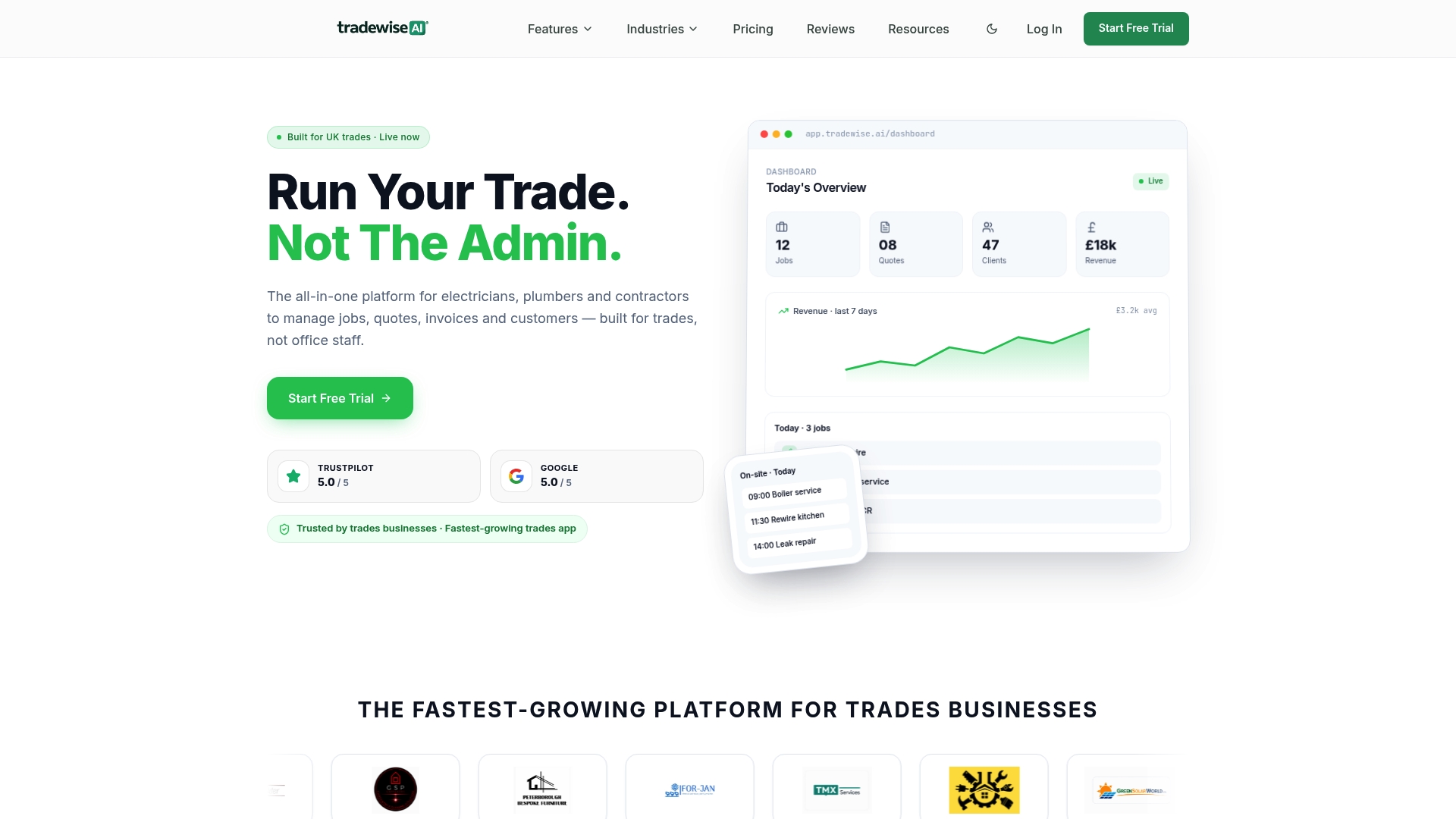
The platform connects live supplier pricing to your quote workflows, so your material costs reflect what merchants are actually charging today. Quotes link directly to project budgets and schedules, removing the manual re-entry that causes cost tracking to break down mid-project. Payment terms, staged invoicing, and client communication are all managed from the same mobile-first interface. If you want to improve your quoting and project control without adding more admin to your day, Tradewisehq is built for exactly that.
FAQ
What should every building work quote include?
Every building work quote should include a detailed scope of works with inclusions and exclusions, itemised labour and material costs, VAT treatment, payment terms, a validity period, and a unique reference number. When a client accepts the quote, it becomes a binding contract.
How do I avoid underpricing a building job?
Conduct a site survey before pricing, source current material costs directly from merchants, apply waste allowances of 5 to 15%, and add a 5 to 10% risk allowance to your preliminaries. Systematic margin application of 15 to 25% on materials and 10 to 20% net profit is the standard benchmark for UK builders.
How long should a building quote be valid for?
Standard trade quotes in the UK are valid for 30 to 60 days. Beyond that period, material price changes may require a revised figure, so always state the validity date clearly on the document.
What is the difference between a provisional sum and a prime cost sum?
A provisional sum covers scope uncertainty, where the full extent of work is not yet defined. A prime cost sum covers material selection uncertainty, where the item is known but the product has not been chosen. Both must be clearly labelled in the quote so the client understands they are subject to change.
Why do building quotes lead to disputes?
Most disputes arise from vague scope language, missing exclusions, or absent payment terms. Writing scope that a neutral third party can interpret without speaking to either party is the most effective way to prevent variation arguments and protect your position if a dispute escalates.