
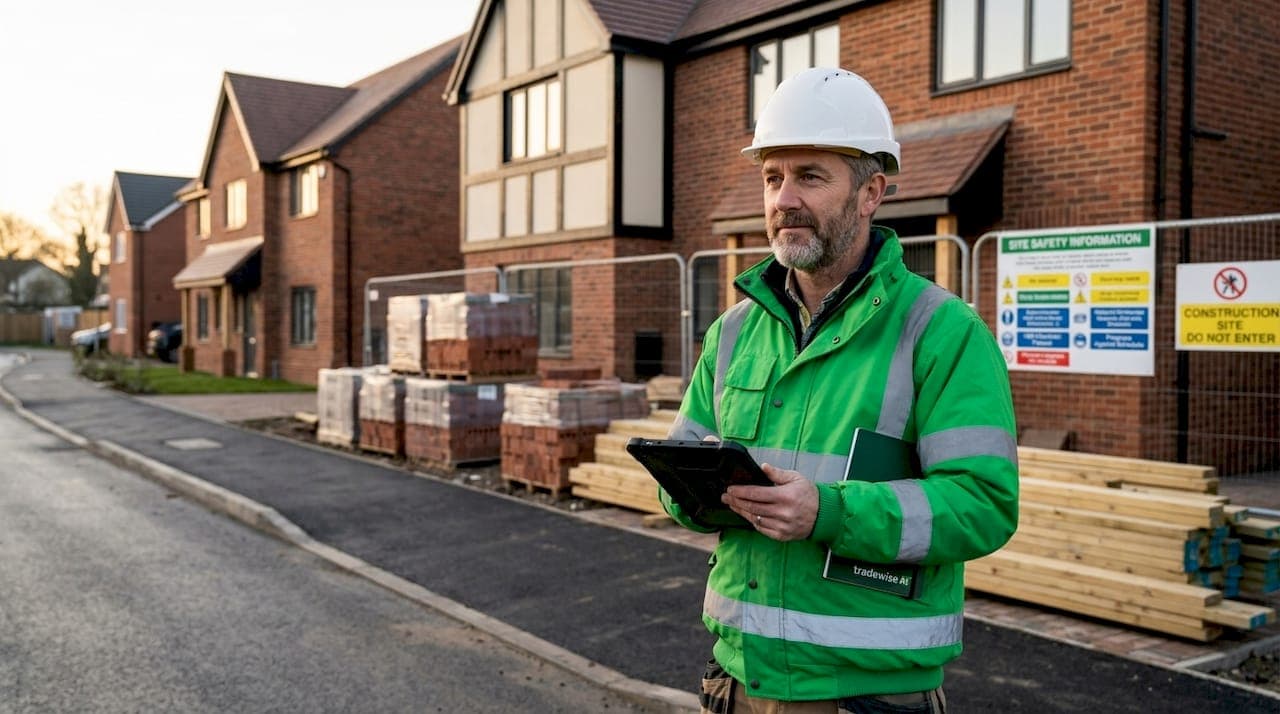
Construction site daily reporting is the process of systematically documenting all relevant site activities, conditions, and events each working day to maintain operational control and create legally defensible records. For UK project managers and site supervisors, the site diary is not an administrative formality. It is the primary evidence base when disputes, claims, or contractual disagreements arise. Autodesk positions daily reports as a cornerstone of accurate project records and legal support, and the FORGE Command 2026 template framework reinforces that consistency and completeness are non-negotiable requirements for UK sites.
What should a UK construction daily report include?
A well-structured daily report captures the full picture of what happened on site, when it happened, and who was involved. FORGE Command's 2026 site diary template sets out the minimum standard for UK-ready reporting, and it goes well beyond a simple attendance sheet.
The following categories belong in every daily site inspection report:
- Weather: Timed observations at the start, middle, and end of the working day, with a note on how conditions affected progress. "Light rain from 09:00, groundworks halted until 11:30" is far more useful than "wet."
- Labour: Each company on site, the trade, the number of operatives, hours worked, and the area of the site where they were active. This level of detail supports both payroll verification and delay claims.
- Plant and equipment: Every item on site, the operator's name, hours in use, and current status. Recording that a tower crane was idle for three hours due to a mechanical fault creates an immediate cost record.
- Deliveries: Supplier name, time of arrival, materials delivered, quantity, and condition on receipt. Damaged deliveries noted at the time are far easier to dispute than those flagged a week later.
- Work executed: Specific activities completed, quantities installed or poured, and precise locations referenced to drawing numbers where possible.
- Visitors and instructions: Every site visit, including client representatives, inspectors, and subcontractor managers, with any verbal or written instructions received. FORGE Command stresses that verbal instructions must be recorded immediately to preserve their evidential value.
- Delays, disruptions, and safety notes: Any event that affected programme, including near misses, safety observations, and unforeseen ground conditions.
The table below summarises the core categories and their primary purpose:
| Category | Primary purpose |
|---|---|
| Weather observations | Evidences programme impact from adverse conditions |
| Labour records | Supports cost allocation and delay substantiation |
| Plant and equipment | Links idle time to cost and schedule impacts |
| Deliveries | Confirms receipt and condition for procurement records |
| Work executed | Tracks progress against programme milestones |
| Visitors and instructions | Creates a contractual record of directions received |
| Delays and safety notes | Builds the narrative for extension-of-time claims |
Pro Tip: Number every report sequentially from day one of the project. A gap in the sequence immediately raises questions about what was omitted, and sequential numbering is a recognised standard for maintaining diary integrity in contentious situations.
How to capture daily site data accurately and efficiently
The single biggest threat to report quality is time. When entries are written from memory at the end of a shift, details blur, sequences get reversed, and critical observations disappear. BuildLog recommends contemporaneous entry as the gold standard, filling each section as events occur rather than reconstructing the day retrospectively.
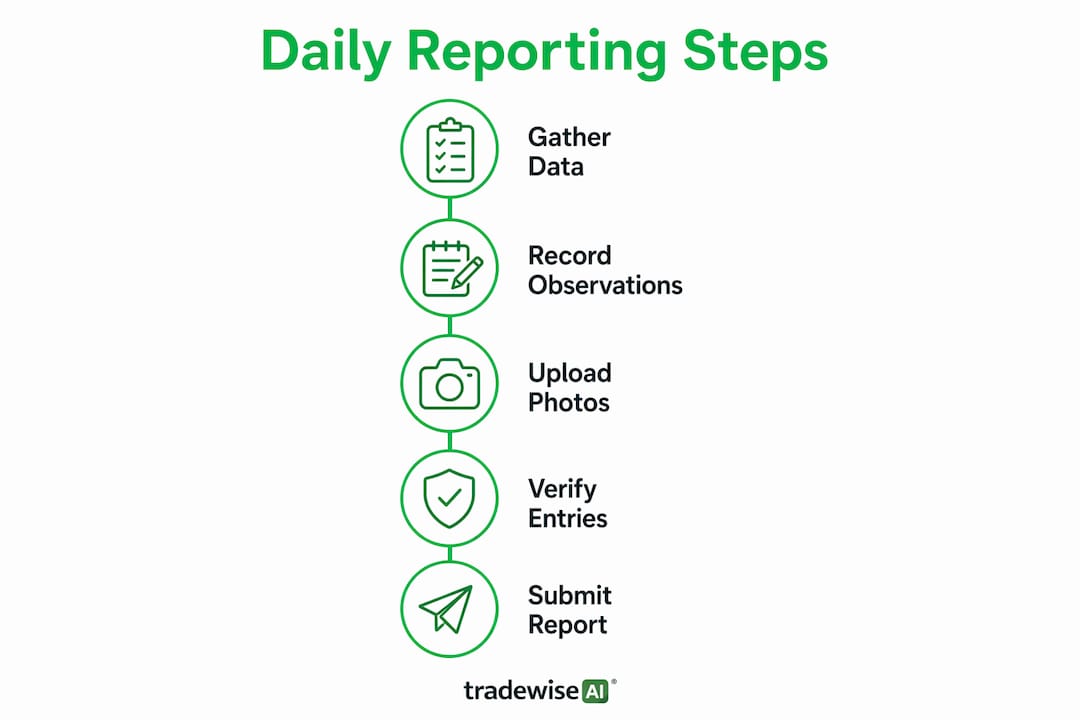
Here is a practical sequence for capturing worksite daily summaries in real time:
- Open the report at the start of the shift. Record weather conditions, confirm which operatives are on site, and note any outstanding items from the previous day before work begins.
- Capture photos immediately after completing each work section. A GPS-tagged, timestamped photograph of freshly poured concrete or completed steelwork is far stronger evidence than a photo taken two days later.
- Record deliveries at the point of receipt. Check quantities and condition before signing the delivery note, then log both in the daily report at the same time.
- Note instructions as they are given. If a client representative verbally changes a specification on site, record it in the diary within minutes, not at the end of the day.
- Close the report before leaving site. Review for completeness, add any end-of-day weather observations, and submit or sync the record so it is time-stamped and stored off-device.
Embedding reporting steps directly within task workflows is the most reliable way to improve compliance. When reporting is a separate activity that happens after the work is done, it creates friction and missed entries. When it is part of the task itself, completion rates improve significantly.
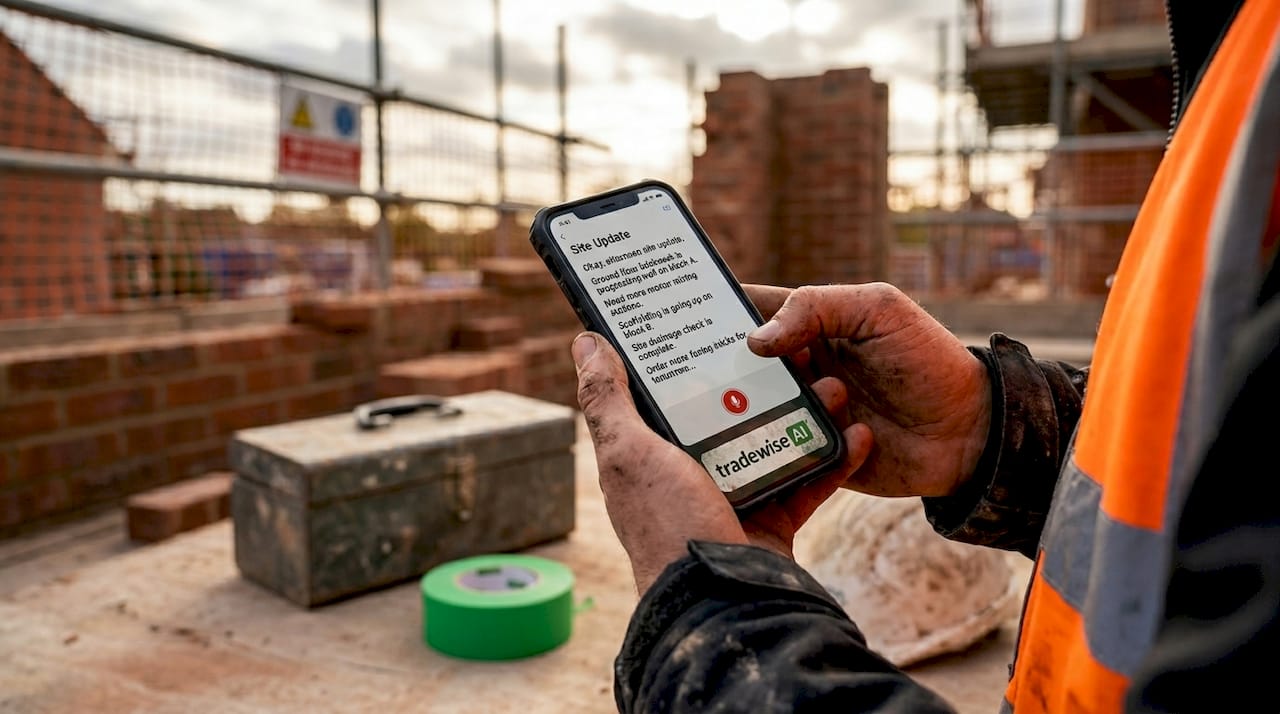
Pro Tip: Use voice dictation on your mobile device to log observations hands-free while on the move. Most digital reporting apps accept voice input, and a 20-second voice note captured on the spot beats a blank field filled in from memory at 17:30.
What are the most common daily reporting mistakes?
The errors that undermine construction progress updates are almost always behavioural rather than technical. They stem from habits and assumptions that feel harmless in the moment but create serious problems when a dispute arises months later.
"UK construction teams often falter by focusing too much on diary form perfection rather than changing workflows to embed reporting actions directly after work completion." — PBC Today, Digital Construction Week 2026
The most damaging mistakes include:
- Delaying entries until the end of the day or the following morning. Memory is unreliable. Times, quantities, and sequences become approximate, which weakens the report's evidential value.
- Skipping zero-activity days. In the UK, reporting every working day without exception is a legal evidence requirement. A blank report for a day when nothing happened is still a valid and necessary record.
- Poor or unlinked photo documentation. Photos stored in a phone gallery with no connection to the daily report are almost useless in a dispute. Images must be attached to the specific report entry they relate to.
- Failing to record verbal instructions immediately. A verbal instruction that is not documented within the same working day may as well not have been given, from a contractual standpoint.
- Selective reporting. Recording only positive progress and omitting delays or disruptions destroys credibility. A report that never mentions a problem is not credible to a tribunal or adjudicator.
- Using a standard template without adjusting detail levels. When an extension-of-time claim or a variation dispute is foreseeable, the level of specificity in daily reports must increase. FORGE Command advises capturing more granular detail on instructions and their programme impacts when claims are anticipated.
What digital tools support construction site reporting in the UK?
Digital tools have transformed what is possible with site activity logs. The shift from paper diaries to mobile-first platforms removes illegibility, eliminates lost pages, and creates tamper-evident, searchable records. Site Manager AI recommends digital diaries specifically for their improved legal evidence quality and the ability to retrieve records instantly during disputes.
The table below compares tools commonly used on UK construction sites:
| Tool | Key features | Best suited for |
|---|---|---|
| BuildLog | Contemporaneous entry, photo tagging, PDF export | Small to mid-size contractors |
| Raken | Mobile daily reports, voice notes, subcontractor logs | Multi-trade sites with subcontractors |
| Sitemate | Customisable forms, offline mode, project integration | Complex projects with bespoke workflows |
| Tradewisehq | AI-powered job management, mobile reporting, real-time syncing | UK trade businesses scaling operations |
When selecting a digital tool, prioritise offline capability. UK construction sites frequently have poor mobile signal, and a tool that requires a live connection will create the same end-of-day bottleneck as paper. GPS tagging and automatic timestamping are non-negotiable features for any tool intended to produce legally credible records.
Pro Tip: Choose a platform built for UK compliance standards rather than adapting a tool designed for the US or Australian market. Contract terminology, HSE reporting requirements, and JCT-related documentation differ significantly from other jurisdictions.
Accurate timesheet data capture is closely linked to daily reporting quality. When labour records in the daily diary align with timesheet submissions, discrepancies surface immediately rather than compounding over weeks.
How to integrate daily reports into project management workflows
A daily report that sits in a folder and is never reviewed is a missed opportunity. CMIC Global describes daily reports as a real-time ledger, and that framing is instructive. A ledger only has value if someone reads it and acts on it.
Effective integration means connecting daily reporting to the broader management system in the following ways:
- Progress monitoring: Compare each day's work executed against the programme. A single day's shortfall may be recoverable. Three consecutive days of shortfall signals a trend that requires intervention.
- Job costing: Link labour hours and plant usage from daily reports to cost codes in real time. This gives project managers live budget visibility rather than month-end surprises.
- Stakeholder communication: Share daily or weekly summaries with clients and design teams. Transparent construction communication tools reduce the frequency of uninformed client calls and build trust.
- Claims substantiation: Daily reports documenting exact start and end times, weather impacts, and instruction records form the chronological backbone of any extension-of-time or loss-and-expense claim. The diary is the narrative; everything else is supporting evidence.
- Subcontractor management: Daily records of subcontractor attendance and output are indispensable for managing performance and resolving payment disputes. The subcontractor management process depends on reliable daily data to function.
- Materials tracking: Cross-referencing delivery records in daily reports with procurement schedules identifies shortfalls before they halt work. Materials management on UK sites is significantly more reliable when delivery data is captured contemporaneously.
The reporting culture on a site is set by the project manager. When the PM reviews daily reports each morning and asks specific questions based on what they contain, supervisors quickly understand that the reports are read and valued. That single behavioural change does more to improve reporting quality than any template redesign.
Key takeaways
Consistent, contemporaneous construction site daily reporting is the single most effective way to protect a project from disputes, delays, and cost overruns.
| Point | Details |
|---|---|
| Record in real time | Fill each report section as events occur to preserve accuracy and evidential value. |
| Never skip a day | Report every working day, including zero-activity days, to maintain legal evidence quality. |
| Use digital tools | GPS-tagged, timestamped records are stronger evidence and easier to retrieve than paper diaries. |
| Embed reporting in workflows | Attach reporting tasks to work activities rather than treating them as a separate end-of-day task. |
| Connect reports to management | Link daily data to job costing, scheduling, and claims processes to extract operational value. |
Why the mindset shift matters more than the template
I have reviewed daily diaries from sites where the template was perfect and the records were useless, and I have seen handwritten notebooks that won six-figure adjudications. The difference was never the form. It was whether the person filling it in understood why it mattered.
The construction industry has spent years debating which template to use. The more productive question is whether reporting is embedded in how work actually happens on site. When a supervisor photographs completed work as a natural part of finishing a task, that behaviour produces better evidence than any structured form filled in retrospectively. The technology now exists to make this effortless. Mobile apps with voice input, automatic GPS tagging, and offline sync remove every practical excuse for incomplete records.
What I find genuinely encouraging about 2026 is that digital adoption on UK sites has reached a tipping point. Supervisors who resisted smartphones for site work five years ago are now the ones asking for better apps. The behavioural change is happening. The challenge now is making sure the tools and workflows are designed to capture that momentum rather than squander it with clunky interfaces and mandatory fields that slow people down.
My advice to any project manager reading this: pick one project, commit to contemporaneous reporting for four weeks, and review what you have at the end. The quality of the record will change how you think about every project that follows.
— Mateusz
How Tradewisehq supports daily reporting for UK construction teams

Tradewisehq is an AI-powered trade management platform built specifically for UK contractors, builders, and site teams. It brings mobile daily reporting, photo capture with GPS tagging, real-time workforce syncing, and job cost tracking into a single platform designed for the way construction work actually happens. Site supervisors can log activities, attach photos, and submit reports from the site without returning to the office. Project managers get live visibility across jobs, with reporting data feeding directly into scheduling and cost management. If you are looking to move beyond paper diaries and disconnected spreadsheets, Tradewisehq is built for exactly that transition.
FAQ
What is construction site daily reporting?
Construction site daily reporting is the practice of recording all significant site activities, conditions, labour, plant, deliveries, and incidents each working day. It creates a contemporaneous record that supports project management and serves as legal evidence in disputes.
What should be included in a UK daily construction report?
A UK daily construction report should include timed weather observations, labour attendance by trade and company, plant usage, deliveries received, work executed with quantities and locations, visitors, instructions received, and any delays or safety incidents.
How often should a site diary be completed?
A site diary must be completed every working day without exception, including days when no productive work takes place. Skipping zero-activity days weakens the legal integrity of the record and creates gaps that are difficult to explain in disputes.
What digital tools are used for daily site reporting in the UK?
BuildLog, Raken, Sitemate, and Tradewisehq are all used on UK construction sites for digital daily reporting. The most important features to prioritise are offline capability, GPS-tagged photo attachments, and automatic timestamping.
How do daily reports support construction claims?
Daily reports provide a chronological record of labour, weather, instructions, and delays that forms the evidential backbone of extension-of-time and loss-and-expense claims. Without contemporaneous records, claims rely on reconstruction from memory, which is far less persuasive to adjudicators and tribunals.