

A construction tender in the UK is a formal, competitive process where a client invites contractors to submit detailed proposals to carry out a defined construction project. The process governs billions of pounds of public and private construction work each year. UK public sector procurement now operates under the Procurement Act 2023, which came into effect in october 2024 and reshaped how contracts are evaluated and awarded. Whether you are bidding for a school extension or a commercial fit-out, understanding the construction tender process in the UK is the foundation of winning work consistently.
What is a construction tender in the UK?
A construction tender, formally known as a bid or tender submission, is the document a contractor prepares in response to a client's request for proposals. The client publishes a tender notice, sets out the scope of work, and invites eligible contractors to compete. The process applies to both public sector bodies and private clients, though public sector tendering carries stricter legal obligations.
Construction bidding in the UK is not simply about offering the lowest price. An Invitation to Tender is legally an invitation to treat, meaning the client is not obliged to accept any bid, including the cheapest one. Clients assess bids against predefined criteria covering price, quality, experience, and increasingly, social value. That shift in weighting is one of the most significant changes the Procurement Act 2023 introduced.

Public tenders are advertised across several government portals. UK tender portals include Contracts Finder, Find a Tender, Public Contracts Scotland, and Sell2Wales. Monitoring all of them is necessary to access the full range of available opportunities, which is why many contractors use aggregator tools to centralise their search.
What are the key stages of the construction tender process in the UK?
The construction tender process in the UK follows a defined sequence. Each stage has specific requirements, and missing any one of them can end your bid before it is scored.
-
Tender notice publication. The client publishes a contract notice on the relevant portal. This sets out the project scope, estimated value, and eligibility criteria. For open procedure tenders, the minimum submission window is 35 days, extended to 45 days for contracts over £5 million. That window is your working deadline.
-
Prequalification. Many clients issue a Pre-Qualification Questionnaire (PQQ) before releasing full tender documents. This stage filters out contractors who lack the financial standing, insurance, or experience required. Buyers typically request 2–3 years of audited accounts and proof of public liability insurance, often set at £5–10 million minimum.
-
Invitation to Tender (ITT). Contractors who pass prequalification receive the ITT pack. This contains drawings, specifications, pricing schedules, and the evaluation criteria. Read every page. The ITT is the blueprint for your entire submission.
-
Submission. You compile and submit your bid by the stated deadline. Late submissions are rejected without exception. The total tender process, from notice to contract award, typically spans 3–9 months, with evaluation alone taking 4–12 weeks.
-
Evaluation and standstill. The client scores bids against the published criteria. Under the Procurement Act 2023, contracts must be awarded to the Most Advantageous Tender, combining price with quality and social value. A mandatory standstill period follows before the contract is signed, giving unsuccessful bidders time to request feedback.
-
Contract award. The winning contractor receives formal notification and the contract is executed.
Pro Tip: Set a calendar reminder three days before the submission deadline to check for any addenda the client may have issued. Buyers frequently update scope or requirements close to the closing date, and missing an addendum is a common cause of disqualification.
Which types of tendering are used in UK construction?
Different tendering routes suit different project types. Choosing the wrong route, or misunderstanding which route a client is using, affects how you prepare your bid.
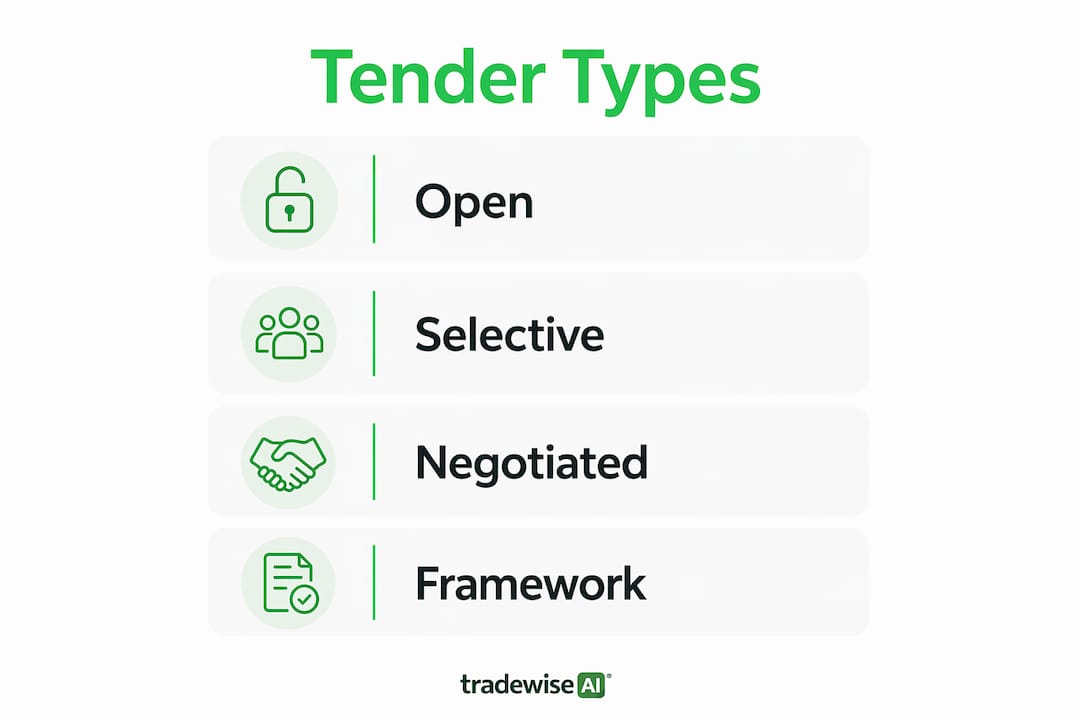
Open tendering is the most common route for public sector contracts. Any contractor can submit a bid, making it the most transparent and competitive method. The trade-off is volume: clients receive large numbers of submissions, and evaluation takes longer.
Selective tendering involves the client inviting a shortlist of pre-approved contractors to bid. This route is favoured for private projects and specialist works where reliability matters more than maximum competition. Selective tendering balances competition with delivery predictability by limiting bids to contractors with a proven track record.
Negotiated tendering cuts the competitive element entirely. The client approaches a single contractor and negotiates the contract directly. This route suits highly specialist projects, emergency works, or situations where an existing relationship justifies a direct appointment.
Serial tendering applies when a client has a programme of similar projects. A contractor wins the first contract and then delivers subsequent phases under pre-agreed rates. This route rewards consistency and builds long-term client relationships.
The choice of route affects your bid strategy directly:
- Open tender: focus on compliance and standing out in a crowded field
- Selective tender: emphasise your track record and specific project fit
- Negotiated tender: prioritise relationship and value demonstration over price competition
- Serial tender: demonstrate capacity to deliver repeatedly at consistent quality
What documents do you need to submit a UK construction tender?
The requirements for UK tenders are non-negotiable. Non-compliance with mandatory requirements is the primary cause of bid rejection, not price. A missing signature or an incomplete form leads to disqualification before a single evaluator reads your proposal.
The standard document set for most UK construction tenders includes:
- Financial accounts. Two to three years of audited accounts demonstrating financial stability. Clients use these to assess whether your business can sustain the contract.
- Insurance certificates. Public liability cover of £5–10 million is standard. Employers' liability and professional indemnity may also be required depending on the project type.
- Health and safety documentation. A current health and safety policy, method statements, and evidence of a strong safety record. Clients will check your accident frequency rate.
- References and project evidence. Case studies from comparable projects, ideally with named referees. Generic portfolio entries without specific outcomes carry little weight.
- Accreditations. Schemes like Constructionline and CHAS are standard prequalification tools that verify compliance across multiple clients simultaneously. ISO 9001 and ISO 14001 certifications strengthen bids for larger contracts.
- Completed tender forms. Every form in the ITT pack must be completed in full. Acknowledge all addenda in writing.
Pro Tip: Build a compliance checklist directly from the mandatory sections of the tender document. Work through it twice before submission: once when you start and once the day before the deadline.
How do you prepare and submit a winning construction tender?
A winning tender is a tailored narrative that aligns with the client's priorities, not just a low price offer. Generic bids fail because evaluators can tell immediately when a contractor has copied a previous submission. Project-specific evidence, written in the client's language, is what separates winning bids from the rest.
Follow this approach when preparing your submission:
-
Mirror the evaluation criteria. Use the buyer's rubric terms as your section headings. If the ITT asks for "approach to programme management," your heading should read exactly that. Evaluators score against a marking sheet, and matching their language makes scoring faster and more accurate.
-
Lead with evidence, not claims. Do not write "we have extensive experience in commercial refurbishment." Write "we delivered a £2.4 million commercial refurbishment for [named client] in 2024, completing on programme and within budget." Specificity wins marks.
-
Address risks explicitly. Clients want to know you have thought about what could go wrong. Name the project-specific risks and explain your mitigation plan for each one.
-
Price strategically. The lowest price rarely wins outright. Under the Procurement Act 2023, quality and social value carry significant weight. Undercutting on price while delivering a weak quality submission is a losing strategy.
-
Check addenda up to the deadline. Tender addenda issued during the submission window must be acknowledged and incorporated. Submitting a bid that ignores a scope change issued three days before the deadline is an automatic disqualification risk.
-
Present professionally. Spelling errors, inconsistent formatting, and missing page numbers signal poor attention to detail. Evaluators notice. Proofread every section, and have a colleague review the final document before submission.
For contractors looking to win more builder contracts consistently, the discipline of structured bid preparation is the single biggest differentiator between firms that grow and those that plateau.
Understanding the types of construction contracts you are bidding under also matters. The contract form, whether JCT, NEC, or bespoke, shapes your risk exposure and pricing assumptions before you write a single word of your proposal.
Key takeaways
A construction tender in the UK is a formal, structured process governed by the Procurement Act 2023, where compliance, tailored evidence, and strategic pricing determine who wins the contract.
| Point | Details |
|---|---|
| Compliance comes first | Non-compliance with mandatory requirements is the leading cause of bid rejection before scoring begins. |
| Timelines are fixed | Open procedure tenders require a minimum 35-day window; the full process spans 3–9 months. |
| Mirror evaluation criteria | Use the buyer's rubric headings in your submission to help evaluators score your bid accurately. |
| Accreditations accelerate prequalification | Constructionline and CHAS memberships verify compliance across multiple clients simultaneously. |
| Price alone does not win | The Procurement Act 2023 requires award to the Most Advantageous Tender, weighting quality and social value alongside cost. |
The part of tendering most contractors get wrong
The most common mistake I see contractors make is treating the tender document as a form to fill in rather than a brief to respond to. They answer the questions, tick the boxes, and submit. Then they wonder why they scored 60% on quality when their work is genuinely excellent.
The Procurement Act 2023 has made this problem worse, not better. The shift toward quality and social value weighting means that a technically compliant bid with a mediocre quality narrative now loses to a well-written bid from a slightly smaller firm. Price used to carry more of the burden. Now your words carry it.
The contractors who win consistently do one thing differently: they decide early whether a tender is worth pursuing. Chasing every opportunity wastes resource and produces rushed bids. A focused firm submitting eight well-prepared tenders a year will outperform a firm submitting thirty generic ones. Selectivity is not a sign of weakness. It is a sign of maturity.
The addenda issue is also chronically underestimated. I have seen bids disqualified because the contractor missed a scope change issued six days before the deadline. Set up a system. Check the portal every two days during the submission window. It takes five minutes and it protects weeks of work.
— Mateusz
How Tradewisehq helps UK contractors manage tenders
Running a construction business means managing bids, compliance documents, site schedules, and client communication at the same time. Most contractors lose hours each week to admin that should take minutes.
Tradewisehq is an AI-powered trade management platform built for UK contractors. It brings job management, scheduling, quotes, and compliance tracking into one mobile-first system. For contractors working through the tender process, Tradewisehq helps you organise bid documents, track submission deadlines, and maintain the compliance records that prequalification demands. Fewer errors, faster submissions, and a cleaner audit trail when clients ask for evidence. Explore Tradewisehq trade management to see how it fits your business.
FAQ
What is a construction tender in the UK?
A construction tender is a formal process where a client invites contractors to submit competitive proposals to carry out a defined project. The client evaluates bids against published criteria covering price, quality, and social value before awarding the contract.
How long does the UK construction tender process take?
The full process typically spans 3–9 months from tender notice to contract award. Evaluation alone takes 4–12 weeks, and open procedure tenders require a minimum 35-day submission window under the Procurement Act 2023.
What documents are needed for a UK construction tender?
Standard requirements include 2–3 years of audited financial accounts, public liability insurance of £5–10 million, health and safety policies, project references, and relevant accreditations such as Constructionline or CHAS.
Why do construction tenders get rejected?
Non-compliance with mandatory requirements is the primary cause of rejection. Missing a signature, failing to acknowledge an addendum, or submitting incomplete forms leads to disqualification before evaluators score the bid on quality or price.
What is the Most Advantageous Tender under the Procurement Act 2023?
The Most Advantageous Tender is the evaluation standard introduced by the Procurement Act 2023. It requires public sector clients to award contracts based on a combination of price, quality, and social value rather than lowest cost alone.