

Construction payroll in the UK is defined by two parallel systems: PAYE for directly employed workers and the Construction Industry Scheme (CIS) for subcontractors. Every contractor operating in the UK must manage both, and confusing the two creates serious HMRC penalties. Understanding how construction payroll works in the UK means knowing which system applies to which worker, how deductions are calculated, and when returns must be filed. Get this right and you protect your business. Get it wrong and the fines start at £100 and escalate fast.
How does construction payroll work in the UK?
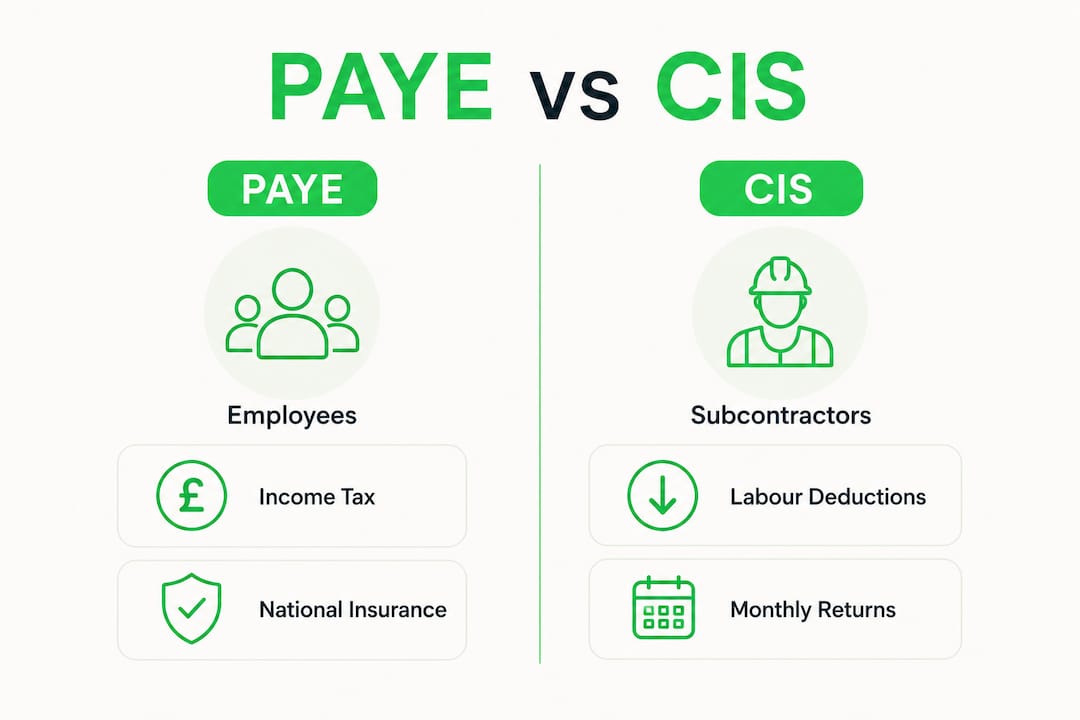
Construction payroll covers two distinct obligations that run simultaneously. PAYE and CIS operate side by side, with PAYE governing employees and CIS governing subcontractors. Most contractors on active sites will have both types of worker, which means running two separate payroll processes every month.
PAYE handles Income Tax and National Insurance Contributions (NICs) for employees on your books. CIS handles deductions from subcontractor payments before they receive their money. The critical difference is this: employees receive a net wage after tax; subcontractors receive a payment minus a CIS deduction, which they then reclaim through their own tax return.
HMRC designed CIS specifically to reduce tax evasion in the construction sector. The scheme requires contractors to verify every subcontractor before making a single payment. That verification determines which deduction rate applies.
How does PAYE operate within UK construction payroll?
PAYE is the standard UK payroll system applied to all directly employed construction workers. It covers Income Tax, employee NICs, and employer NICs, with the employer deducting the correct amounts before paying wages. PAYE also handles statutory payments including Statutory Sick Pay (SSP) and Statutory Maternity Pay (SMP).

The key reporting mechanism under PAYE is Real Time Information (RTI). Every time you run payroll, you submit a Full Payment Submission (FPS) to HMRC on or before the payment date. This is not optional and not something you can batch up at month end. HMRC receives payroll data in real time, which means discrepancies are spotted quickly.
Key PAYE obligations for construction employers include:
- Deducting Income Tax using each employee's tax code
- Calculating employee and employer NICs on earnings above the threshold
- Processing SSP, SMP, and Statutory Paternity Pay (SPP) where applicable
- Submitting an FPS to HMRC on or before each pay date
- Issuing P45 forms when employees leave and P60 forms at the end of each tax year
Pro Tip: Always check that new starters have provided a P45 or completed a starter checklist. Using the wrong tax code from day one creates underpayment issues that take months to correct.
Accurate labour hour tracking feeds directly into PAYE calculations. If your timesheets are unreliable, your payroll will be too.
What is the Construction Industry Scheme and how does it affect subcontractor payments?
The Construction Industry Scheme is HMRC's mechanism for collecting tax from self-employed workers in construction before they receive payment. As a contractor, you are legally responsible for deducting CIS from subcontractor invoices and paying that money to HMRC. The subcontractor does not pay this themselves upfront. You do it on their behalf.
The process follows a clear sequence:
- Register as a contractor with HMRC before making any subcontractor payments.
- Verify each subcontractor with HMRC before their first payment. This confirms their registration status.
- Apply the correct deduction rate based on the verification result.
- Deduct only from the labour element of the invoice. Materials and VAT are excluded.
- Pay the subcontractor the net amount after deduction.
- Submit the monthly CIS300 return by the 19th of the following month.
- Issue a payment and deduction statement to each subcontractor within 14 days of the tax month ending.
The three deduction rates are:
| Subcontractor status | Deduction rate |
|---|---|
| Registered with Gross Payment Status | 0% |
| Registered (standard) | 20% |
| Unregistered | 30% |
The 30% rate is the default for any subcontractor you have not verified. That is a significant hit to their cash flow, and it creates friction on site. Always verify before you pay.
CIS deductions apply only to the labour portion of an invoice. If a subcontractor invoices £2,000 for labour and £800 for materials, you deduct CIS only from the £2,000. Getting this split wrong either over-deducts from the subcontractor or under-deducts and leaves you exposed to HMRC.
Monthly CIS300 returns must be filed by the 19th of the month following the tax month. Miss that deadline and the penalties begin immediately.
Pro Tip: If you have no subcontractor payments in a given month, you must still file a nil return from 6 april 2026 onwards. Omitting it triggers the same penalty as missing a normal return.
How to manage payroll compliance and avoid common CIS and PAYE pitfalls
Compliance in construction payroll comes down to process discipline. The rules are not complicated, but the volume of transactions on a busy site makes it easy to miss a step.
The most common errors contractors make include:
- Paying a subcontractor before completing HMRC verification
- Applying CIS deductions to the full invoice amount including materials
- Missing the 19th deadline for monthly CIS returns
- Failing to issue payment and deduction statements within 14 days of the tax month end
- Omitting nil returns during quiet periods
Failing to submit a CIS nil return when no subcontractors are paid triggers the same penalty regime as failing to file a normal return. Many contractors omit this step, assuming silence is acceptable. From 6 april 2026, HMRC has reinstated penalties for late nil returns, making this a live compliance risk for every contractor.
Late CIS returns attract an automatic £100 penalty at one month late. That rises to £200 at two months and reaches £300 or 5% of the deductions due at six months, whichever is higher. These penalties compound across multiple subcontractors if your return covers several workers.
Precise documentation is equally critical. HMRC mandates that invoices clearly separate labour from materials. Inaccurate splits cause over-deduction, which damages subcontractor cash flow and creates disputes, or under-deduction, which triggers audits and leaves you liable.
Good record-keeping means retaining verification records, copies of all CIS300 returns, payment and deduction statements, and subcontractor invoices for at least three years. HMRC can open an enquiry at any point, and you need to produce these documents quickly.
For guidance on managing the subcontractor relationship beyond payroll, the subcontractor management guide covers the full picture.
What role does technology play in construction payroll management?
Managing fluctuating construction workforces with overlapping PAYE and CIS obligations is one of the most administratively demanding tasks a contractor faces. Payroll software built for construction automates verification lookups, calculates deductions correctly, and files returns directly with HMRC.
The practical benefits of using dedicated payroll software or an outsourced service include:
- Automatic HMRC verification at the point of adding a new subcontractor
- Correct deduction rate applied without manual calculation
- CIS300 returns generated and submitted by the deadline
- Payment and deduction statements produced automatically
- RTI submissions for PAYE sent on or before each pay date
- Audit trail maintained for every transaction
Making Tax Digital (MTD) compatibility matters here. Cloud accounting platforms that integrate with payroll software allow you to reconcile CIS deductions against VAT returns and corporation tax in one place. The VAT domestic reverse charge, which applies to most construction services between VAT-registered businesses, adds another layer of complexity that integrated software handles without manual intervention.
The choice between in-house payroll and outsourcing depends on your workforce size and how frequently your subcontractor roster changes. Smaller contractors with a stable team often manage in-house with good software. Larger firms with dozens of subcontractors rotating across multiple sites typically benefit from a managed payroll service.
Pro Tip: When evaluating payroll software, check whether it handles both PAYE and CIS in a single platform. Running two separate systems doubles your admin and increases the risk of reconciliation errors.
For a broader view of how software supports day-to-day operations, the job management software guide explains the wider operational benefits.
How are statutory payments and year-end reporting handled?
Statutory payments sit within the PAYE system and affect your monthly payroll calculations. SSP, SMP, and SPP are paid through the payroll run and then reclaimed from HMRC via the Employer Payment Summary (EPS) submission. The EPS also reports periods of no payment to employees, which prevents HMRC from chasing phantom PAYE liabilities.
Year-end obligations under PAYE include:
- Issuing P60 forms to all employees still on your books by 31 may each year
- Providing P45 forms to any employee who leaves during the year
- Submitting the final FPS of the tax year marked as the year-end submission
For subcontractors, the year-end process works differently. CIS deductions are recovered through the subcontractor's own self-assessment tax return or, for limited company subcontractors, through their corporation tax return. The deductions act as advance payments against their final tax liability. If deductions exceed the tax owed, HMRC issues a refund. This is why accurate payment and deduction statements matter so much. Subcontractors rely on them to complete their returns correctly.
The interaction between CIS and the VAT domestic reverse charge also affects cash flow reporting. Contractors need to account for this correctly in their VAT returns to avoid mismatches that trigger HMRC queries.
Key takeaways
Construction payroll in the UK requires running PAYE for employees and CIS for subcontractors simultaneously, with strict HMRC deadlines, correct deduction rates, and precise invoice documentation to avoid penalties.
| Point | Details |
|---|---|
| Two systems run at once | PAYE covers employees; CIS covers subcontractors. Both require separate processes every month. |
| Verify before you pay | Always verify subcontractors with HMRC before payment to avoid the 30% default deduction rate. |
| Labour only, not materials | CIS deductions apply to the labour element of invoices only. Materials and VAT are excluded. |
| File by the 19th | Monthly CIS300 returns are due by the 19th. Penalties start at £100 and escalate to £300 or 5% of deductions. |
| Nil returns are mandatory | From 6 april 2026, failing to file a nil return in quiet months triggers the same penalties as missing a normal return. |
Construction payroll: what I have learned from working with UK contractors
The contractors who get into trouble with CIS are rarely the ones who ignore the rules. They are the ones who assume the rules are simpler than they are. The most common mistake I see is treating CIS as just a deduction to apply and forgetting the verification step. That single omission can cost a contractor the 30% default rate on every payment to an unverified subcontractor, and HMRC will not waive it retrospectively.
The second thing I have noticed is that the labour versus materials split causes more disputes than almost anything else in construction payroll. Subcontractors often do not itemise their invoices clearly, and contractors either guess or apply the deduction to the full amount. Both approaches create problems. The right habit is to request a clearly itemised invoice before processing any payment.
Technology genuinely helps here, but only if it is set up correctly from the start. I have seen contractors buy payroll software and then configure it without understanding CIS, which means the automation reinforces the wrong process. Get the process right first, then automate it.
The 2026 nil return rule is the change most contractors are not prepared for. If your site goes quiet for a month and you have no subcontractor payments, you still need to file. Build that into your monthly calendar now, before it catches you out.
— Mateusz
Tradewisehq: built for contractors who need more than a spreadsheet
Running PAYE and CIS alongside quotes, invoices, scheduling, and client communication is a significant operational load for any contractor. Tradewisehq is an AI-powered platform built specifically for tradespeople and construction businesses in the UK.

Tradewisehq brings job management, workforce scheduling, invoicing, and client communication into one mobile-first platform. It is designed for builders, electricians, plumbers, and HVAC contractors who need to stay on top of compliance without drowning in admin. If you are managing a growing team and want to reduce the risk of payroll errors, explore Tradewisehq to see how it supports your day-to-day operations.
FAQ
What is the difference between PAYE and CIS in construction?
PAYE applies to directly employed workers, deducting Income Tax and NICs from wages before payment. CIS applies to subcontractors, with the contractor deducting tax from the labour element of invoices before paying them.
What are the CIS deduction rates in the UK?
The three rates are 0% for subcontractors with Gross Payment Status, 20% for registered subcontractors, and 30% for unregistered subcontractors. Always verify with HMRC before making the first payment.
When is the monthly CIS return due?
The CIS300 return is due by the 19th of the month following the tax month. Penalties start at £100 for one month late and rise to £300 or 5% of deductions at six months.
Do I need to file a CIS return if I made no subcontractor payments?
Yes. From 6 april 2026, contractors must file a nil return or notify HMRC of inactivity. Failing to do so triggers the same penalty structure as missing a normal return.
How do subcontractors reclaim CIS deductions?
Subcontractors reclaim CIS deductions through their annual self-assessment tax return or, for limited companies, through their corporation tax return. The deductions offset their final tax liability, with any excess refunded by HMRC.