

Written contracts are the single most effective tool a builder has to protect their income, define their obligations, and resolve disputes without going to court. Without one, you are relying on memory, goodwill, and luck. Contractors without written contracts are three times more likely to face payment disputes than those with signed agreements. That statistic alone should settle the debate. The importance of written contracts cannot be overstated for any builder operating in the UK today, whether you are running a one-person operation or managing a team of twenty.
Why builders need written contracts: the legal foundation
A written contract is a legally enforceable document that records what work will be done, at what price, and under what conditions. In UK construction, the term "building contract" is the standard industry phrase. It covers everything from a simple loft conversion to a full commercial fit-out. The Consumer Rights Act 2015 provides baseline protections for clients, but it cannot replace the specific terms that a well-drafted contract delivers. Without those terms, you have no agreed reference point when things go wrong.

The practical value of legal contracts in construction goes beyond dispute resolution. A signed agreement sets the tone for the entire project. It tells your client you are professional, organised, and serious about delivering what you promise. Builders who use written agreements consistently report fewer misunderstandings and smoother payment cycles. That is not a coincidence. It is the direct result of having expectations written down before a single brick is laid.
Industry-standard contracts such as AIA documents are used by 88% of top ENR contractors to standardise risk management and payment workflows. That level of adoption reflects how central written agreements are to running a profitable building business. UK builders have access to equivalent standard forms through bodies such as the Joint Contracts Tribunal (JCT), which produces contracts specifically designed for the domestic and commercial building sector.
What are the key components of a written building contract?
A building contract is only as strong as the clauses it contains. Weak or missing clauses create gaps that disputes fall through.
- Scope of works. This is the most critical clause. It defines exactly what you will build, supply, and install. A vague scope is an open invitation for a client to claim you agreed to more than you did.
- Payment terms and schedule. Specify the total price, deposit amount, stage payment dates, and what triggers each payment. Builders who tie payments to clearly defined milestones protect their cash flow throughout the project.
- Change order clause. Change order clauses are the highest value protection a builder can include. Scope creep is the top cause of unrecovered contractor revenue. A "no written change order, no extra work" policy is the clearest way to enforce this.
- Timeline and delay provisions. State the start date, expected completion date, and what happens if delays occur. Include which delays are your responsibility and which are outside your control, such as client-caused delays or material shortages.
- Liability limits and warranty provisions. Cap your liability at a reasonable figure, typically the contract value. Define the warranty period and what it covers. Without this, a client could pursue you for consequential losses that far exceed your fee.
Pro Tip: Use a simple, plain-English scope of works rather than technical specifications alone. Clients who understand what they are getting are far less likely to dispute it later.
Every one of these clauses serves a specific protective function. Together, they create a project roadmap that both parties can refer to at any point. A clear contract acts as a project roadmap aligning milestone payments, scopes, and timelines, and it improves enforceability when kept simple. Complexity does not make a contract stronger. Clarity does.
How do written contracts reduce risk and prevent disputes?
Written contracts reduce risk by replacing assumptions with agreed facts. Most construction disputes do not start with bad intentions. They start with two parties who remember a conversation differently.
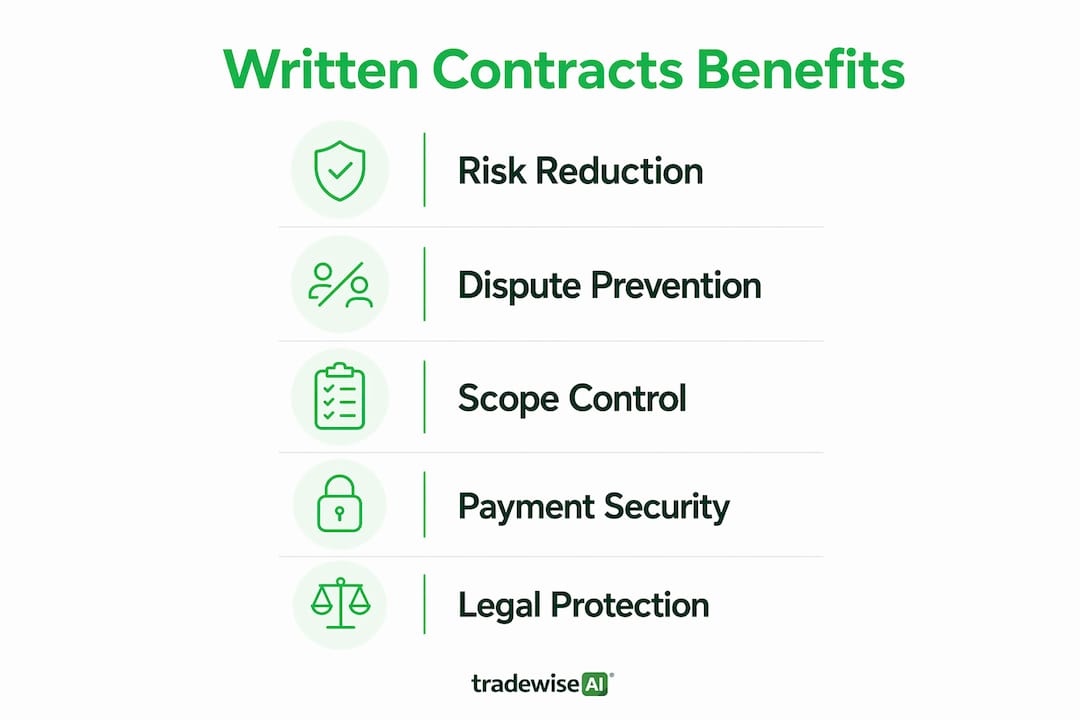
A written contract eliminates that ambiguity. Good contracts function as communication frameworks that prevent conflicts arising from mismatched expectations, according to construction attorney Dean Kilgore. That framing is worth taking seriously. A contract is not just a legal shield. It is a shared understanding of the project, documented before work begins.
The most common sources of building disputes that written agreements prevent include:
- Disagreements over what was included in the original price
- Clients refusing to pay for variations they verbally approved
- Arguments over whether delays were the builder's fault
- Disputes about the standard of workmanship required
- Confusion over who is responsible for obtaining planning permission or building regulations approval
Courts rely heavily on contemporaneous documents such as contracts, emails, and invoices to resolve disputes. Documentation consistently outweighs verbal recollections. A builder without a written contract enters any legal proceeding at a significant disadvantage, regardless of how clearly they remember the original agreement.
For builders managing subcontractor relationships, written agreements are equally critical. Every subcontractor on your site should be working under a written agreement that mirrors the terms of your main contract. Gaps between the two create liability exposure that you carry alone.
Are verbal agreements legally binding for UK builders?
Verbal agreements are technically binding under UK law, but they are extremely difficult to enforce. That distinction matters enormously in practice.
To enforce a verbal agreement in court, you must prove what was agreed, when it was agreed, and by whom. Without written evidence, you are relying entirely on witness testimony. Courts apply an objective standard, asking what a reasonable person would have understood the agreement to mean. That standard rarely favours the party without documentation.
Here is how the typical verbal agreement dispute unfolds for a builder:
- Builder and client agree a price and scope in conversation, often on site.
- Work begins without a signed document.
- The client requests additional work, which the builder carries out expecting payment.
- On completion, the client disputes the additional charges, claiming they were included in the original price.
- The builder has no written change order and no signed contract to reference.
- The dispute goes to a small claims court or adjudication, where the builder's case rests entirely on recollection.
The Consumer Rights Act 2015 does offer some baseline protections, requiring that services are carried out with reasonable care and skill. But it cannot tell a court what price was agreed, what was included in the scope, or what the payment schedule was. Only a written contract can do that. For complex projects, relying on a verbal agreement is not a calculated risk. It is an avoidable one.
How should builders tailor contracts to match their insurance cover?
The biggest risk for builders is not working without any contract. It is signing a contract that creates liabilities their insurance does not cover. These two problems are related but distinct, and the second is far less understood.
Builders often unknowingly accept broader liabilities than their insurance policy covers, particularly in design-and-build scenarios. A standard builder's public liability policy covers physical damage and personal injury. It does not automatically cover design liability. If your contract includes design responsibilities, even informally, and something fails, you may face a claim that your insurer refuses to pay.
Design-and-build contracts often expand a builder's liability beyond traditional negligence. This is a specific and serious exposure that many builders in the UK do not account for when pricing or signing work. The contract language and the insurance policy must be read together, not separately.
Pro Tip: Before signing any contract that includes design, specification, or material selection responsibilities, send the relevant clauses to your insurance broker and confirm in writing that your policy covers those obligations.
Aligning contract terms with insurance coverage is not a legal formality. It is the difference between a claim being paid and a personal financial loss. Builders who understand their contractual risk exposure are far better placed to price jobs correctly and negotiate terms that sit within their actual risk appetite.
What practical steps can UK builders take to implement written contracts?
Implementing written contracts does not require a solicitor on retainer or a complex document management system. It requires consistency and a clear process.
- Start with an industry-standard template. JCT produces domestic building contracts specifically for the UK market. These are well-tested, widely understood, and cover the core clauses every builder needs. Use them as your starting point, not a blank page.
- Keep the language simple. Simplicity and clarity in contracts enhance enforceability and client understanding more than complex, jargon-heavy documents. A concise contract that a client actually reads and understands is worth more than a 40-page document they sign without reading.
- Make signing mandatory before work starts. No signed contract means no start date. This is a firm policy, not a preference. Rushing from handshake to contract without careful drafting risks misaligned incentives and last-minute disputes.
- Have a solicitor review your template once. You do not need legal advice on every job. But having a construction solicitor review your standard template annually is a worthwhile investment. They will catch clauses that create unintended liability.
- Document everything during the project. A signed contract is the foundation, but emails, site notes, and variation approvals build the structure on top of it. Courts treat this contemporaneous documentation as strong evidence.
| Step | What it achieves |
|---|---|
| Use a JCT template | Covers standard UK legal requirements from the outset |
| Define scope in plain English | Reduces client misunderstandings before work begins |
| Include a change order clause | Prevents unrecovered revenue from scope creep |
| Align contract with insurance | Avoids liability exposure outside your policy cover |
| Sign before starting work | Removes ambiguity about agreed terms from day one |
For builders who want to understand how different contract forms work across project types, a practical guide to types of construction contracts in the UK is a useful reference point.
Key takeaways
Written contracts are the primary legal and commercial protection available to UK builders, and every project, regardless of size, should begin with one.
| Point | Details |
|---|---|
| Contracts prevent payment disputes | Builders with written agreements are three times less likely to face payment disputes. |
| Verbal agreements are enforceable but weak | UK courts favour documented evidence over verbal recollections in every dispute. |
| Change order clauses protect revenue | A written change order policy stops scope creep from eroding your profit margin. |
| Insurance alignment is critical | Contract liabilities must match your insurance cover, especially in design-and-build work. |
| Simplicity improves enforceability | A clear, plain-English contract outperforms a complex document the client does not understand. |
Contracts are about trust, not just paperwork
I have spoken with builders who avoided written contracts because they thought it would make them look distrustful of their clients. That logic is completely backwards. A contract does not signal distrust. It signals professionalism.
The builders I have seen struggle most with disputes are not the ones who were dishonest or careless. They are the ones who were too informal. They built good relationships, did good work, and assumed that would be enough. It usually is, right up until it is not. And when it is not, the absence of a written agreement turns a manageable disagreement into an expensive, stressful, and sometimes business-ending problem.
The other misconception I encounter regularly is that contracts are only for large projects. That is wrong. A kitchen extension worth £15,000 has just as much potential for a payment dispute as a commercial fit-out worth ten times that. The stakes are proportional to the builder's business, not the absolute contract value.
What I have found consistently is that clients who are given a clear, well-written contract feel more confident, not less. They know what they are getting, what it costs, and what happens if something changes. That clarity builds the kind of trust that generates referrals. A contract is not the end of a conversation. It is the beginning of a well-managed project.
— Mateusz
Tradewisehq: built for builders who mean business
Managing contracts, quotes, invoices, and client communication across multiple live projects is genuinely difficult without the right tools. Tradewisehq is an AI-powered platform built specifically for tradespeople and contractors in the UK.

With Tradewisehq, you can generate quotes, track job progress, manage payments, and keep all your client communication in one place. The platform supports the kind of organised, documented approach that written contracts demand. When your contract says payment is due at a specific milestone, Tradewisehq helps you track that milestone and send the invoice at the right moment. Visit Tradewisehq to see how the platform supports builders who take their contracts and their business seriously.
FAQ
Are written contracts legally required for builders in the UK?
Written contracts are not legally required for every building project in the UK, but they are strongly advisable. Without one, you rely on verbal agreements that are difficult to enforce and leave you exposed in any dispute.
What should a basic builder's contract include?
A basic building contract should include the scope of works, total price, payment schedule, start and completion dates, a change order clause, and liability limits. These six elements cover the most common sources of dispute.
Can a client refuse to pay without a written contract?
A client can dispute payment far more easily without a written contract in place. Courts rely on documented evidence, and without a signed agreement, proving what was agreed becomes significantly harder for the builder.
How do written contracts protect builders from scope creep?
A written contract with a change order clause requires all additional work to be agreed and signed off before it begins. This prevents clients from claiming extra work was included in the original price.
Do verbal agreements hold up in UK courts?
Verbal agreements are technically binding under UK law but are very difficult to enforce. Courts favour contemporaneous written evidence, placing builders without documentation at a clear legal disadvantage.