

Builder trade account management is the systematic process of organising, monitoring, and optimising credit accounts with construction suppliers to improve cash flow, reduce purchasing costs, and maintain uninterrupted project delivery. For UK builders and contractors, this practice sits at the heart of financial operations. Done well, it unlocks net-30 payment terms, volume discounts, and the kind of supplier relationships that keep projects moving. Done poorly, it causes supply stoppages, cash flow crises, and audit headaches that no site manager needs.
What tools do you need for builder trade account management?
The prerequisites for effective trade account management fall into two categories: documentation and software. Get both right before you open a single account.
On the documentation side, you need your Companies House registration number, VAT certificate, two trade references from existing suppliers, and at least six months of bank statements. Suppliers use these to assess credit risk. Providing detailed credit references upfront reduces probationary cash-on-delivery phases, which means you access credit faster and avoid tying up working capital on day one.

For software, generic accounting packages like standard QuickBooks or Sage setups are not sufficient on their own. Generic accounting software lacks the specialised closed-loop features builders need to match purchase orders, delivery dockets, and invoices automatically. This gap is where overpayments happen and budgets drift. Purpose-built platforms like Tradewisehq and NeroTrade are designed specifically to close that loop.
Here is what a well-equipped trade account management setup looks like:
- Business documentation: Companies House number, VAT certificate, trade references, bank statements
- Credit management software: A platform that tracks payment terms, credit limits, and days-beyond-terms (DBT) in real time
- Accounting integration: Connection to your project management and invoicing tools so costs flow automatically
- Supplier catalogue access: Digital access to pricing tiers and volume discount thresholds
- Audit trail capability: Timestamped records of every order, delivery, and payment for tax compliance
| Feature | Why it matters |
|---|---|
| Net-30 payment terms | Preserves cash flow between project milestones |
| Volume discounts | Reduces material costs on large builds |
| Closed-loop PO matching | Prevents overpayments and budget overruns |
| Real-time credit tracking | Flags payment issues before they cause supply stops |
| Audit-ready records | Simplifies tax filing and job-level profitability reviews |
Pro Tip: Before approaching any supplier, prepare a one-page business summary covering your annual turnover, typical project values, and three client references. Suppliers grant higher initial credit limits to builders who demonstrate financial stability upfront.
How to set up construction trade accounts step by step
Setting up construction trade accounts correctly from the start saves weeks of renegotiation later. Follow this process and you will avoid the most common mistakes UK contractors make.
-
Research and shortlist suppliers. Identify three to five suppliers per material category. Compare their credit terms, delivery lead times, and minimum order values. Builders who adopt data-driven sourcing rather than walk-in purchasing consistently report better margins and fewer supply disruptions.
-
Prepare your application pack. Compile your Companies House number, VAT registration, two trade references, and recent bank statements. The more complete your submission, the shorter your probationary period. Suppliers typically run a credit check through Experian or Creditsafe at this stage.
-
Complete the credit application. Most major UK builders' merchants, including Travis Perkins, Jewson, and Buildbase, offer online applications. Fill in your typical monthly spend, project types, and requested credit limit. Be specific. Vague applications receive conservative credit limits.
-
Digital onboarding and software setup. Once approved, connect the account to your trade management platform. Digital account setup via guided support typically takes 20 to 30 minutes. Use this session to configure payment reminders, delivery notifications, and credit limit alerts.
-
Understand your terms before you order. Confirm your net-30 start date, whether it runs from invoice date or delivery date, and what triggers a stop-supply notice. Contractor trade accounts typically offer net-30 terms alongside volume discounts on large project purchases. Knowing both figures lets you plan cash flow accurately.
-
Set up your internal approval workflow. Decide who on your team can raise purchase orders against each account, and what the authorisation threshold is. This single step prevents unauthorised spending and keeps your credit utilisation predictable.
Pro Tip: If a supplier insists on a COD period despite strong documentation, ask for a six-week review date in writing. Consistent on-time payments during that window almost always accelerate the move to full credit terms.
What are best practices for ongoing trade account monitoring?
Opening accounts is the easy part. The real work is in ongoing management, and most UK contractors underinvest here.
The most reliable metric for account health is days-beyond-terms (DBT). Effective credit management uses DBT as a real-time signal to adjust payment terms proactively rather than waiting for a supplier to flag a problem. A DBT creeping above five days is an early warning sign. Above ten days, you risk a credit limit reduction or a stop-supply notice.
Stop-supply thresholds deserve particular attention. Automatic stop-supply triggers based on credit limits and payment delays prevent supply interruptions and force timely financial reviews. On a live construction site, a supply stop costs far more than the invoice that triggered it. Configure your software to alert you at 80% of your credit limit, not 100%.
Here are the practices that separate well-run trade accounts from reactive ones:
- Monthly account reconciliation: Match every delivery note to its invoice and purchase order. Unmatched items are where overcharges hide.
- Quarterly credit limit reviews: If your project volume has grown, request a credit limit increase proactively. Suppliers respond better to planned requests than emergency ones.
- Supplier relationship calls: A brief monthly call with your account manager builds goodwill and often surfaces unpublished promotions or extended terms.
- Payment run discipline: Batch payments on a fixed weekly schedule rather than ad hoc. This reduces bank charges and makes your payment behaviour predictable to suppliers.
- Audit-ready record keeping: Store timestamped copies of every PO, delivery note, and invoice. HMRC expects this level of documentation, and it also makes job-level profitability analysis straightforward.
"The builders who manage trade accounts well treat them like a financial instrument, not a purchasing convenience. They monitor credit utilisation, track payment performance, and review terms regularly. The ones who struggle treat accounts as an open tab."
Pro Tip: Use your subcontractor payment workflows as a template for supplier payment discipline. The same batching and reconciliation logic applies to both.
How do digital systems transform managing builder accounts?
The shift from spreadsheets and paper delivery notes to integrated digital platforms is the single biggest operational change available to UK builders in 2026. The efficiency gains are not marginal. They are structural.
Integrated software platforms enable forward-looking cash flow forecasts rather than backward-looking reports. This distinction matters enormously. A builder using a platform like Tradewisehq or BuilderGM can see projected cash position across all active jobs three months out, factoring in outstanding supplier invoices and expected payment receipts. A builder using a spreadsheet sees last month's numbers.
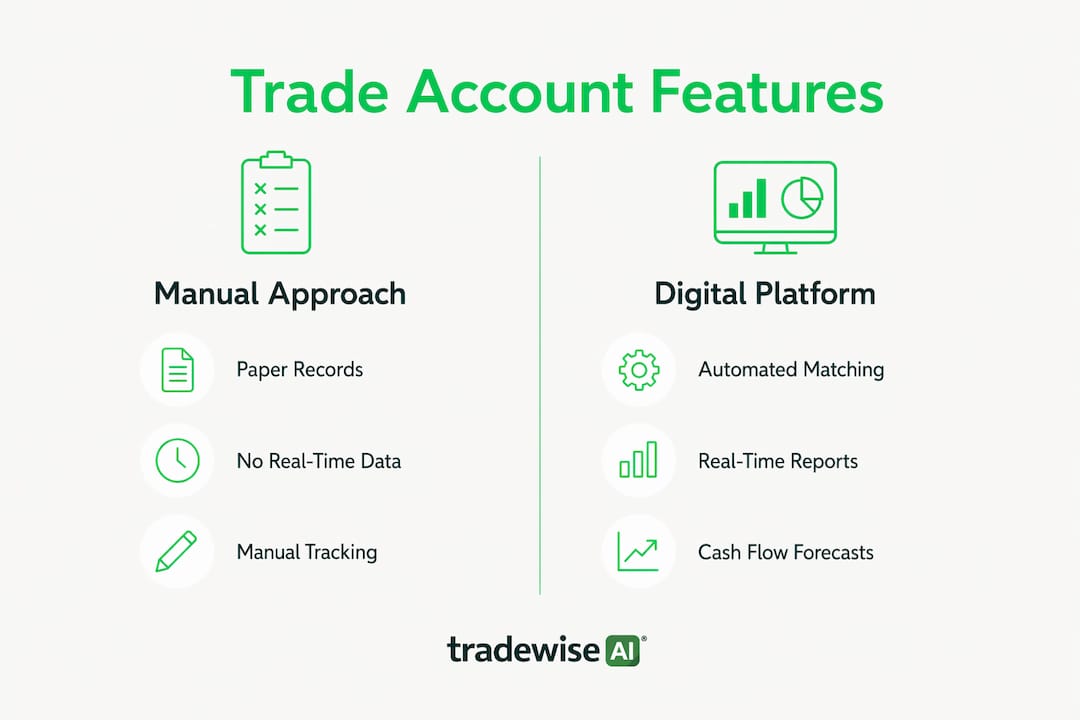
The table below compares manual and digital approaches across the dimensions that matter most to UK contractors:
| Management area | Manual approach | Digital platform approach |
|---|---|---|
| Invoice matching | Manual cross-reference of paper records | Automated PO, delivery note, and invoice matching |
| Credit monitoring | Reactive, checked when problems arise | Real-time DBT tracking with automated alerts |
| Cash flow forecasting | Monthly, based on historical data | Rolling 90-day forecast updated daily |
| Audit compliance | Manual file compilation before deadlines | Continuous audit-ready record generation |
| Payment reminders | Calendar-based, prone to human error | Automated reminders triggered by due dates |
Beyond the operational gains, digital platforms reduce the risk of costly errors. The most successful builders move away from manual sourcing and adopt systems that produce audit-ready transaction records. This matters for both tax compliance and for understanding which jobs are actually profitable once materials costs are properly allocated.
Platforms worth evaluating for UK builders include Tradewisehq for end-to-end trade and job management, NeroTrade for wholesale credit and delivery tracking, and BuilderGM for project-level financial management. Each addresses a different layer of the problem. The strongest setups integrate at least two of these functions into a single data environment, so information does not have to be re-entered across systems.
For builders managing live job tracking across multiple sites, the ability to see material costs against job budgets in real time is particularly valuable. It turns trade account data from a finance function into a project management tool.
Key takeaways
Effective builder trade account management requires closed-loop digital systems, proactive credit monitoring, and disciplined payment workflows working together to protect cash flow and prevent supply disruptions.
| Point | Details |
|---|---|
| Prepare documentation first | Strong credit references and business history shorten probationary periods and unlock higher credit limits sooner. |
| Use closed-loop software | Purpose-built platforms automatically match POs, delivery notes, and invoices to prevent overpayments. |
| Monitor DBT continuously | Days-beyond-terms is the most reliable early warning signal for credit risk and supply stop exposure. |
| Set stop-supply alerts at 80% | Configuring alerts before you hit your credit limit gives you time to act rather than react. |
| Integrate project and finance data | Platforms that connect trade accounts to job management deliver real-time profitability visibility across all active sites. |
Why most builders are still managing accounts the hard way
I have spoken with dozens of UK contractors over the past few years, and the pattern is almost always the same. They open trade accounts with five or six suppliers, manage them through a combination of email threads and a shared spreadsheet, and only discover a problem when a delivery gets stopped or an invoice dispute surfaces three months after the fact.
The uncomfortable truth is that manual trade account management is not just inefficient. It actively costs money. Unmatched invoices, missed volume discount thresholds, and reactive credit limit increases all erode margins on jobs that looked profitable at the quote stage. I have seen builders lose two to three percent of project value to these invisible leakages, which on a £500,000 build is a significant sum.
The shift to digital is not about technology for its own sake. It is about having accurate information at the right moment. When you can see your credit utilisation across all accounts, your projected payment obligations for the next 90 days, and your material costs against job budgets in a single view, you make better decisions. You negotiate from a position of knowledge rather than guesswork.
My advice to any builder still managing accounts manually is to start with one platform and one supplier relationship. Connect them properly, configure the alerts, and run the reconciliation process for 60 days. The time saving alone will justify the change. The financial visibility will make it permanent. For builders thinking about digital business setup more broadly, trade account integration is the highest-return starting point.
— Mateusz
How Tradewisehq simplifies trade account management for UK builders
Tradewisehq is built specifically for the way UK tradespeople and contractors actually work. It connects trade account management, job scheduling, invoicing, and materials tracking in one mobile-first platform, so you are not re-entering data across three separate systems.
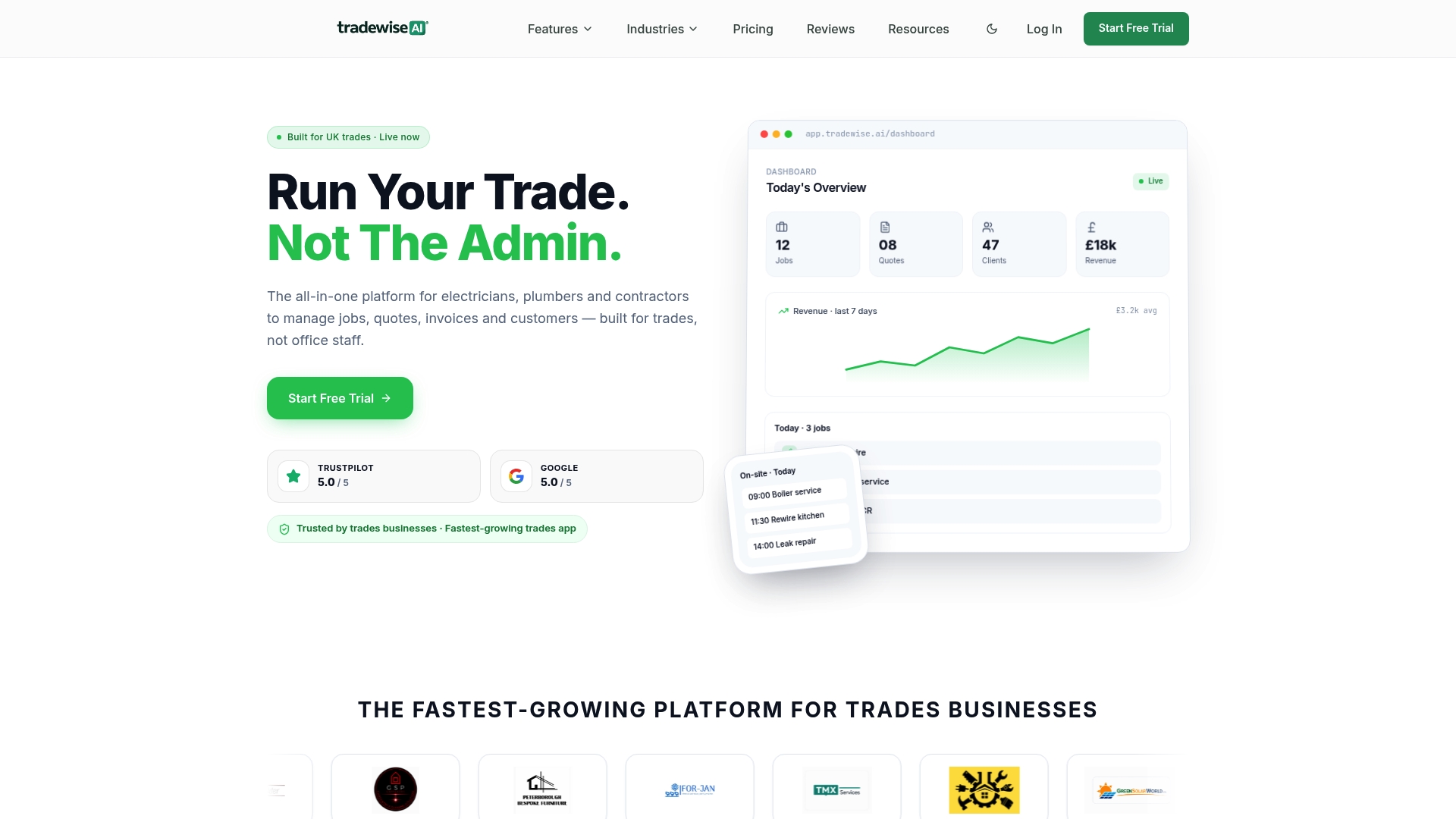
For builders managing multiple supplier accounts, Tradewisehq automates payment reminders, tracks credit utilisation in real time, and generates audit-ready records without manual intervention. The platform integrates with your existing accounting software, so cash flow forecasting reflects actual job costs rather than estimates. Builders managing sole trader cash flow and larger contractor operations alike use it to replace reactive financial management with forward-looking control. Visit Tradewisehq to explore a demo and see how it fits your operation.
FAQ
What is builder trade account management?
Builder trade account management is the process of organising, monitoring, and optimising credit accounts held with construction material suppliers. It covers payment terms, credit limits, invoice reconciliation, and supplier relationship management.
How long does it take to set up a digital trade account?
Digital trade account setup via a guided support call typically takes 20 to 30 minutes. Having your business documentation and credit references prepared in advance reduces this further.
What is days-beyond-terms (DBT) and why does it matter?
DBT measures how many days past the agreed payment deadline an invoice remains unpaid. Suppliers use it as a real-time credit risk signal, and a rising DBT can trigger credit limit reductions or stop-supply notices before you are aware of a problem.
Why is generic accounting software not enough for builders?
Standard accounting platforms lack the closed-loop matching features that automatically reconcile purchase orders, delivery notes, and invoices. Without this, overpayments and budget overruns go undetected until they have already affected job profitability.
How do I avoid a COD probationary period when opening a new trade account?
Submit a complete application pack including trade references, bank statements, and a clear business history. Comprehensive documentation shortens approval periods and unlocks credit access faster than incomplete submissions.