
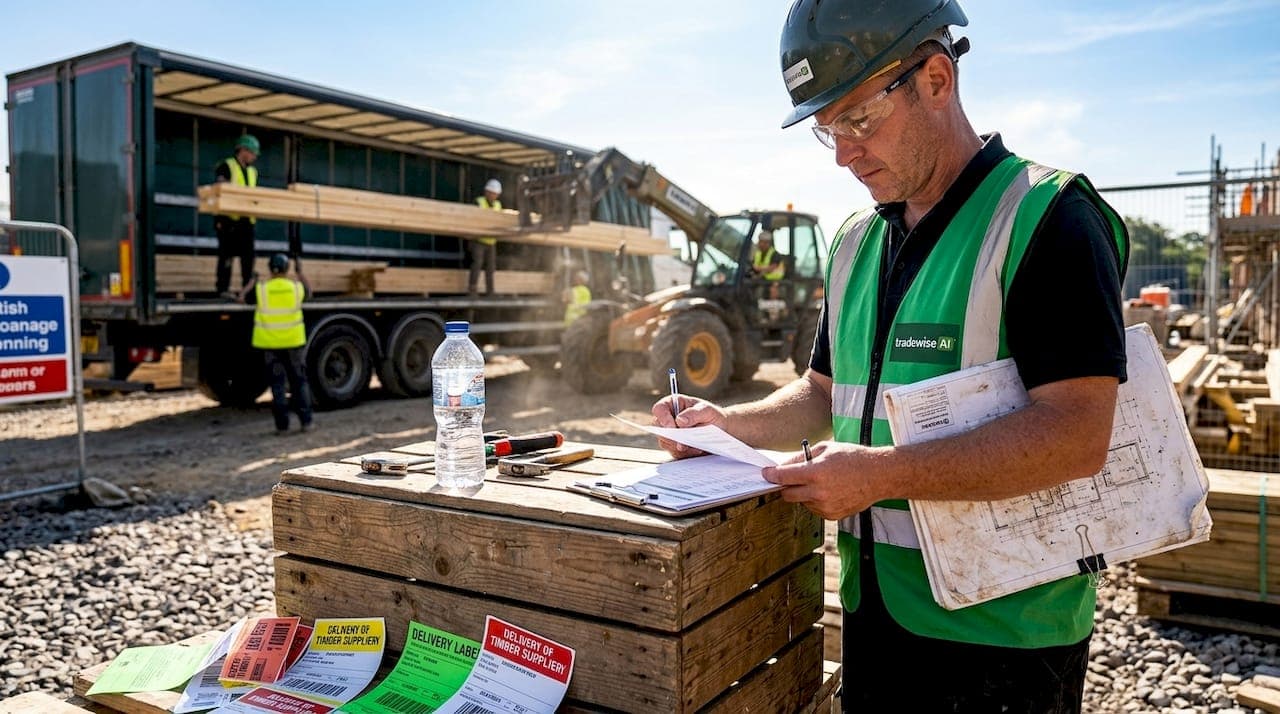
Materials management is one of those functions that gets misunderstood on nearly every construction site in the UK. Most builders treat it as a warehousing task, something for the stores team to handle while the "real" project work happens elsewhere. That framing is expensive. The role of materials management builders rely on is a programme-level discipline that connects procurement, site logistics, compliance, and cost control into a single coherent system. Get it right and your project runs to schedule. Get it wrong and you are paying for delays, rework, and waste that could have been avoided entirely.
Table of Contents
- Key takeaways
- The role of materials management builders depend on
- Site logistics and optimising material flow
- Materials management plans and UK site compliance
- Technology for inventory accuracy and procurement
- Practical steps to improve materials management
- Why materials management is underestimated
- How Tradewisehq supports your materials management
- FAQ
Key takeaways
| Point | Details |
|---|---|
| Materials management is strategic | It connects procurement, logistics, inventory, and compliance rather than just storing goods on site. |
| UK compliance requires documented evidence | Excavated materials can only be reused legally when supported by traceable records under DoWCoP guidance. |
| Logistics choreography beats procurement price | On constrained sites, optimised delivery scheduling often has more impact on timely installation than the unit cost of materials. |
| Technology closes the audit gap | ERP systems, RFID, and AI tools align procurement orders with site availability to prevent shortages and duplication. |
| Continuous improvement is non-negotiable | Regular KPI reviews, discrepancy investigations, and team training sustain accuracy and reduce waste over time. |
The role of materials management builders depend on
The phrase "materials management" covers a wide scope. In industry terms, it sits within the broader discipline of construction resource management, and it spans every stage from pre-construction planning through to final installation. Understanding what that actually means in practice is the starting point for improving it.
At its core, materials management on a UK construction project involves:
- End-to-end material flow. Receiving deliveries, checking quality, storing correctly, controlling movement across the site, and issuing materials to the right trade at the right time.
- Procurement coordination. Working alongside buyers and suppliers to align order schedules with programme milestones, avoiding both shortages and costly overstocking.
- Inventory accuracy. Maintaining records that reflect what is physically on site, not just what was ordered. Inventory discrepancy investigation and root cause analysis are standard responsibilities in this role.
- Supplier performance monitoring. Tracking KPIs such as on-time delivery rates, quality conformance, and lead times. Supply chain KPI management is a defined responsibility in procurement and materials roles on major projects.
- Compliance and record-keeping. Maintaining documentation that satisfies both internal audit requirements and external regulatory obligations, particularly around waste classification and material reuse.
The importance of materials management becomes obvious the moment you look at what happens without it. Duplicate orders, materials sitting in the wrong location, deliveries arriving when the gate is blocked, trades waiting on materials that are technically "on site" but untraceable. These are not rare edge cases. They are the default outcome when materials management is treated as an afterthought.
Pro Tip: Assign a named materials coordinator at the project outset, even on smaller builds. Having one person responsible for material flow from day one prevents the fragmented record-keeping that causes most on-site shortages.
Builders working with subcontractors should also consider how materials responsibilities are divided between principal contractors and specialist trades, since gaps in ownership are a common source of delays.
Site logistics and optimising material flow
Logistics planning is where the importance of materials management becomes tangible. On a constrained UK site, the physical movement of materials is often more critical to programme delivery than the procurement price you negotiated. Logistical choreography including consolidation hubs and optimised delivery scheduling is frequently the deciding factor in whether installations happen on time.
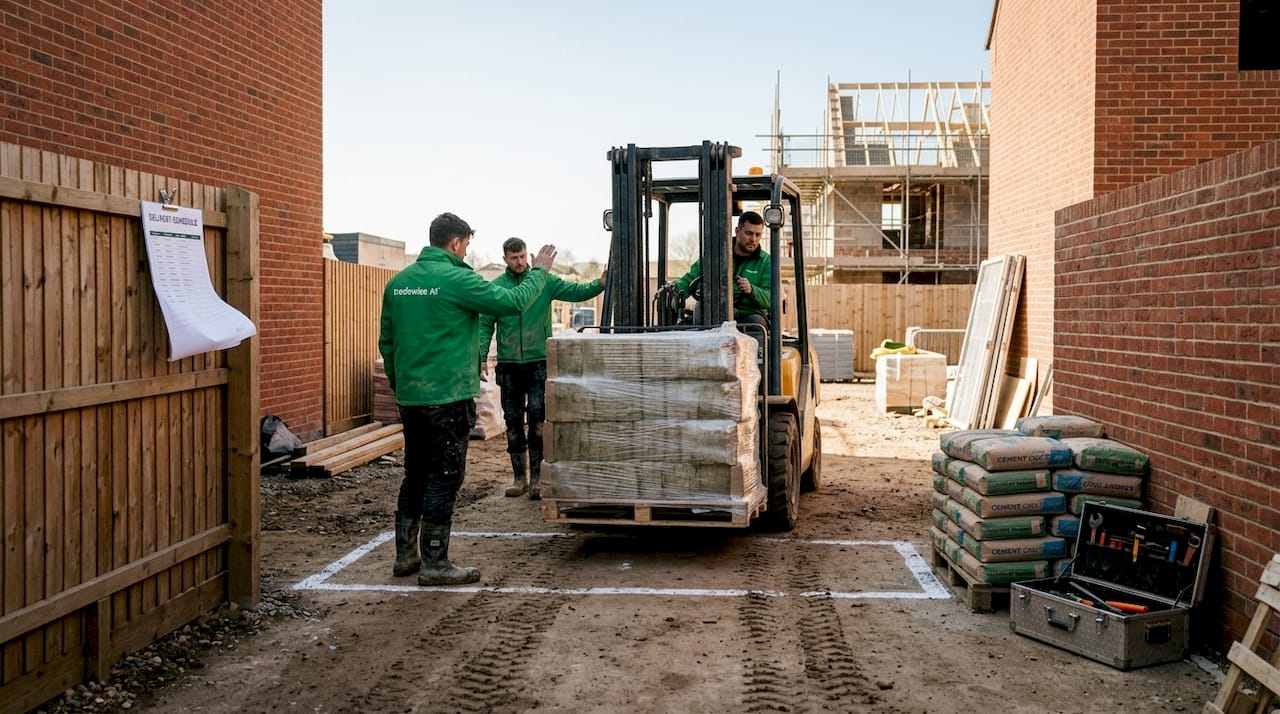
Effective site logistics starts before a single delivery arrives. The planning phase should map lay-down areas, site access routes, and phasing sequences so that materials are positioned close to where they will be used, and not in the way of the next phase of work. Optimising lay-down areas and access routes from the outset reduces congestion and the double-handling that quietly consumes labour hours.
Time-slotted deliveries are another practical lever. Rather than accepting materials whenever a supplier can deliver, builders who manage building materials ordering through a scheduled booking system match inbound vehicles to gate capacity and workforce availability. The result is fewer bottlenecks and better utilisation of unloading resource.
Consolidation is the most underused tool in builders material efficiency. Rather than accepting multiple small deliveries from different suppliers across a single day, consolidation hubs batch materials into optimised loads. 97% delivery reliability has been achieved on major UK projects using this approach, alongside measurable reductions in vehicle movements and CO₂ emissions.
Pro Tip: When scheduling deliveries, build a 15-minute buffer between time slots. It sounds minor, but it prevents one late vehicle from cascading delays across an entire morning's programme.
Short-term storage hubs on site serve a related purpose. Rather than issuing materials directly from the delivery vehicle to the work face, hubs allow just-in-time issuance that keeps the work face clear and reduces the risk of materials being damaged, stolen, or misplaced before they are needed.
Materials management plans and UK site compliance
This is the area where many builders, particularly those new to larger or more complex projects, find themselves exposed. A Materials Management Plan (MMP) is a documented framework that tracks excavated materials across a site, covering volumes, stockpile locations, suitability assessments, and reuse plans.
In the UK, the Development Industry Code of Practice (DoWCoP) provides the primary guidance for managing excavated materials. The core principle is straightforward: if you want to reuse soil or stone on site rather than classify it as waste, you need documented evidence to support that decision. Without traceable records, excavated material defaults to waste classification on paper, which creates compliance risk and commercial exposure.
A well-structured MMP typically covers:
- Volume tracking. Recording quantities of material excavated, moved, stockpiled, and reused at each phase of the project.
- Stockpile location plans. Mapping where materials are held, with clear labelling of suitability status.
- Suitability assessments. Testing and documentation confirming that materials meet the criteria for intended reuse.
- Reuse scheduling. Aligning when materials will be reused with the programme, to avoid unnecessary double-handling or stockpile degradation.
- Disposal records. Documenting any materials that cannot be reused and the licensed routes taken for their removal.
The risks of poor practice are not just regulatory. Quality failures from using unsuitable fill material can cause structural problems years later. Programme impacts from misclassified waste that has to be removed and replaced are immediate and costly. Commercial disputes over quantities are also common where measurement records are incomplete.
Drone surveying and routine measurement cycles are increasingly used on larger UK sites to maintain volumetric accuracy. Regular measurement prevents paying twice for materials and provides the evidence base needed to defend quantities in any dispute.
| Risk area | Consequence of poor practice |
|---|---|
| Waste misclassification | Regulatory penalties and forced removal of reusable material |
| Missing suitability records | Structural liability and potential rework costs |
| Inaccurate volume tracking | Overpayment for disposal or shortfall in available fill |
| No reuse schedule | Double-handling costs and stockpile degradation |
Technology for inventory accuracy and procurement
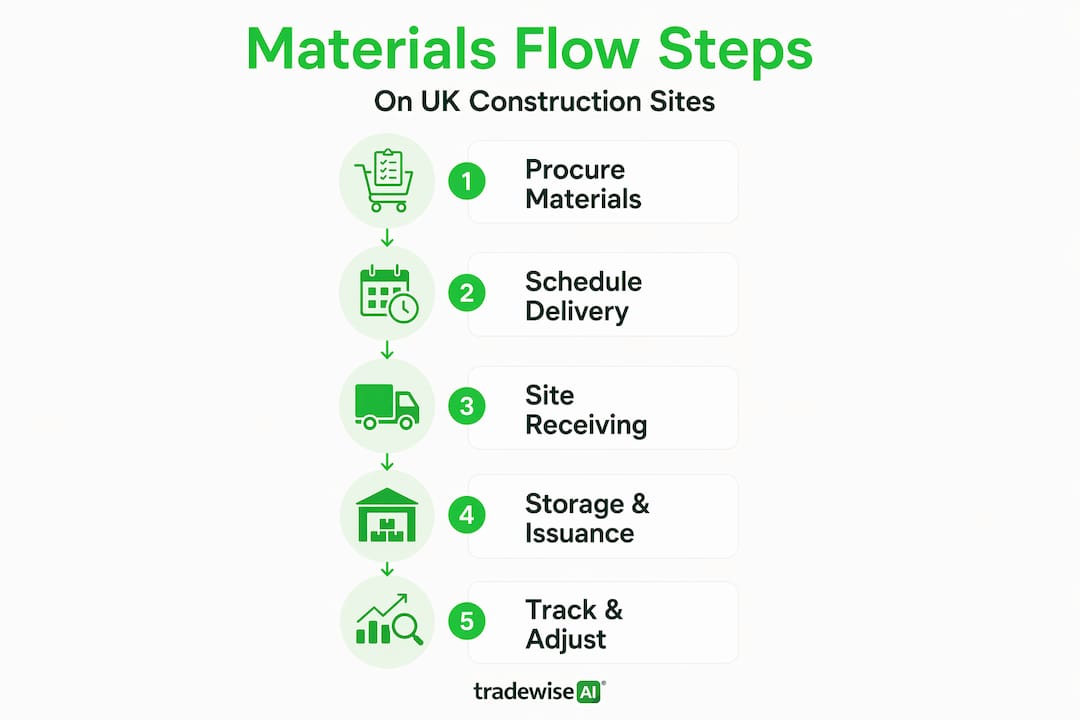
The gap between what procurement has ordered, what the stores team believes is on site, and what the work face actually has available is where most materials management failures begin. Misaligned records across procurement, stores, and field availability create duplications, stoppages, and the kind of last-minute emergency orders that destroy margin.
Closing that gap requires systems, not just good intentions. Here is how builders are using technology to manage construction materials more accurately:
- ERP and MRP systems. These platforms connect purchase orders, goods receipts, stock movements, and bills of materials into a single record. Cycle counting within these systems keeps physical stock aligned with system data, and discrepancies trigger investigation rather than being written off.
- GPS and RFID tracking. GPS and RFID tools allow builders to track materials from the point of order through to installation, providing a live audit trail that removes the guesswork from stock queries.
- AI-assisted forecasting. Emerging AI tools analyse consumption patterns, programme progress, and supplier lead times to flag potential shortages before they become stoppages. The role of AI tools for builders is expanding rapidly in this area.
- Integrated mobile platforms. When site teams can record material receipts, movements, and issuances from a mobile device, the data reaches the central system in real time rather than being transcribed from paper at the end of the week. The accuracy difference is significant.
- Live job tracking tools. These connect material movements to specific jobs and phases, so that cost allocation and programme tracking reflect what is actually happening on site.
The benefits of material control through technology are not limited to large contractors. Small and medium UK builders can reduce costs and improve delivery reliability by adopting appropriate digital tools scaled to their project size.
Practical steps to improve materials management
Knowing the theory is one thing. Applying it on a live project is another. These steps give you a practical starting point.
- Plan early and involve the right people. Bring logistics, procurement, and site management together at pre-construction stage. Pre-construction logistics planning aligned to programme priorities is the foundation of effective materials flow.
- Establish standard operating procedures. Document how materials are received, checked, stored, moved, and issued. Without written procedures, every operative follows their own approach and records become unreliable.
- Set KPIs and review them regularly. Track on-time delivery rates, stock accuracy percentages, and the number of emergency orders raised per month. These numbers tell you where the system is breaking down.
- Investigate discrepancies, do not just correct them. When stock counts do not match system records, find out why. The root cause is almost always a process gap that will keep creating problems until it is fixed.
- Train your site team. Lean materials flow and accurate record-keeping are skills, not instincts. Regular training on how to manage construction materials correctly pays back quickly in reduced waste and fewer delays.
Pro Tip: Create a simple one-page materials receipt checklist for your site. Delivery vehicle, quantity, condition, storage location, and signature. Five fields, completed every time, will transform your stock accuracy within a month.
Why materials management is underestimated
I have spent enough time working with UK builders to know that materials management gets treated as a support function rather than a core project discipline. That framing is wrong, and it costs money.
What I have seen repeatedly is that the projects which run smoothly are not necessarily the ones with the best procurement prices or the most sophisticated programme software. They are the ones where someone is actively managing material flow from the start. When materials arrive in the right sequence, in the right quantities, and go to the right location, every other part of the project benefits. Trades work without interruption. Waste is lower. The programme holds.
The fragmented records problem is the one I see most often on UK sites. Procurement knows what was ordered. The stores team knows what arrived. The site team knows what they have used. But nobody has one document that shows all three. That gap is where margin disappears.
My advice to any builder starting to take materials management seriously is this: do not wait for a large project to justify the investment. The habits, the procedures, and the discipline you build on a smaller job will scale. The builders who struggle on complex projects are usually the ones who never built those habits when the stakes were lower.
— Mateusz
How Tradewisehq supports your materials management

Tradewisehq is built for builders who want to stop managing materials through spreadsheets, phone calls, and memory. The platform connects your material orders, inventory records, and job tracking into one mobile-first system, so your site team and office are always working from the same data. You can track what has been ordered, what has arrived, and what has been issued to each job, without chasing anyone for an update.
For UK builders looking to put the best practices in materials handling covered in this article into daily practice, Tradewisehq's trade management tools give you the structure to do it without adding administrative burden. Less manual error, better cost control, and a clear audit trail from order to installation.
FAQ
What does a materials manager do on a UK construction site?
A materials manager oversees the full flow of materials from procurement through to on-site issuance, including inventory accuracy, supplier performance, logistics coordination, and compliance with waste and reuse regulations.
Why is a Materials Management Plan required in the UK?
Under DoWCoP guidance, excavated materials can only be classified as non-waste for reuse when supported by documented evidence. Without a Materials Management Plan, soil and stone default to waste classification, creating regulatory and commercial risk.
How do builders improve materials ordering accuracy?
Aligning procurement orders, warehouse stock records, and field availability in a single system prevents the record drift that causes shortages and duplicate orders. ERP platforms and mobile receipt tools are the most practical solutions for most UK builders.
What are the main benefits of material control on construction projects?
Effective material control reduces emergency orders, minimises waste, keeps trades working without interruption, and provides the audit trail needed for cost allocation and compliance. It also directly supports programme delivery by preventing material-related delays.
Can small builders benefit from materials management practices?
Yes. Small and medium UK builders who adopt structured materials management, even using basic digital tools, see measurable improvements in delivery reliability and cost control without needing enterprise-level systems.