

Pricing a construction job is defined as calculating all direct costs, overheads, and profit margin to produce a competitive and sustainable quote. Most builders understand this in theory. In practice, 60% of contractors do not know their actual profit margin on completed jobs. That gap between theory and practice is where businesses stall. This guide covers how builders price a job from the ground up, including material takeoffs, fully burdened labour rates, overhead allocation, and the markup versus margin distinction that trips up even experienced contractors.
How do builders price a job from start to finish?
Pricing a construction job follows a defined sequence. You calculate direct costs first, add indirect costs and overheads, then apply a profit margin. Skipping or guessing any stage is where money disappears.
The four core components are:
- Materials — net quantities plus waste allowance, priced at current supplier rates
- Labour — hours multiplied by fully burdened rates, not just base wages
- Overheads and preliminaries — site facilities, management time, plant hire, travel
- Profit margin — a deliberate percentage that funds business growth, not an afterthought
A healthy net profit margin for residential building work sits between 15% and 25%, with a minimum survival margin of 10%. Falling below that threshold means you are funding your clients' projects with your own cash reserves. The four components above are not optional extras. They are the structure of every profitable quote.
How to calculate material and labour costs accurately
Step 1: Complete your quantity takeoff first
The takeoff phase and the pricing phase are two separate mental tasks. Separating these processes reduces errors because measuring quantities and calculating costs require different levels of focus. Experienced estimators finish all measurements before opening a pricing spreadsheet. Conflating the two leads to missed items and audit difficulties later.
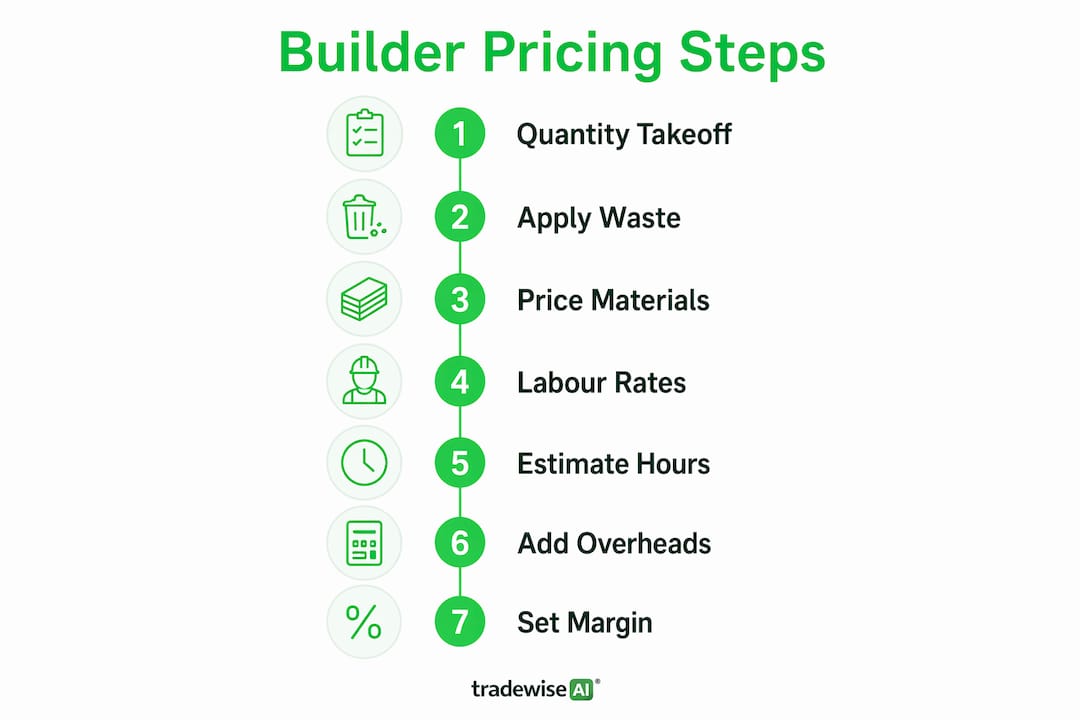
Step 2: Apply realistic waste factors
Net quantities are never what you order. Timber framing typically carries a 10–15% waste factor. Ceramic tiles run at 10–20% depending on the cut pattern. Brickwork sits around 5%. Use trade-specific waste rates rather than a blanket percentage across all materials. Applying a single 10% waste factor to every line item will underprice some materials and overprice others, distorting your quote.
Step 3: Price materials at current rates
Use live supplier prices, not last quarter's figures. Timber, steel, and insulation prices in the UK have moved significantly over recent years. Call your merchant or check your trade account pricing before locking in a quote. A material markup of 15–30% on top of net cost is standard practice to cover sourcing time, delivery, and waste risk.
Step 4: Calculate fully burdened labour rates
Base wages are not your true labour cost. Labour costs represent 35–55% of total project costs, and the fully burdened rate includes employer National Insurance contributions, holiday pay, tool allowances, and any pension contributions. A carpenter on £40 per hour base wage becomes £55–£57 per hour when all employer burdens are included. Quoting at the base rate means you absorb those additional costs directly from your margin.

Step 5: Estimate hours using production rates
Do not guess hours based on gut feel. Use historical job data or published production rates for each trade task. If your team lays 80 bricks per hour on average, a 10,000-brick job requires 125 labour hours before breaks and supervision time. Build in a realistic contingency for site conditions, access restrictions, and weather delays on external work.
Pro Tip: Complete your full quantity takeoff on paper or in a spreadsheet before you open your pricing template. The two tasks use different parts of your brain, and mixing them is the single most common cause of estimating errors.
What are overheads and preliminaries in construction pricing?
Overheads and preliminaries are the costs that belong to a project but are not tied to a single material or labour task. They are the costs most commonly underpriced or forgotten entirely.
Typical preliminaries on a UK residential project include:
- Site facilities — temporary toilets, welfare units, site signage
- Plant hire — scaffolding, skips, concrete mixers, access equipment
- Management time — your time visiting site, writing reports, attending client meetings
- Travel and fuel — daily site travel for your team and for materials collection
- Permits and surveys — skip permits, party wall surveys, structural engineer fees
- Site security — hoarding, locks, temporary fencing on longer projects
All indirect costs must be explicitly itemised to be funded within the job price. Grouping them under a vague "miscellaneous" line does not make them disappear. It means you pay for them yourself. A skip permit in London costs £150–£400 depending on the borough. A welfare unit hire for a six-week project runs £600–£1,200. These are real costs that belong in your quote.
Overhead percentages for UK residential projects typically run at 10–20% of direct costs, depending on business size and project complexity. Larger firms with more management layers sit at the higher end. Sole traders running lean operations can sit closer to 10%, but only if they have genuinely accounted for their own time.
Pro Tip: List every overhead and preliminary item as its own line in your quote. Clients rarely push back on itemised costs they can see. They do push back on a single large "overheads" lump sum they cannot understand.
Markup vs margin: why the difference matters for builders
This is the most expensive misunderstanding in construction pricing. Markup and margin are not the same number, and confusing them causes chronic underpricing.
Markup is calculated on cost. Margin is calculated on selling price. Here is the practical difference:
| Scenario | Costs | Calculation | Selling price | Actual margin |
|---|---|---|---|---|
| 20% markup applied | £10,000 | £10,000 × 1.20 | £12,000 | 16.7% |
| 20% margin targeted | £10,000 | £10,000 ÷ 0.80 | £12,500 | 20.0% |
A 20% markup on £10,000 costs produces a £12,000 price but only a 16.7% profit margin. To achieve a true 20% margin, you divide costs by 0.8 to reach £12,500. The difference is £500 on a £10,000 job. Scale that across ten jobs per year and you have lost £5,000 in profit you thought you were making.
The correct method is always to use a divisor, not a multiplier. To target a 25% margin, divide total costs by 0.75. To target a 15% margin, divide by 0.85. This is the calculation method used by profitable UK contractors who treat pricing as a financial discipline rather than a rough estimate.
Underpricing to win work traps contractors in a survival mode that prevents business growth and better resource investment. Winning a job at a 5% margin means you have no buffer for delays, defects, or client-requested changes. You end up working harder for less money than a well-priced job would have delivered.
Which pricing strategy works best for builders?
There is no single correct pricing model. The best contractors use different approaches depending on job type, client relationship, and project complexity.
Cost-plus pricing is the most transparent method. You calculate all costs, add overheads, and apply your margin on top. It works well for larger or more complex projects where scope is uncertain at the outset. The risk is that clients can challenge your cost figures if they are not clearly documented.
Flat rate pricing uses a price book of standard rates for common tasks. Fitting a standard door costs £X. Laying a square metre of block paving costs £Y. This method speeds up quoting for repeat work and removes the need to re-estimate every small job from scratch. It also makes your pricing consistent across your team, which matters when multiple estimators are quoting similar work.
Value-based pricing sets the price based on what the outcome is worth to the client rather than what it costs you to deliver. A loft conversion that adds £80,000 to a property's value justifies a higher price than a straight cost-plus calculation would produce. This approach works best for custom or high-specification projects where the client is buying a result, not a commodity.
The most successful contractors employ a hybrid model: flat rate pricing for repeat and standard work, cost-plus or value-based pricing for bespoke or complex jobs. This combination balances speed and consistency with the flexibility to capture full value on higher-margin projects. For more on building a consistent quoting process, the method matters as much as the numbers.
Key takeaways
Builders who price jobs profitably treat estimating as a financial discipline, not an administrative task, by calculating every cost layer before applying a correctly calculated margin.
| Point | Details |
|---|---|
| Separate takeoff from pricing | Complete all quantity measurements before calculating costs to reduce errors and improve accuracy. |
| Use fully burdened labour rates | Add employer NI, holiday pay, and pension to base wages; a £40/hr worker costs £55–£57/hr fully burdened. |
| Itemise every overhead | List site facilities, plant hire, travel, and permits as individual lines so they are funded within the price. |
| Apply margin using a divisor | Divide total costs by (1 minus target margin) rather than multiplying by a markup percentage to hit your profit target. |
| Match pricing model to job type | Use flat rate pricing for standard work and cost-plus or value-based pricing for complex or custom projects. |
The uncomfortable truth about builder pricing
I have reviewed pricing processes with dozens of UK contractors over the years, and the pattern is almost always the same. The builder who wins the most work is rarely the most profitable. The builder who prices with discipline, loses some tenders, and tracks actual job costs against estimates is the one still trading in five years.
The cheap quote trap is real. Cost overruns average 28% across the industry, and the primary cause is inaccurate estimating, not unexpected site conditions. That means most overruns are preventable with better process. When you track actual costs against your original estimate on every job, you start to see where your pricing assumptions are consistently wrong. That data is worth more than any pricing guide.
My honest view is that most builders undervalue their own time most of all. Management hours, client calls, site visits, and problem-solving rarely appear in quotes at a realistic rate. If you are a sole trader spending ten hours a week managing a project, those hours need to be in the price. Pricing them at zero is a choice to work for free.
Adopt a job costing approach that compares estimated costs to actual costs on every job. It is the only way to know whether your pricing model is working or quietly bleeding money.
— Mateusz
Price smarter with Tradewisehq

Tradewisehq is built for UK builders who want to stop guessing and start pricing with confidence. The platform brings together live material costs, fully burdened labour rates, overhead tracking, and margin calculations in one place. You can build accurate quotes faster, see your real job profitability in real time, and stop losing money to costs you forgot to include. Whether you are pricing a kitchen extension or a full commercial fit-out, Tradewisehq gives you the data to quote competitively without cutting into your margin. Visit Tradewisehq to see how the platform supports better pricing decisions for trade businesses across the UK.
FAQ
What are the main components when pricing a building job?
The four main components are materials, labour, overheads and preliminaries, and profit margin. Every accurate construction quote must include all four to avoid underpricing.
What is a realistic profit margin for UK builders?
A healthy net profit margin for residential building work sits between 15% and 25%, with 10% considered the minimum survival margin. Falling below 10% leaves no buffer for delays or variations.
What is the difference between markup and margin in construction?
Markup is calculated on cost; margin is calculated on selling price. A 20% markup on £10,000 costs produces a 16.7% margin, not 20%. Use a divisor (divide costs by 0.80 for a 20% margin) to hit your actual target.
Why do builders struggle with pricing jobs accurately?
The most common causes are conflating quantity takeoff with pricing, using base wages instead of fully burdened labour rates, and failing to itemise overhead costs. These errors compound across a job and erode profit before work even starts.
Should builders use flat rate or cost-plus pricing?
The most effective approach combines both. Use flat rate pricing for standard, repeat tasks and cost-plus or value-based pricing for complex or bespoke projects. This hybrid model delivers both speed and accuracy across different job types.