

A legally compliant UK invoice always needs a sequential ID, supplier and customer details, a supply date, an invoice date, a clear description of the work, and the amounts due. If you're VAT-registered, add your VAT number, the VAT rate per line, and the totals split by rate and gross.
That's the whole answer in one sentence. Here's the checklist version you can pin to a wall or paste into a template:
- Unique, sequential invoice number (no gaps, no repeats)
- Your business name, address, and contact details
- Customer's name and address
- Date the goods or services were supplied (the tax point)
- Date the invoice was issued
- Description of what was supplied
- Amount charged per item, plus the total owed
- VAT registration number, VAT rate, and VAT amount, if you're VAT-registered
Gov sets the baseline for every business; HMRC layers extra rules on top for anyone charging VAT.
Key Takeaways
A compliant UK invoice needs a sequential number, supplier and customer details, both a supply date and an invoice date, a clear description, and correct totals, with VAT-registered businesses adding VAT-specific fields on top.
| Point | Details |
|---|---|
| Core legal fields | Every invoice needs a sequential number, supplier and customer details, supply date, invoice date, description, and totals. |
| VAT invoices need extra fields | VAT-registered suppliers add their VAT number, rate per line, and totals split by rate and gross. |
| Timing rules apply | VAT invoices to registered customers should go out within 30 days of supply, per GOV.UK. |
| Special cases need wording | Reverse charge, margin schemes, and zero-rated supplies each need specific invoice references, not just numbers. |
| Keep records for six years | Digital storage that meets Making Tax Digital rules protects you during any HMRC review. |
| Software reduces errors | Tradewisehq automates sequential numbering, tax-point capture, and VAT lines so invoices are audit-ready from the start. |
Where to check the legal detail yourself
- Gov for the basic legal checklist.
- HMRC's VAT invoice manual and VAT Notice 700 for full VAT invoice rules.
- Stripe's UK invoicing guide for operational best practice and software integration notes.
Table of Contents
- What is required on an invoice in the UK?
- When do you need a VAT invoice, and what must it show?
- What about reverse charge, margin schemes and zero-rated supplies?
- Do electronic invoices count, and how long must you keep them?
- How do you actually create a compliant invoice?
- How Tradewisehq keeps your invoicing compliant without the admin
- Frequently asked questions
- Sources
What is required on an invoice in the UK?
Every field above earns its place because HMRC uses invoices as primary evidence during an inspection. Get one wrong and, at worst, you lose the ability to reclaim input tax or prove a sale happened at all.
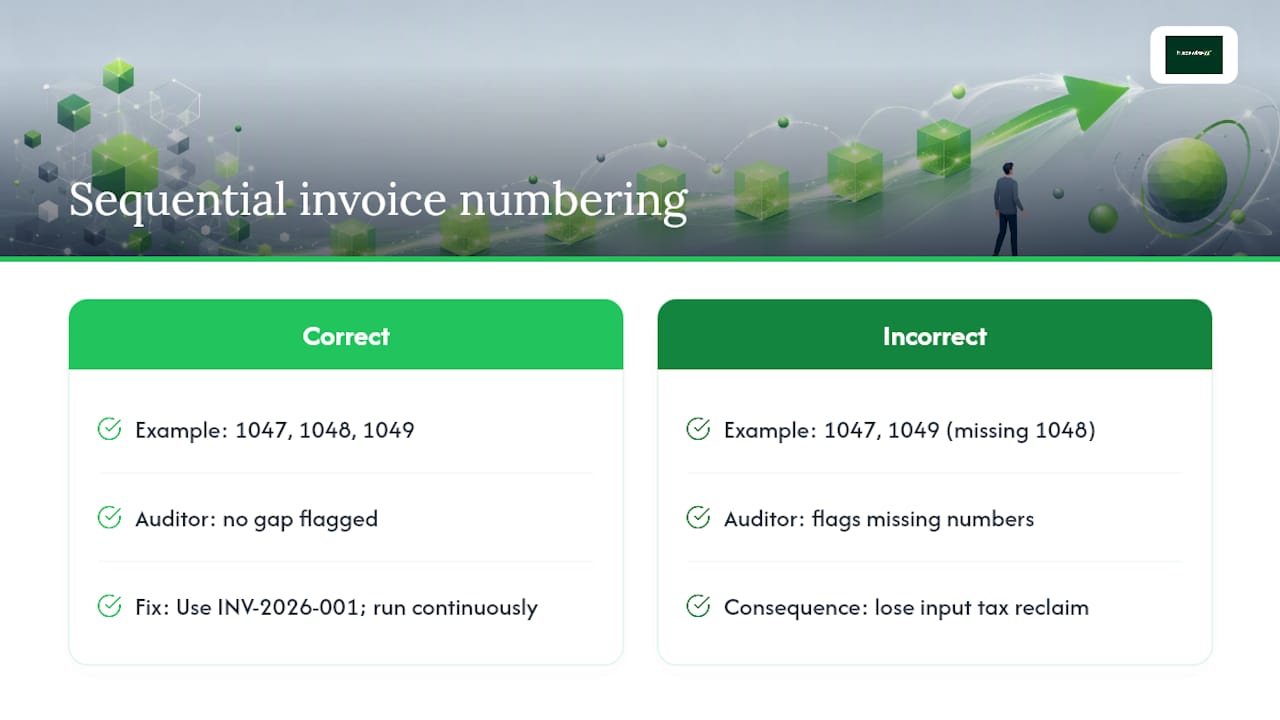
Sequential numbering has to run without gaps. Invoice 1047 followed by 1049 with no 1048 in sight is the first thing an auditor flags, even if the missing number was just voided. Use a simple format like INV-2026-001 and let it run continuously, whether by calendar year or a single unbroken series for the life of the business.
Supplier identity differs by structure. A sole trader must show their own name (not just a trading name) plus an address suitable for legal correspondence, such as a solicitor's letter or a court notice. A limited company must use its full registered name exactly as it appears at Companies House, alongside its trading name if different.
Customer identity needs a proper name and address, not just an email or a job site postcode. For B2B invoices, use the registered business name; for consumers, their full name and home or billing address.
Dates matter more than people assume. The invoice date is when you issue the document. The supply date, or tax point, is when the work was actually delivered or the goods handed over. These are often the same day, but not always. Progress payments, staged building projects, and pre-payments routinely create a gap between the two, and that gap determines which VAT period the transaction falls into.
Your description needs enough detail to identify the supply without a follow-up phone call. "Electrical work" fails that test. "Rewire of kitchen circuit, including 6 double sockets and consumer unit upgrade" passes.
Amounts and totals should show each line item, the net total, VAT if applicable, and the gross figure the customer actually pays.
Beyond the legal minimum, a few extras cut down on payment disputes: explicit payment terms (30 days from invoice date, for instance), a purchase order number if the client issued one, and your preferred payment method.
Pro Tip: Keep a digital copy of every invoice the moment you send it, not just the ones a client queries. HMRC can ask to see records going back years, and a scattered inbox is a poor filing system when that happens.
When do you need a VAT invoice, and what must it show?
You must issue a VAT invoice when you're VAT-registered and selling taxable goods or services to another VAT-registered business. If your customer isn't registered for VAT, or the supply is exempt, you don't have the same legal obligation, though most businesses issue one anyway for clarity.
A full VAT invoice needs everything on the basic checklist, plus:
- Your VAT registration number
- The tax point (time of supply)
- The rate of VAT charged on each line
- The net total for each VAT rate applied
- The total VAT amount
- The gross total, VAT included
HMRC's own internal guidance on regulation 14 spells this out in detail, including the requirement that quantities and VAT rates appear per item, not just as a lump sum at the bottom.
A VAT invoice is more than a receipt. It's the document HMRC treats as proof that input tax can legitimately be reclaimed, which is why a missing VAT number or an unclear tax point can cost a business real money at reclaim time.
Timing has a hard rule attached. VAT invoices to registered customers should normally go out within 30 days of the supply. Miss that window regularly and you risk falling foul of HMRC's record-keeping expectations, even if the VAT itself is eventually paid correctly.
Simplified invoices are allowed for retail transactions of £250 or less, including VAT. You can drop the customer's name and address and skip the net/VAT split per rate, but you still need the supplier's VAT number, the date, a description, and the gross amount including VAT.
Cross-border supplies bring extra wrinkles. Goods moving under the Northern Ireland Protocol carry an "XI" VAT prefix rather than "GB", and invoices to EU customers may need to show the customer's own VAT number where the reverse charge applies. Notice 700 covers when these territory-specific details are triggered.
What about reverse charge, margin schemes and zero-rated supplies?
Some transactions need specific wording, not just extra numbers.
Reverse charge situations (common in construction, under the domestic reverse charge rules) require an invoice note stating that the customer must account for the VAT themselves. A line reading "Reverse charge: customer to account for VAT to HMRC" satisfies this. Our service call checklist walks through how this looks in practice for trades invoicing other VAT-registered contractors.
Margin schemes, used for second-hand goods, antiques, or tour operator services, need a reference such as "Margin scheme: second-hand goods" rather than a standard VAT breakdown, since VAT is only due on the margin, not the full sale price.
Zero-rated and exempt supplies should be shown separately from standard-rated items on a mixed invoice, each clearly labelled so the customer (and HMRC) can see which rate applied to which line.
Pro Tip: If you're unsure whether a special scheme applies, default to a full VAT invoice rather than guessing at a simplified format. A missing reverse charge note is a common reason input tax claims get queried.
Do electronic invoices count, and how long must you keep them?
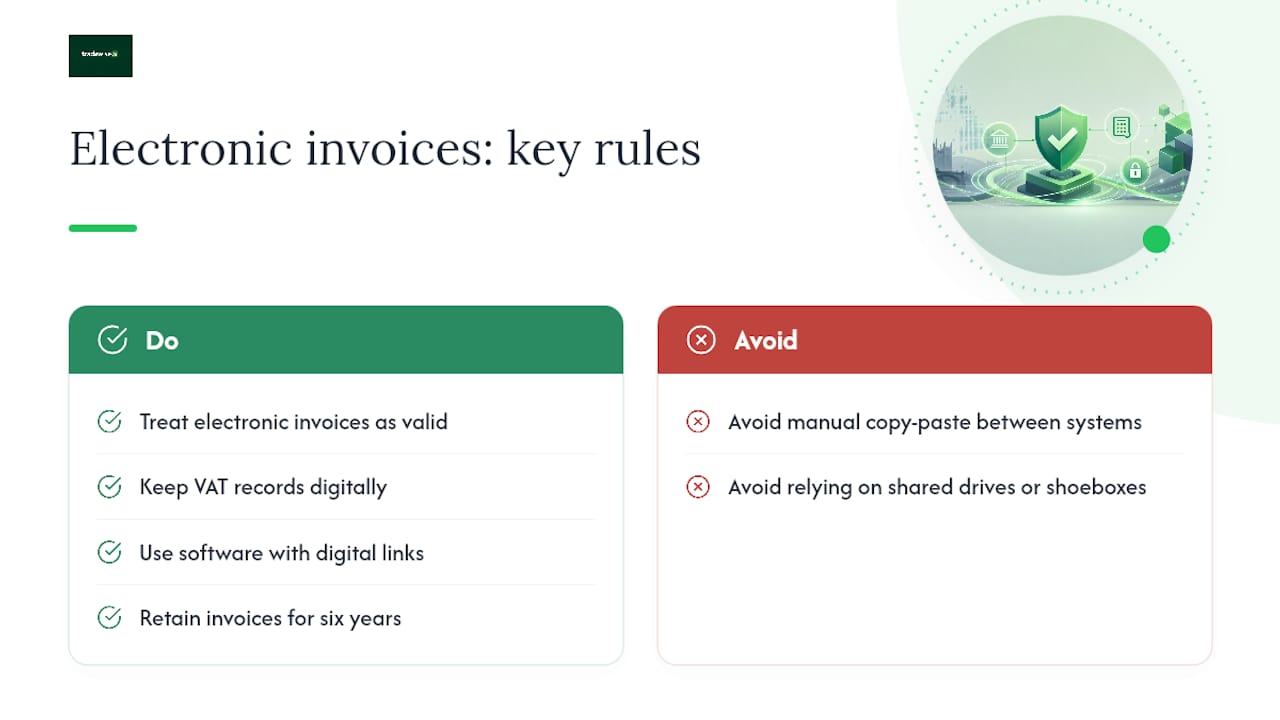
Yes. HMRC accepts paper, PDF, and fully electronic invoices, provided the format preserves authenticity, integrity, and legibility from the moment it's issued to the moment it's archived. There's no legal preference for paper over digital.
If you're VAT-registered, Making Tax Digital rules mean you need to keep VAT records digitally and use software that can pull figures directly into your VAT return without manual re-typing between systems. A spreadsheet updated by hand and then copied into another program usually doesn't meet the "digital links" requirement.
Retention is six years minimum for invoices and VAT records. That's a long time to trust a shared drive or a shoebox of receipts, which is exactly why organised digital storage matters more than most business owners initially think.
Software that enforces sequential numbering automatically, timestamps the tax point separately from the issue date, and exports records in HMRC-compatible formats removes most of the manual error that trips up smaller businesses.
Pro Tip: For staged or progress-based work, record the supply date at each milestone, not just at final completion. If you invoice in phases, each invoice needs its own accurate tax point, not a shared one borrowed from the final job date.
How do you actually create a compliant invoice?
Follow this order every time:
- Assign the next sequential invoice number.
- Enter your supplier details in the correct legal format for your business type.
- Add the customer's name and address.
- Record both the supply date and the invoice date, even if they're the same.
- List each item or service with a clear, specific description and quantity.
- Calculate VAT per line if registered, and total it clearly.
- Add payment terms, due date, and any PO number requested.
- Save a copy, then send.
A minimal template runs: supplier details, customer details, invoice number and date, supply date, line items with descriptions and amounts, VAT breakdown, gross total, payment terms.
The mistakes that cause the most grief are dull ones: vague descriptions ("labour" instead of "3 hours diagnostic and boiler repair"), gaps in numbering, a missing or wrong tax point, VAT calculated on the gross instead of the net, and no digital backup once the invoice leaves your outbox. Send as a PDF where possible; it's harder to alter accidentally than a Word document, and most accounting systems on the client side prefer it for their own subcontractor records.
Practical tips for tradespeople and small teams
HMRC's rules read like legislation until you apply them on a job site, where a standard template and automatic tax-point capture matter more than legal theory. Standardise the field order across every invoice your team sends, and most clients' accounting software will accept it without a query first time.
Pro Tip: Put supplier details, invoice number, supply date, and VAT breakdown in the same order every time. Consistent structure is what gets an invoice approved on the first pass, not just legal accuracy.
How Tradewisehq keeps your invoicing compliant without the admin
Tradewisehq is the practical alternative to building invoice templates from scratch and hoping they hold up under an HMRC check. Every invoice generated through the platform applies sequential numbering automatically, separates the supply date from the issue date, and adds VAT lines per item, so the legal checklist above gets handled in the background rather than manually rebuilt on every job.
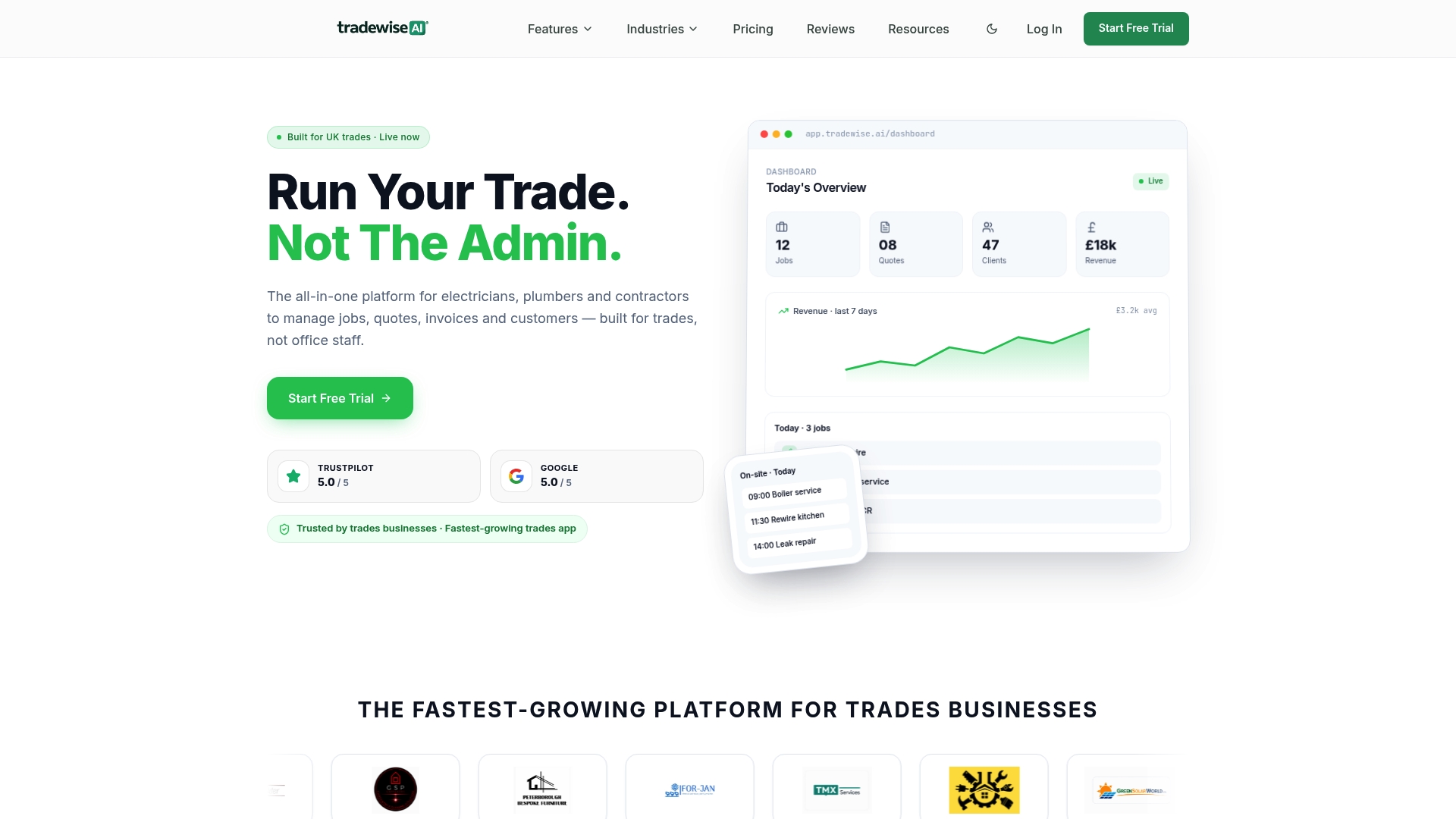
For electricians, plumbers, and builders working from a van or site office, invoices can be issued on a mobile device the moment a job finishes, with records backed up automatically for the six-year retention period HMRC expects. Templates are built around common trade services, so you're not starting from a blank page for every quote-to-invoice conversion.
If you want to see how it fits your own invoicing workflow, start a 14-day free trial and issue your next invoice through the platform directly.
Frequently asked questions
Do I need to charge VAT if I'm not VAT-registered? No. Only VAT-registered businesses can charge VAT or issue a VAT invoice. Charging VAT without being registered is a compliance breach, not a pricing choice.
Can I use the same invoice number twice? No. Every invoice needs a unique number in an unbroken sequence, even across different clients or projects.
What happens if I issue a non-compliant invoice? At minimum, you risk payment delays as clients query missing details. For VAT invoices, missing fields can block a customer's ability to reclaim input tax, and repeated errors can draw closer HMRC scrutiny during a VAT inspection.
Is an emailed PDF invoice legally valid in the UK? Yes, provided it preserves the invoice's authenticity, integrity, and legibility from issue to storage, which HMRC accepts for both VAT and non-VAT invoices.
Do I need to show my company registration number on invoices? It's not a strict legal requirement on every invoice, though limited companies often include it alongside their registered address as good practice, particularly on formal correspondence.
This article is general information, not a substitute for advice from a qualified financial advisor. Consult a qualified financial professional about your own circumstances before acting on anything here.