

A contractor bid sheet is the document that converts your internal cost estimate into a formal, client-ready price and scope submission. It is not the same as a rough quote scribbled on a notepad: once submitted, it typically binds you to the price, terms, and programme stated within it. Construction bidding is the formal process of submitting a proposal to undertake a construction project, and the bid sheet is the centrepiece of that submission.
You can download ready-to-use templates in Excel, Word, PDF, and Google Sheets formats from resources such as Smartsheet's free construction bid template library, which includes blank forms, filled examples, and subcontractor price sheets. Every compliant bid sheet needs at least three things:
- Detailed scope of work — what is included and, critically, what is excluded
- Itemised cost breakdown — materials, labour, plant, overhead, profit, and VAT treatment
- Commercial terms and schedule — bid validity, payment terms, and programme milestones
Key takeaways
A compliant, competitive contractor bid sheet requires accurate cost itemisation, explicit UK tax treatment, complete supporting evidence, and a final checklist review before submission.
| Point | Details |
|---|---|
| Itemise every cost | Break down materials, labour, plant, subcontractors, overhead, profit, and contingency as separate line items. |
| Handle VAT and CIS correctly | Show VAT as a separate line; apply Domestic Reverse Charge where relevant and gross up CIS-affected subcontractor costs. |
| Attach supporting evidence | Include current insurance certificates, trade accreditations, and any required bid bond with every submission. |
| Run the pre-submission checklist | Confirm addenda acknowledgements, signatures, bid bond, unit consistency, and file naming before sending. |
| Use Tradewisehq for bid management | The platform stores templates, collects subquotes, and manages document attachments to reduce bid-day admin. |
Table of Contents
- What is a contractor bid sheet, and when do you need one?
- What every contractor bid sheet must include
- How to create a contractor bid sheet: step-by-step with a worked example
- Which template format should you use: Excel, Word, PDF, or Google Sheets?
- How to price work correctly in the UK: VAT, CIS, and contingency
- Common quoting errors and your final pre-submission checklist
- UK legal, tax, and procurement notes every contractor should know
- The part of bid preparation most contractors underestimate
- Tradewisehq cuts bid admin so you can focus on winning work
- Sources
What is a contractor bid sheet, and when do you need one?
A bid sheet is a formal document used to list offers, pricing, and terms from contractors or suppliers, structured so that buyers can compare responses side by side. That is the key distinction from an internal estimate: an estimate is a planning tool for your own use, while a bid sheet is an external, often legally binding submission addressed to a client or procurement team.
You need a formal bid sheet rather than an informal quote in four main situations:
- Public tender or framework procurement — local authorities, housing associations, and NHS trusts almost always require a prescribed bid form with specific ordering of alternates and a figures-and-words base bid total
- Commercial client requirements — main contractors and developers typically issue a Request for Proposal (RFP) or Invitation to Tender (ITT) with a mandatory form; deviating from it can render your submission non-responsive
- Nominated or domestic subcontracting — where a main contractor requires written subquotes for scope, price, and programme before they submit their own bid
- Client-requested formal pricing — even on smaller private jobs, some clients ask for a structured bid form rather than a letter quote, particularly where multiple contractors are competing
The recipient-facing elements that distinguish a bid sheet from a simple estimate include your company registration details, the project reference number, a bid validity period typically specified, a signature block, and any required bond or insurance declarations.
What every contractor bid sheet must include
A well-structured construction bid form is both a commercial document and an audit trail. Here is the blueprint, section by section.
Project and parties
State your company name, registered address, Companies House number, and VAT registration number at the top. Include the client's name and address, the project name, a unique bid reference number, and the date of submission. These fields sound obvious, but a missing VAT number or incorrect project reference is a common reason bids get returned.
Scope of work
Write the scope in trade-line items or CSI-style divisions, whichever the RFP specifies. Be explicit about inclusions and exclusions. Templates that separate assumptions, exclusions, and commercial exceptions reduce post-award disputes and speed internal approval because reviewers can find owner-facing text and internal assumptions quickly. A scope section that simply says "all groundworks as per drawings" is not enough: list the drawings by revision number and state what is excluded (for example, contaminated material disposal, temporary works design).
Cost breakdown
Overhead, profit, and contingency
Show these as explicit line items rather than burying them in unit rates. Clients and quantity surveyors will ask, and a transparent breakdown signals commercial confidence. Overhead typically covers head-office costs, insurances, and non-project staff; profit is your return on risk. Contingency is a separate allowance for identified but unquantified risks, and it belongs above the line, not hidden inside labour rates.

Alternates, unit prices, and named subcontractors
List alternates in the exact order the RFP requests them. Providing both unit prices and a lump-sum base bid prevents later owner confusion and makes alternate selection straightforward. Name your principal subcontractors where the form requires it, and attach their written quotations or a summary schedule.
Pro Tip: Always state your bid in both figures and words for the base bid total. Discrepancies between the two are a common disqualification trigger on public tenders.
How to create a contractor bid sheet: step-by-step with a worked example
The workflow from RFP to submission
- Read the full RFP and all addenda before touching a spreadsheet. Note mandatory forms, alternates, and submission requirements. Acknowledge every addendum by number on the bid form.
- Extract the scope and identify mandatory forms. List every section of work and cross-reference it against the drawings and specification. Flag items that need specialist subquotes.
- Build your line items. Populate materials, labour, plant, and general conditions from your cost database or supplier quotes. Use the unit-price format the RFP specifies.
- Collect subcontractor quotes in writing. On bid day, confirm subcontractor prices in writing the morning of submission and confirm the surety will issue bid bonds at the stated percentage. A verbal subquote that changes at 4 PM on bid day is one of the most expensive problems in estimating.
- Apply VAT, CIS adjustments, and provisional sums. See the pricing section below for the mechanics.
- Add overhead, profit, and contingency as explicit percentage lines above the VAT calculation.
- Format and attach supporting evidence. Attach copies of your public liability insurance, contractor's all-risk policy, relevant licences, and any required bond documentation.
- Run the final checklist (see Section 7) before submitting.
Worked pricing example (UK figures)
A small commercial fit-out bid might look like this:
The VAT line sits outside your margin calculation. Your actual margin is the overhead and profit applied to direct costs, not to the VAT-inclusive total. Getting that wrong is a common and costly error.
Owners often require bid validity dates and sometimes bid bonds for bidding, with performance bonds expected on award; including a material escalation clause is routine for bids with long validity periods.
Pre-submission checklist
Before you hit send, work through this list:
- Addenda acknowledgements completed and numbered
- Bid form signed by an authorised signatory
- Base bid stated in figures and words
- Alternates listed in RFP order
- Unit prices completed for all keyed items
- Named subcontractors listed with scope references
- Bid bond attached at the required percentage
- Insurance certificates current and attached
- Relevant licences and accreditations included
- File named per the RFP convention (e.g.,
CompanyName_ProjectRef_Bid_Date.pdf) - Bid validity period confirmed and stated on the form
- Submission method confirmed (portal upload, email, or hard copy)
Pro Tip: Assign a single person as the final commercial owner on bid day. Last-minute scope changes from two estimators updating the same spreadsheet simultaneously are how errors get submitted.
Which template format should you use: Excel, Word, PDF, or Google Sheets?
The format you choose depends on the complexity of the bid and the buyer's submission rules. Template packs commonly offer blank and sample versions for Excel, Google Sheets, Word, and PDF, and include a cost breakdown sheet that calculates materials, labour, tax, and contingency.
Excel is the right choice for any bid with more than a handful of line items. Formulas handle unit-price multiplication, percentage markups, and VAT calculations automatically, and you can build a reusable cost database that feeds multiple bids. The risk is version control: always lock formula cells and save a dated copy before editing.
Google Sheets works well when your estimating team is split across sites or when you are collecting live subquotes from multiple subbies simultaneously. Shared access means everyone sees the same figures, though you need to manage edit permissions carefully to prevent accidental overwrites.
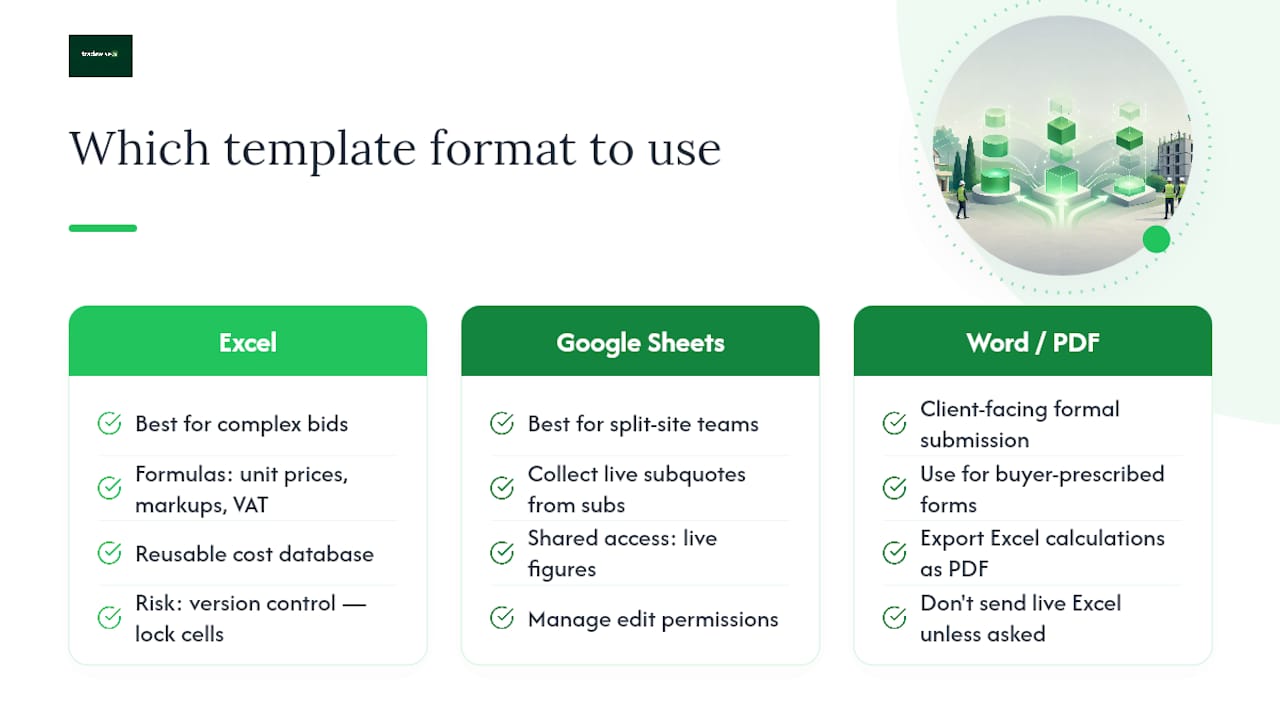
Word or PDF is the right format for the client-facing bid form itself, particularly where the buyer has issued a prescribed form. Export your Excel calculations as a PDF attachment and complete the buyer's Word form separately. Never send a live Excel file as your formal submission unless the RFP explicitly requires it.
Template variants to have ready
- Blank bid form — your standard layout, ready to populate for any project
- Filled example — a completed sample showing how each section should look, useful for training junior estimators
- Subcontractor price sheet — a simplified form you send to subbies to collect quotes in a consistent format
- Bid comparison matrix — a side-by-side tabulation of competing subquotes for the same package
- Client-facing proposal supplement — a covering document that summarises your company credentials, relevant experience, and key programme assumptions
Packaging files for submission
Combine your completed bid form, cost breakdown, and all attachments into a single PDF. Name the file clearly: [CompanyName]_[ProjectRef]_Bid_[DDMMYYYY].pdf. If attachments push the file above portal size limits, compress images in the PDF or use a secure file-transfer link rather than stripping out evidence documents.
How to price work correctly in the UK: VAT, CIS, and contingency
Pricing a construction bid in the UK involves several layers that do not appear in a simple quote. Getting them wrong does not just cost margin — it can make your bid non-compliant.
VAT treatment
- Standard-rated work (20%) — most commercial construction and fit-out work. Show VAT as a separate line below your bid total, never embedded in unit rates unless the RFP explicitly requires an inclusive price.
- Reduced-rate or zero-rated work — certain residential new-build and conversion work qualifies for 5% or 0% VAT. If your project falls here, state the applicable rate and the basis for it on the bid form. HMRC's VAT Notice 708 is the primary reference.
- Domestic Reverse Charge (DRC) — applies to most construction services supplied between VAT-registered businesses in the construction sector. Under DRC, you do not charge VAT to the main contractor; instead, the main contractor accounts for it. State "Reverse Charge applies — customer to account for VAT" on the relevant line items.
CIS considerations
When pricing labour supplied by subcontractors, gross up the net payment to reflect the CIS deduction the client or main contractor will apply.
Provisional sums and allowances
A provisional sum is an allowance for work that cannot be fully defined at tender stage. Present it as a named line item with the allowance figure stated, and note whether it is a "defined" or "undefined" provisional sum under NEC or JCT contract terms, as this affects your entitlement to programme and overhead recovery when the work is instructed.
Contingency sizing
Justify the percentage in a brief assumptions note on the bid form. Clients and QSs will query an unexplained contingency, and a clear rationale protects you from being asked to remove it during negotiation. For more on why construction quoting is complex, the drivers of allowance sizing are worth understanding before you set your contingency line.
Markup vs margin
These are not the same, and confusing them costs money.
Pro Tip: State bond costs, professional indemnity insurance, and performance guarantee premiums as explicit line items. Burying them in overhead makes it harder to recover them if the client asks for a cost breakdown during negotiation.
Common quoting errors and your final pre-submission checklist
The most expensive mistakes in construction bidding are rarely arithmetic. They are process failures: the wrong form submitted, an addendum missed, a signature block left blank.
Errors that most commonly disqualify bids
- Missing addenda acknowledgements — if the RFP issued three addenda and your form only acknowledges two, many procurement teams will reject the bid as non-responsive without further review
- Unsigned bid form — a bid signed by someone without authority to bind the company, or not signed at all, is invalid
- Inconsistent units — pricing groundworks in square metres when the bill of quantities uses cubic metres creates a scope gap that will cost you on award
- Omitted exclusions — failing to state what is excluded leaves you commercially exposed if the client assumes it is included
- Incorrect or missing bid bond — public and many commercial tenders require a bid bond at a stated percentage; submitting without one, or at the wrong amount, is an automatic disqualification
- Stale insurance certificates — certificates that expired before the submission date are treated as no certificate at all
For a deeper look at the patterns behind these failures, the common construction quoting errors that UK contractors most frequently make are worth reviewing before your next submission.
How to fix each error in your template workflow
Build the addenda acknowledgement block into your standard template so it cannot be overlooked. Use a signature-required field in your PDF form. Lock unit columns so they match the bill of quantities format. Include a standard exclusions schedule as a template tab. Set a calendar reminder to renew insurance certificates 60 days before expiry and attach the current certificate to your bid folder at the start of each tender.
Pro Tip: Route the completed bid form to a second reviewer — ideally someone who was not involved in the estimating — for a 15-minute read-through before submission. They will spot the missing signature or the wrong project reference that the estimator's eyes have stopped seeing.
UK legal, tax, and procurement notes every contractor should know
Construction Act payment timelines
The Housing Grants, Construction and Regeneration Act 1996 (as amended by the Local Democracy, Economic Development and Construction Act 2011) governs payment timelines on most UK construction contracts. Key points for bid preparation:
- Payment notices must be issued within five days of the payment due date
- Pay Less notices must be issued at least seven days before the final date for payment
- Adjudication is available as a rapid dispute resolution mechanism at any time during the project
State your payment terms on the bid form and ensure they are consistent with the contract terms in the RFP. A bid that proposes 14-day payment terms against an RFP that specifies 30 days will need to be reconciled before award.
Bid bonds and validity periods
In UK public procurement, bid bonds of a specified percentage of the bid value are common on larger schemes, with performance bonds typically required on award. Bid validity periods usually range accordingly; for bids with long validity, include a material escalation clause that allows price adjustment if specific commodities move beyond a stated threshold before acceptance.
A bid validity clause and a material escalation clause are two separate protections: the first sets an acceptance window, the second allocates supply-price risk for long project mobilisation periods. Both belong on the bid form, not in a covering letter where they can be overlooked.
Keeping your evidence organised
Attach a single, dated evidence pack to every bid: public liability certificate, contractor's all-risk policy, relevant trade accreditations (Gas Safe, NICEIC, CHAS, Constructionline), and any client-requested references. Keep a master folder updated quarterly so you are never scrambling for a certificate on bid day.
For a full picture of how bid management fits into the wider procurement cycle, the construction bid management guide for UK contractors covers version control, tender registers, and post-bid review in detail.
Pro Tip: Keep one authoritative source list — approved suppliers, current certificates, and company accreditations — attached to each bid folder. Reviewers who find inconsistent certificate numbers across a submission will question the accuracy of your pricing too.
The part of bid preparation most contractors underestimate
Most estimating guides focus on the arithmetic. The contingency percentage, the markup formula, the VAT line. Those matter, but they are rarely where bids are lost.
Bids are lost on process: the addendum that was issued on day 14 of a 21-day tender period and was never read, the subcontractor who verbally confirmed a price at 9 AM and revised it upward at 3:30 PM on submission day, the bid form that was completed correctly but signed by the wrong director.
The contractors who win consistently are not always the cheapest. They are the ones whose submissions are complete, clearly structured, and free of the ambiguities that give a procurement team a reason to score them down. A well-prepared contractor bid sheet signals commercial competence before a single meeting takes place. Clients notice.
One rule worth keeping: never submit a bid without a second pair of eyes on the final form. Not the spreadsheet — the actual submission document, the one the client will open. That 15-minute review catches more errors than any checklist.
Tradewisehq cuts bid admin so you can focus on winning work
Putting together a compliant bid takes time that most contractors do not have spare. Tradewisehq is built for exactly this: a mobile-first platform that holds your bid templates, material price comparisons, subquote collection, and document attachments in one place, so bid day is a process rather than a scramble.

You can build and save reusable bid templates, pull live material prices for your cost breakdown, collect subcontractor quotes through the platform, and attach insurance certificates and accreditations directly to each bid record. Signature capture works on mobile, so a director can sign off the final form from site rather than waiting until they are back at a desk. The result is less time spent on admin on the day submissions are due, and a cleaner audit trail if a client queries your pricing after award.
Start a 14-day free trial at Tradewisehq and see how much of your bid preparation can be handled before bid day even arrives.
Sources
The following references were used in preparing this guide and are worth bookmarking for your own bid preparation: