

A job sheet is a structured document that records every task, material, labour hour, and client approval on a construction job. For UK builders, these records are not optional paperwork. They are the operational backbone of every project, from a single bathroom refit to a multi-phase commercial build. The role of job sheets for builders extends beyond simple note-taking. They drive accurate invoicing, protect against disputes, and provide the quantitative evidence required under contracts such as NEC4. This guide explains what job sheets do, how they differ from site diaries, and how to use them correctly in 2026.
How do job sheets improve efficiency on building sites?
Job sheets are the primary tool for organising daily work on site. They tell each operative what to do, what materials to use, and how long the task should take. Without them, labour gets misallocated, materials go untracked, and supervisors spend hours chasing updates that should already be on paper.

Digital job sheet apps have changed how builders manage this process. Workers can update job progress in real time, which means the office sees completions as they happen rather than at the end of the week. That live visibility reduces delays and keeps projects on schedule.
The construction job sheet benefits for resource management are equally significant:
- Labour allocation: Each operative is assigned specific tasks with time targets, reducing idle time and overlap between trades.
- Materials tracking: Quantities used are logged against each job, making it straightforward to reconcile deliveries against actual consumption.
- Equipment deployment: Plant and tools are recorded against tasks, supporting accurate hire cost recovery.
- Progress monitoring: Supervisors can see at a glance which tasks are complete, in progress, or overdue.
- Invoicing accuracy: Accurate labour time tracking in job sheets supports workload planning and invoicing precision, directly protecting profit margins.
Without reliable time records, quoting and project costing become unreliable, risking budgets on every job.
Pro Tip: Integrate your job sheets with your workforce scheduling tool. When task durations are recorded consistently, you build a reliable data set for future project estimates, which tightens your quotes and reduces cost overruns over time.
Site diary vs. daily allocation sheet: what is the difference?
Builders often use the terms interchangeably, but site diaries and daily allocation sheets serve fundamentally different purposes. Confusing them is a costly mistake, particularly on NEC4 contracts.
A site diary is a narrative record. It captures what happened on site each day: weather conditions, visitor logs, instructions received, delays encountered, and general observations. The site manager or foreman typically writes it. Its primary value is contextual. It explains why something happened.
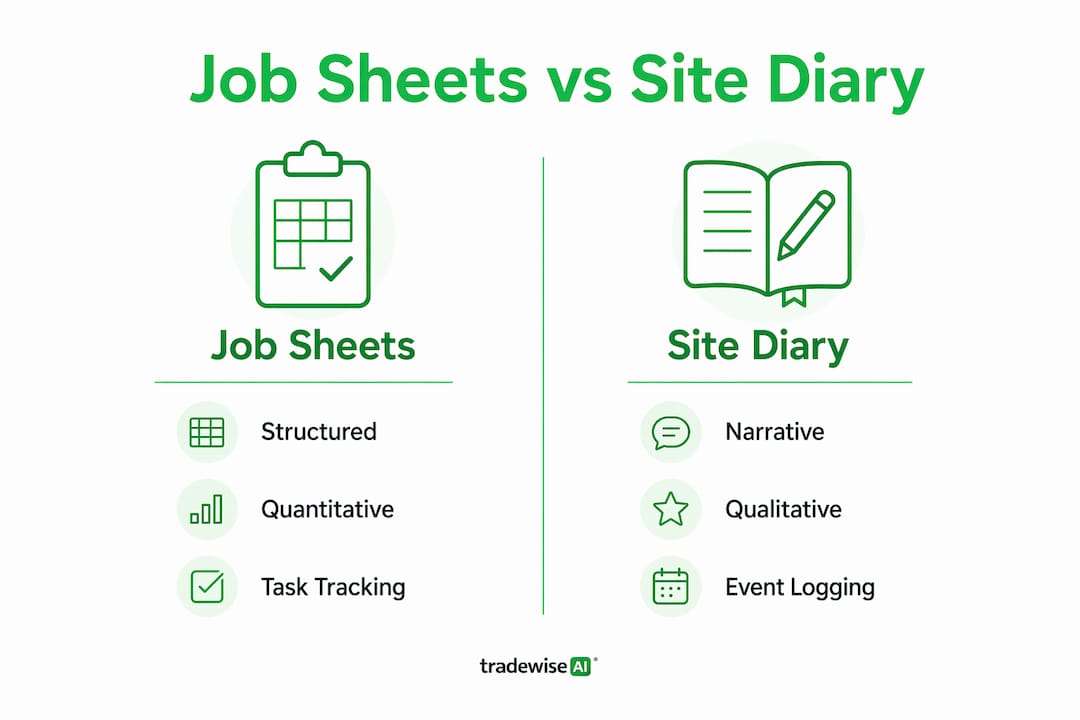
A daily allocation sheet is a quantitative record. It captures what was deployed: how many operatives worked, on which tasks, for how many hours, alongside plant and materials consumed. It answers the commercial question rather than the operational one.
The table below sets out the key differences:
| Feature | Site Diary | Daily Allocation Sheet |
|---|---|---|
| Format | Narrative prose | Structured data fields |
| Primary author | Site manager or foreman | Quantity surveyor or site supervisor |
| Content | Events, conditions, instructions | Labour hours, plant, materials |
| Commercial use | Context and explanation | Substantiating costs and claims |
| NEC4 relevance | Supporting narrative | Core evidence for Defined Cost |
Under NEC4 contracts, daily allocation sheets substantiate Defined Cost and support compensation event assessments. Without these quantitative records, project managers may undervalue compensation events, directly reducing contract profitability. For builders working under NEC4, understanding UK construction contract types is the foundation for knowing which documents carry commercial weight.
Builders who use allocation sheets properly are in a far stronger position to challenge lower compensation event assessments by project managers. That is a commercial advantage that narrative diaries alone cannot provide.
Pro Tip: Keep your site diary and daily allocation sheet as separate documents, even if they are completed by the same person. Mixing narrative and quantitative data in one document weakens both records when they are scrutinised commercially or legally.
How do job sheets support compliance and dispute avoidance?
Accurate job sheets prevent disputes and protect both the builder and the client when disagreements arise. A well-maintained job sheet creates an audit trail that is difficult to challenge. This matters in UK construction, where payment disputes and scope disagreements are common.
The compliance and financial protection benefits of thorough job sheet records include:
- Client approval documentation: Any change to the original scope, agreed verbally on site, should be recorded on the job sheet with the client's signature or written confirmation. This single habit prevents the majority of "that's not what I asked for" disputes.
- Invoicing accuracy: Job sheets record every task, time spent, and materials used, giving your accounts team precise data to invoice from. Clients are far less likely to query an invoice backed by a signed, itemised job sheet.
- Insurance and warranty claims: When a defect or incident occurs, insurers and warranty providers need evidence of what work was done, when, and by whom. A complete job sheet provides exactly that.
- Regulatory compliance: Building regulations in England and Wales require evidence that work meets specified standards. Job sheets recording inspection dates, materials used, and sign-off stages support compliance documentation.
- Subcontractor accountability: When multiple trades are on site, job sheets clarify which operative completed which task. This matters when defects are traced back to a specific piece of work.
The role of documentation in building is not bureaucratic box-ticking. It is financial self-defence. Builders who maintain thorough records spend less time in disputes and more time on site.
What are the best practices for job sheets in 2026?
Effective builders task management starts with a consistent, well-structured job sheet process. The format matters less than the discipline. A paper template completed accurately every day outperforms a digital system filled in sporadically.
Follow these steps to build a reliable job sheet process for your business:
- Choose a structured template or digital app. Standardised job sheet templates enable clear task allocation, progress tracking, and easier project management. Digital apps add real-time updating and automatic data storage.
- Include all essential fields. Effective job sheets include fields for task description, labour time, materials used, client approvals, and job progress status. Missing any of these creates gaps that cause problems later.
- Assign clear responsibility. Decide who completes the job sheet for each task. On larger sites, this is typically the foreman or trade supervisor. On smaller jobs, the lead operative takes responsibility.
- Update in real time, not at the end of the day. Memory degrades quickly on a busy site. Tasks completed at 9am are recorded accurately at 9am, not reconstructed at 5pm.
- Get client sign-off at key stages. For jobs running more than one day, obtain written confirmation at each completion milestone. This protects you if the client later disputes the scope or quality of work.
- Review weekly for accuracy. A brief weekly review by the site manager catches errors before they reach the invoice stage. Consistently updated job sheets reduce invoicing errors and improve project transparency.
Pro Tip: Run a short training session with your site team on job sheet completion. Most errors come from operatives not understanding what level of detail is required. A 30-minute briefing at the start of a project saves hours of correction later.
For builders looking to go further, live job tracking in construction offers a practical framework for connecting job sheet data to real-time site management.
You can also find job booking best practices relevant to trade businesses that help set the standard for record-keeping from the moment a job is booked.
Key takeaways
Job sheets are the single most effective tool builders have for protecting project profitability, avoiding disputes, and meeting contractual obligations on every job.
| Point | Details |
|---|---|
| Job sheets drive accuracy | Record tasks, labour, and materials in real time to support precise invoicing and cost control. |
| Site diaries and allocation sheets differ | Use allocation sheets for NEC4 Defined Cost evidence; use site diaries for narrative context. |
| Compliance depends on records | Client approvals, inspection dates, and materials records protect builders legally and financially. |
| Templates and apps improve consistency | Standardised formats reduce errors and make project data easier to review and audit. |
| Staff training is non-negotiable | Operatives must understand what detail is required to make job sheets commercially useful. |
Why builders underestimate job sheets until it's too late
I have spoken with dozens of UK builders over the years, and the pattern is almost always the same. Job sheets are treated as an afterthought until the first serious dispute lands. Then, suddenly, everyone wishes they had kept better records.
The uncomfortable truth is that most builders are excellent at the physical work and genuinely poor at the paperwork that protects it. A plasterer who produces flawless walls but cannot prove what he used, when he worked, or what the client approved is commercially exposed every single time.
What I find particularly striking is how few builders distinguish between a site diary and a daily allocation sheet. They keep one document, call it whatever feels right, and discover too late that it does not carry the commercial weight they assumed. Under NEC4 contracts, that confusion costs real money. Compensation events get undervalued because the quantitative evidence simply does not exist.
The digital shift is helping, but only for builders who commit to it properly. A digital job sheet app that is half-completed is worse than a paper template filled in carefully, because it creates a false sense of having a system. The discipline matters more than the format.
My honest view is this: job sheets are not an administrative burden. They are the commercial record of your business. Treat them that way, and they will protect your margins, your reputation, and your relationships with clients for every job you take on.
— Mateusz
How Tradewisehq helps builders manage jobs more effectively
Tradewisehq is built for builders who want to spend less time on paperwork and more time on site. Its AI-powered platform connects job sheets, scheduling, invoicing, and client communication in one mobile-first system.

With Tradewisehq, your team updates job progress in real time from any device. The platform pulls that data directly into quotes and invoices, cutting the gap between work completed and payment received. For builders managing multiple sites or subcontractors, the trade management tools give you a live view of every job without chasing calls or waiting for end-of-day reports. If you want to see how job management software benefits UK builders in practice, Tradewisehq is worth exploring today.
FAQ
What is a job sheet in construction?
A job sheet is a document that records the tasks, labour hours, materials, and client approvals for a specific construction job. It serves as the primary operational and commercial record for builders managing site work.
How do job sheets improve efficiency for builders?
Digital job sheet apps allow workers to update job progress in real time, reducing administrative errors and keeping teams coordinated. Accurate records also support faster, more precise invoicing at the end of each job.
What is the difference between a site diary and a daily allocation sheet?
A site diary records narrative events and conditions on site, while a daily allocation sheet quantifies labour, plant, and materials deployed. Under NEC4 contracts, allocation sheets carry the commercial weight needed to substantiate Defined Cost claims.
What fields should a builder's job sheet always include?
Every job sheet should include task description, labour time, materials used, client approvals, and job progress status. Consistently completing all fields reduces invoicing errors and protects builders in the event of a dispute.
Can job sheets help with insurance and warranty claims?
Yes. A complete job sheet records what work was done, when, and by whom, giving insurers and warranty providers the evidence they need to process claims. Builders without these records often find claims delayed or rejected.