

Builder apprentice management is the structured process of onboarding, training, supervising, and assessing apprentices to develop competent tradespeople while meeting UK legal and funding requirements. Known formally as apprenticeship programme management, it covers everything from signing the correct legal documents on day one to confirming behavioural competence before gateway assessment. For construction managers and trainers, getting this right means fewer compliance risks, better retention, and apprentices who genuinely add value on site. This guide covers each stage of the process, aligned with 2025 to 2026 apprenticeship funding and assessment rules, so you can manage construction site roles with confidence.
What should a builder apprentice onboarding checklist include?
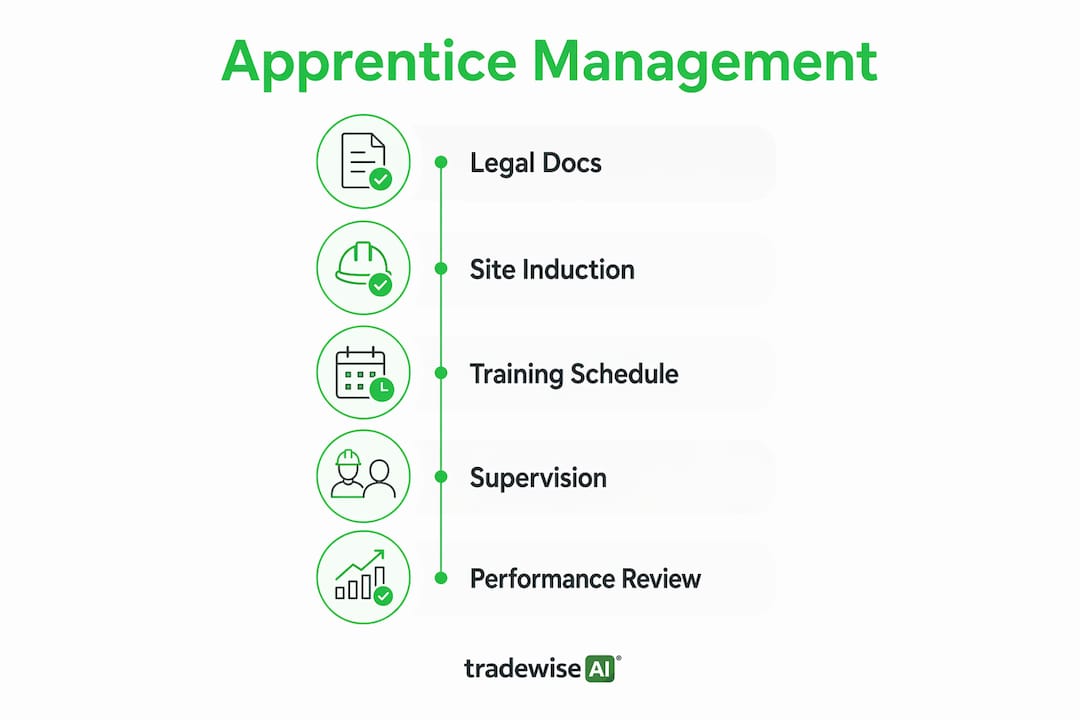
A thorough builder apprentice onboarding checklist covers legal documents, site safety, welfare, and an initial skills assessment before the apprentice sets foot on a live site. The Federation of Master Builders' 2025 guide identifies a signed apprenticeship agreement and a training plan as the two non-negotiable documents every employer must have in place. Without both, you are not legally compliant, and your funding claim is at risk from the outset.
Site induction is the next critical step. Under CDM 2015, site-specific inductions must cover emergency procedures, site hazards, welfare facilities, and reporting lines, and they must be tailored to each individual site. A generic induction copied from a previous project does not satisfy this requirement. Apprentices must also receive a briefing on their worker rights, minimum wage entitlements, and insurance cover before they begin productive work.
The initial skills and knowledge assessment often gets skipped, but it is one of the most useful tools you have. It tells you where the apprentice genuinely sits against the occupational standard, so you can target training where it is actually needed rather than delivering a one-size-fits-all programme.
A practical onboarding checklist should include:
- Signed apprenticeship agreement and training plan
- Site-specific CDM 2015 induction with documented sign-off
- Worker rights and minimum wage briefing
- Insurance confirmation and emergency contact details
- PPE issue and equipment access log
- Initial skills and knowledge baseline assessment
- Introduction to the training provider and point of contact
Pro Tip: Structuring your onboarding over the first two to four weeks rather than delivering it all on day one improves engagement and reduces the risk of information overload. The Manukau Institute of Technology's employer toolkit recommends progress check-ins throughout the onboarding period as a proven way to keep apprentices on track.
How to plan and schedule builder apprentice training effectively
Off-the-job training is the element most managers underestimate until it becomes a compliance problem. GOV.UK guidance specifies minimum training hours per apprenticeship standard for apprentices starting between August 2025 and July 2026, and these hours must be delivered away from the apprentice's normal day-to-day duties. That distinction matters. Watching a colleague lay bricks does not count. Attending a structured session to learn the technique does.

Scheduling off-the-job training into regular workweeks from the start prevents the compliance risk of trying to catch up hours in the final months of the programme. The most practical approach is to block a fixed day or half-day each week in the apprentice's rota and protect it from being overridden by site pressures.
Follow these steps to build a compliant training schedule:
- Confirm the minimum off-the-job hours required for your specific apprenticeship standard with your training provider.
- Map those hours across the programme duration and divide them into weekly or fortnightly blocks.
- Agree the training plan with the provider and get it signed before any delivery begins. GOV.UK unit funding rules confirm that milestone payments are linked to verified delivery hours, so unsigned plans create payment delays.
- Record actual training hours delivered against the plan each month.
- Review the schedule quarterly with the provider and adjust for site changes or absences.
| Training element | Employer responsibility |
|---|---|
| Off-the-job hours | Schedule and protect time; track delivery against the plan |
| On-site practical learning | Assign a named supervisor; log tasks completed |
| English and maths (if required) | Confirm enrolment and monitor progress |
| Progress reviews | Attend tri-party reviews with provider and apprentice |
Pro Tip: Use your workforce scheduling process to create a recurring block for off-the-job training. Treat it with the same priority as a client appointment. Sites that do this consistently report far fewer compliance issues at the end of the programme.
What is the role of employer supervision in confirming apprentice competence?
Employer supervision in apprenticeship management is not just about keeping an apprentice safe on site. It is the primary mechanism for collecting the behavioural evidence that determines whether an apprentice is ready for gateway assessment. GOV.UK states clearly that employers are responsible for verifying that apprentices demonstrate the required behaviours throughout the programme, not just at the end.
The practical implication is that day-to-day supervision should be treated as continuous evidence collection. Every time an apprentice demonstrates a behaviour from the occupational standard, such as communicating professionally with a client or working safely without prompting, that is an evidence opportunity. GOV.UK guidance recommends lightweight recording methods, such as a standardised notebook or digital form, completed whenever key tasks are finished.
Supervisors who wait until the final review to assess behaviour almost always find gaps. Those gaps then delay the gateway, which delays the end-point assessment, which delays the certificate and the final funding payment. Regular progress reviews, ideally monthly or at least every six weeks, prevent this pattern.
Key supervision responsibilities include:
- Observing and recording behavioural demonstrations against the Apprenticeship Assessment Plan (AAP)
- Providing structured feedback after significant tasks, not just at formal reviews
- Flagging concerns to the training provider early, before they become programme-threatening issues
- Confirming readiness for gateway in writing, with documented evidence to support the decision
Supervisors must actively confirm apprentices meet behavioural standards throughout the programme, not just at the end. Treating every working day as a potential evidence opportunity is the single most effective way to avoid end-of-programme delays.
How to troubleshoot common challenges in managing builder apprentices
The most common problems in construction apprentice training fall into three categories: missed off-the-job hours, absent behavioural evidence, and funding compliance gaps. Each one is avoidable with the right systems in place, but each one is also surprisingly easy to overlook when site pressures take over.
Missed off-the-job hours are usually a scheduling problem rather than a motivation problem. When training days get cancelled because of a tight deadline or a staff shortage, they rarely get rescheduled. The fix is to build a catch-up protocol into your training plan from the start, so that any missed session has a default rescheduled date within two weeks.
Absent behavioural evidence is the issue that catches managers off guard most often. An apprentice can be technically competent and still fail to progress if there is no documented record of their behaviours. A simple digital form completed after key tasks takes under two minutes and creates a defensible evidence trail.
Funding compliance gaps often relate to co-investment. From August 2025, co-investment is set at 5% of the agreed training price for non-levy paying employers. That figure should be budgeted from the start of the programme, with monthly funding reports reviewed to avoid gaps. Employers who track this monthly avoid the cash-flow surprises that can disrupt programme continuity.
- Set a catch-up protocol for any missed off-the-job training session.
- Use a digital form to record behavioural evidence after every significant task.
- Budget for co-investment from day one and review monthly funding reports.
- Confirm English and maths enrolment early, as late enrolment is one of the most common gateway blockers.
- Update the training plan whenever site conditions or the apprentice's role changes significantly.
What tools and processes support efficient apprentice management?
Job management software is the most practical tool available to UK construction managers for tracking apprentice progress, training schedules, and compliance records in one place. Platforms designed for the trades sector allow supervisors to log tasks, record observations, and flag training milestones without switching between spreadsheets, paper forms, and email threads. The case for job management software in construction has strengthened considerably as apprenticeship compliance requirements have grown more detailed.
Digital evidence collection is particularly valuable for behavioural observations. A standardised digital form that supervisors complete on a mobile device after key tasks is faster than a paper notebook and far easier to retrieve when the training provider requests evidence at a progress review.
| Approach | Manual process | Digital process |
|---|---|---|
| Behavioural evidence | Paper notebook, easy to lose | Digital form, searchable and shareable |
| Training hour tracking | Spreadsheet, updated irregularly | Automated log, updated in real time |
| Induction records | Printed sign-off sheet | Digital record with timestamp |
| Milestone payment evidence | Compiled at review, often incomplete | Continuous record, ready on demand |
Useful processes to put in place alongside software include:
- A compliance checklist reviewed at each progress review
- A site induction update protocol triggered whenever site conditions change
- A monthly funding report review with the training provider
- A live job tracking system that logs apprentice task completion alongside other site activities
Key takeaways
Effective builder apprentice management requires signed legal documents, scheduled off-the-job training, continuous behavioural supervision, and monthly compliance reviews to meet UK funding rules and produce competent tradespeople.
| Point | Details |
|---|---|
| Start with the right documents | A signed apprenticeship agreement and training plan are legal requirements before any delivery begins. |
| Protect off-the-job training time | Schedule training blocks into the rota from week one and treat them as non-negotiable. |
| Supervise as evidence collection | Record behavioural demonstrations after key tasks throughout the programme, not just at the end. |
| Budget for co-investment | Non-levy employers pay 5% co-investment from August 2025; track monthly to avoid funding gaps. |
| Use digital tools | Digital forms and job management software reduce admin and create a ready evidence trail for milestone payments. |
What I have learned managing apprentices on UK construction sites
The biggest mistake I see construction managers make is treating apprentice management as a compliance exercise rather than a development process. They focus on ticking the right boxes at the right times, and then wonder why their apprentices reach gateway without the confidence or the behavioural evidence to pass. The paperwork matters, but it is a record of something that should already be happening, not a substitute for it.
The managers who get the best outcomes are the ones who treat every working day as a coaching opportunity. They give feedback in the moment, not just at formal reviews. They talk to their training provider regularly, not just when something goes wrong. And they prepare their apprentices for gateway assessment months in advance, not weeks.
The other thing I would say is that early preparation genuinely reduces completion delays. Managers who complete a thorough onboarding process, including a real skills baseline assessment, know exactly where to focus training effort. That focus pays off at the end-point assessment. The ones who skip the baseline spend the final months of the programme discovering gaps they could have addressed in month two.
The FMB's guidance on business readiness before hiring an apprentice is worth reading before you take on your first or your fifth. The principle is the same at any scale: treat apprentice management as a business function, not an afterthought.
— Mateusz
How Tradewisehq simplifies builder apprentice management
Managing apprentice training schedules, behavioural evidence, and compliance records across multiple sites is exactly the kind of administrative burden that Tradewisehq is built to remove.

Tradewisehq is an AI-powered operating system for trade businesses that brings job tracking, staff scheduling, and site documentation into a single mobile-first platform. For construction managers overseeing apprentices, that means training milestones, induction records, and task logs all in one place, accessible from site. You can track off-the-job hours, log behavioural observations, and generate the evidence your training provider needs for milestone payments without leaving the app. If you are ready to take the admin out of apprentice management, explore Tradewisehq and see how it fits your operation.
FAQ
What documents are legally required to start a builder apprenticeship?
Employers must have a signed apprenticeship agreement and an apprenticeship training plan in place before delivery begins. The FMB's 2025 guide identifies these as the core legal documents, alongside insurance confirmation and minimum wage compliance.
How many off-the-job training hours does a builder apprentice need?
The minimum hours depend on the specific apprenticeship standard and are set out in GOV.UK's funding rules for 2025 to 2026. Hours must be delivered away from the apprentice's normal duties and tracked against the agreed training plan.
Who is responsible for confirming an apprentice's behavioural competence?
The employer is responsible for verifying that apprentices demonstrate the required behaviours throughout the programme, as confirmed by GOV.UK's apprenticeship assessment guidance. This must be documented and evidenced before a certificate request is submitted.
What is co-investment and how much do employers pay?
Co-investment is the employer's contribution to apprenticeship training costs. From August 2025, non-levy paying employers contribute 5% of the agreed training price, with the government funding the remaining 95%.
How can digital tools help with construction apprentice training compliance?
Job management software allows supervisors to log behavioural evidence, track training hours, and store induction records digitally. This creates a ready evidence trail for milestone payments and progress reviews without relying on paper records.