

Construction site roles are classified into three broad levels: upper management, middle management, and skilled tradespeople, with over 20 distinct job titles spanning planning, supervision, and physical delivery. Whether you are weighing your first trade apprenticeship or targeting a superintendent position, understanding how these construction site positions relate to one another is the clearest way to map a career path. This guide covers the key roles in building projects, from project manager to scaffolder, explaining what each position does, how authority flows between them, and where the most direct routes to advancement lie.
1. Types of construction site roles: the three core levels
Construction site roles divide into three functional tiers, and knowing which tier a job belongs to tells you immediately what kind of work it involves.
Upper management covers the roles responsible for planning, design, and high-level supervision. These positions typically operate away from the physical site, dealing with contracts, budgets, and client relationships. Common upper management construction job titles include:
- Project manager
- Architect
- Civil engineer
- Estimator
- Quantity surveyor
- Safety manager
Middle management sits between the office and the tools. These roles translate plans into daily site operations and are the primary point of contact for trade crews. Key middle management positions include:
- Site superintendent
- General foreman
- Site engineer
- Construction manager
Skilled tradespeople carry out the physical and specialist work that actually builds the structure. Their roles are defined by a specific craft or technical discipline. Examples include:
- Bricklayer
- Electrician
- Plumber
- Carpenter
- Welder
- Scaffolder
- Roofer
This three-tier structure is not just an organisational chart. It defines who holds authority over safety decisions, who controls the schedule, and who is accountable when something goes wrong on site.
2. Site superintendent vs project manager: key differences
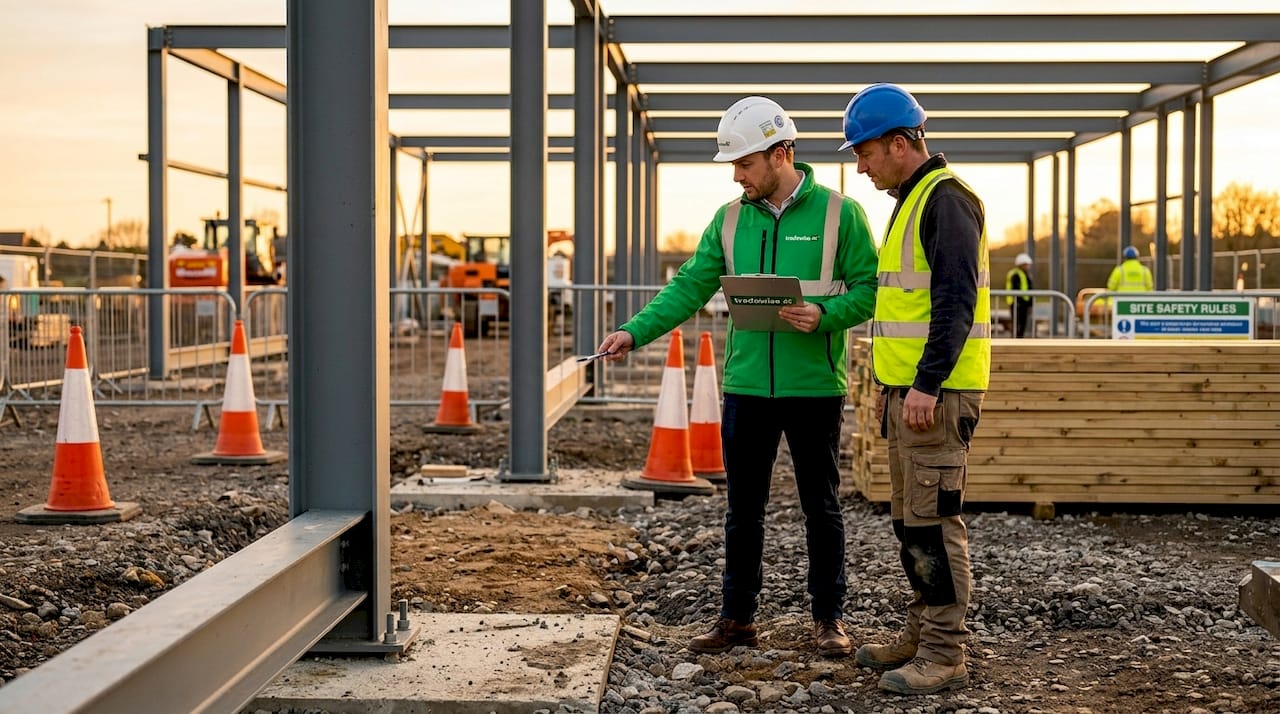
The site superintendent and the project manager are the two most consequential leadership roles on any building project, yet they operate in fundamentally different ways.
The site superintendent directs on-site operations, coordinating subcontractors, enforcing safety protocols, and maintaining the physical construction schedule. The superintendent is the primary authority for everything that happens on the ground. Critically, the superintendent's authority typically includes stop-work powers to halt unsafe or non-compliant activity, a power that distinguishes this role from almost every other position on site.
The project manager, by contrast, focuses on budgeting, scheduling, and client communications from an office environment. The project manager procures land, manages contracts, and reports to clients and stakeholders. Both roles demand strong communication, but their daily realities are quite different.
| Aspect | Site superintendent | Project manager |
|---|---|---|
| Primary location | On-site with crews | Office or client meetings |
| Core responsibility | Field operations and safety | Budget, schedule, and contracts |
| Authority over trades | Direct, daily | Indirect, through superintendent |
| Key skill | Crew coordination | Financial and client management |
| Typical background | Experienced tradesperson | Engineering or construction degree |
Pro Tip: If you are a tradesperson considering management, the superintendent path is more accessible than the project manager route. Most superintendents rise through the trades rather than through formal degree programmes.
3. Skilled trades and specialist roles on construction sites
Skilled tradespeople form the productive core of any construction crew. Each trade carries a distinct set of responsibilities, and the differences matter when you are planning a career or hiring skilled trades workers.
Bricklayer. Bricklayers construct walls, partitions, and structural elements using brick, block, and mortar. The role requires precision in alignment and an understanding of load-bearing principles.
Electrician. Electricians install, test, and maintain electrical systems across residential, commercial, and industrial sites. Licensing requirements vary by region, but the master electrician credential is a recognised milestone that accelerates advancement into supervisory positions. Licensing milestones like the master electrician credential are particularly significant for electricians seeking to move into site leadership.
Plumber. Plumbers install and maintain water supply, drainage, and gas systems. Like electricians, plumbers operate under licensing frameworks that require demonstrated competency before independent practice.
Carpenter. Carpenters work across formwork, framing, joinery, and finishing. The breadth of carpentry means it is one of the most common entry points into construction and one of the most direct routes to foreman and superintendent roles.
Welder. Welders join metal components and are found on structural steel, pipeline, and industrial projects. Welding certifications are trade-specific and internationally recognised, making welders highly portable across project types.
Scaffolder. Scaffolders erect and dismantle temporary access structures. The role carries significant safety responsibility because faulty scaffolding directly endangers every other worker on site.
Roofer. Roofers install and repair roof coverings including tiles, slates, felt, and metal sheeting. Working at height means roofers must hold specific safety training qualifications.
Pro Tip: Tradespeople who gain experience across two or more related disciplines, such as carpentry and formwork, are consistently faster to reach foreman level than those who specialise narrowly from the start.
4. Safety roles: competent person and qualified person
Safety designations on construction sites are not just job titles. They carry legal authority and direct operational responsibility.
OSHA defines a "competent person" as someone capable of identifying existing and predictable hazards and who is authorised by their employer to take prompt corrective action. This authorisation is the critical element. A competent person is not simply someone with safety knowledge. They have the employer-granted power to act on what they identify.
A "qualified person" holds a recognised degree, certificate, or extensive experience that equips them to solve complex technical problems on site. The distinction matters because safety role titles carry real authority and directly affect what tasks can be assigned and who can supervise them.
"The competent person designation is not a title you put on a business card. It is a formal assignment of authority that changes what you are legally permitted to do on a construction site."
Common responsibilities assigned under these designations include:
- Conducting pre-work hazard assessments before excavation or demolition
- Inspecting scaffolding and fall protection systems before each shift
- Overseeing confined space entry procedures
- Authorising the resumption of work after a safety stop
Understanding these designations is particularly relevant for tradespeople moving into supervisory roles, because holding a competent person designation is often a prerequisite for foreman and superintendent positions.
5. Career progression from tradesperson to superintendent
The path from apprentice to site superintendent is well-established, though it typically spans 10 to 20 years and requires deliberate development at each stage.
-
Apprentice. The starting point for most trades. Apprentices work under journeymen, learning the technical fundamentals of their craft through a combination of on-site practice and formal training.
-
Journeyman. A fully qualified tradesperson who can work independently. At this stage, the focus shifts from learning the trade to mastering efficiency, quality, and reliability. Journeymen who show an ability to organise their own work and support newer colleagues attract attention from foremen.
-
Lead hand. An informal step between journeyman and foreman. Lead hands take responsibility for a small crew or a defined section of work without yet holding full foreman authority.
-
Foreman. Foremen manage crews and schedules for a defined scope of work and report directly to the superintendent. This is where technical skill becomes secondary to crew management, communication, and problem-solving. The move from foreman to superintendent is the single largest responsibility jump in the construction career ladder.
-
Superintendent. The superintendent oversees the entire physical site, coordinating multiple trades simultaneously and holding ultimate authority over field operations. Reaching this level requires not just experience but the ability to manage conflict, read schedules critically, and make fast decisions under pressure.
The route differs slightly by trade. Carpenters and labourers have traditionally had the most direct path because their work touches every phase of a project. Electricians and plumbers often progress more slowly because licensing requirements create defined gates in their advancement. For live job tracking across these stages, digital tools are increasingly part of how superintendents manage their sites.
Key takeaways
Construction site roles are best understood through three tiers of authority: upper management, middle management, and skilled tradespeople, with each tier carrying distinct responsibilities and career trajectories.
| Point | Details |
|---|---|
| Three-tier structure | Upper management, middle management, and skilled trades define authority and career paths. |
| Superintendent vs project manager | Superintendents control the field; project managers control budgets and client relationships. |
| Skilled trades diversity | Roles from bricklayer to welder each require distinct certifications and carry different advancement routes. |
| Safety designations matter | Competent person and qualified person are formal authority assignments, not honorary titles. |
| Career progression timeline | Most tradespeople take 10 to 20 years to reach superintendent level, moving through journeyman and foreman stages. |
Why construction roles are more structured than most people realise
I have spent years working alongside tradespeople and site managers, and the single most common mistake I see from people entering construction is treating job titles as interchangeable labels. They are not. The gap between a journeyman electrician and a foreman is not just seniority. It is a fundamentally different job with different legal responsibilities, different communication demands, and a different relationship to risk.
What surprises most people is how early the career fork appears. A carpenter who starts taking on lead hand duties at year three is on a completely different trajectory from one who stays heads-down in their craft until year eight. Neither path is wrong, but only one leads to superintendent. The tradespeople I have seen advance fastest are those who deliberately seek out exposure to scheduling, subcontractor coordination, and safety documentation long before they hold a formal management title.
Technology is changing this too. Sites using platforms like Tradewisehq for materials management and workforce coordination are creating new expectations for foremen and superintendents. The ability to read a digital job board or update a live schedule is becoming as expected as reading a blueprint. Tradespeople who build these skills early will find the path to leadership considerably shorter.
— Mateusz
How Tradewisehq supports construction site teams

Managing a construction site means coordinating multiple roles simultaneously, from superintendents tracking subcontractor progress to foremen updating daily schedules. Tradewisehq is an AI-powered platform built specifically for tradespeople and construction businesses. It brings job management, staff scheduling, quoting, invoicing, and client communication into a single mobile-first system. For site managers overseeing complex crews, Tradewisehq provides live workforce syncing and automated task tracking so nothing falls through the gaps. If you are running a trade business or managing a construction site and want to reduce the administrative load on your team, explore what Tradewisehq can do for your operation.
FAQ
What are the main types of construction site roles?
Construction site roles fall into three levels: upper management (project managers, architects, estimators), middle management (site superintendents, foremen), and skilled tradespeople (electricians, plumbers, carpenters, bricklayers). Each level carries distinct responsibilities and authority.
What is the difference between a site superintendent and a project manager?
A site superintendent manages physical field operations and coordinates trade crews on-site, while a project manager oversees budgets, contracts, and client communications, typically from an office. Both roles require strong communication but differ in location and scope of authority.
What does a "competent person" mean on a construction site?
OSHA defines a competent person as someone who can identify site hazards and is authorised by their employer to take immediate corrective action. This is a formal designation that grants specific legal authority, not simply a description of experience.
How long does it take to become a site superintendent?
The typical career path from journeyman tradesperson to site superintendent takes between 10 and 20 years, progressing through lead hand and foreman stages. Advancement depends on developing crew management and coordination skills alongside technical expertise.
Which trades offer the fastest route to site leadership?
Carpentry and general labour traditionally offer the most direct route to foreman and superintendent roles because both trades are involved in every phase of a construction project. Electricians and plumbers advance on a similar trajectory but face additional licensing gates along the way.