

Construction bid management is the end-to-end system contractors use to identify, prepare, and submit competitive tenders that win projects. It governs every stage of the bidding lifecycle, from spotting the right opportunity to analysing why you won or lost. Most contractors win only 20%–30% of the bids they pursue. That figure makes one thing clear: bid management is a strategic discipline, not an administrative task. Firms that treat it as such, by investing in accurate preconstruction data, selective pursuit, and professional documentation, consistently outperform those that do not. The Chartered Institute of Building (CIOB) and the Royal Institution of Chartered Surveyors (RICS) both recognise structured tender management as a core competency for UK construction professionals.
What is construction bid management and why does it matter?
Construction bid management is the organised process of controlling every activity between spotting a potential contract and receiving a decision from the client. It is distinct from estimating, which is a technical sub-task within the broader system. Bid management covers opportunity qualification, bid package assembly, submission, and post-award review. Structured bid management leads to predictable work capacity and efficient scheduling. Without it, firms experience unpredictable workloads and wasted resources on tenders they were never likely to win.
The importance of bid management grows with the size and complexity of a firm's pipeline. A sole trader chasing two or three jobs a month can manage informally. A contractor running ten simultaneous pursuits cannot. At that scale, missed deadlines, duplicated effort, and inconsistent pricing become genuine commercial risks. Bid management provides the framework that prevents those failures.

What are the key stages of the construction bidding process?
The construction bidding process follows five core stages, each with distinct activities and decision points.
-
Solicitation. The client issues a tender notice, invitation to tender (ITT), or request for proposal (RFP). Your team reviews the documents and makes a go/no-go decision. This is the most critical gate in the entire process. Pursuing the wrong opportunities wastes estimating hours and dilutes focus on high-margin work.
-
Proposal submission. Your team assembles the bid package. This includes the priced bill of quantities, method statement, programme, health and safety plan, and any pre-qualification questionnaire (PQQ) responses. In UK public sector procurement, compliance with the Public Contracts Regulations 2015 is mandatory at this stage.
-
Contractor selection. The client evaluates submissions against published criteria. Most UK public contracts use a most economically advantageous tender (MEAT) framework, which scores quality and price together. Private clients vary widely, but many use similar weighted scoring.
-
Contract formation. The preferred bidder enters negotiations or receives a letter of intent. Standard forms such as JCT or NEC contracts are common in the UK. Your commercial team reviews terms before execution.
-
Project delivery method selection. The client and contractor agree on how the project will be delivered: traditional, design and build, management contracting, or another route. This decision affects risk allocation and shapes how future bids for similar work should be priced.
Qualifying opportunities early, at stage one, is where the most resource is saved. A disciplined go/no-go process at solicitation stage protects your estimating team from bid fatigue and keeps your pipeline focused on work you can genuinely win.
Pro Tip: Build a simple go/no-go scorecard with five criteria: project size fit, client reputation, geographic reach, crew availability, and margin history. Score each out of ten. Pursue only bids that score above thirty.
How does bid management differ from estimating?
Estimating is a technical skill focused on projecting the cost of delivering a defined scope of work. Bid management is the broader operational discipline that determines which projects to price, how to package the proposal, and what to do with the outcome. The two are related but not interchangeable.
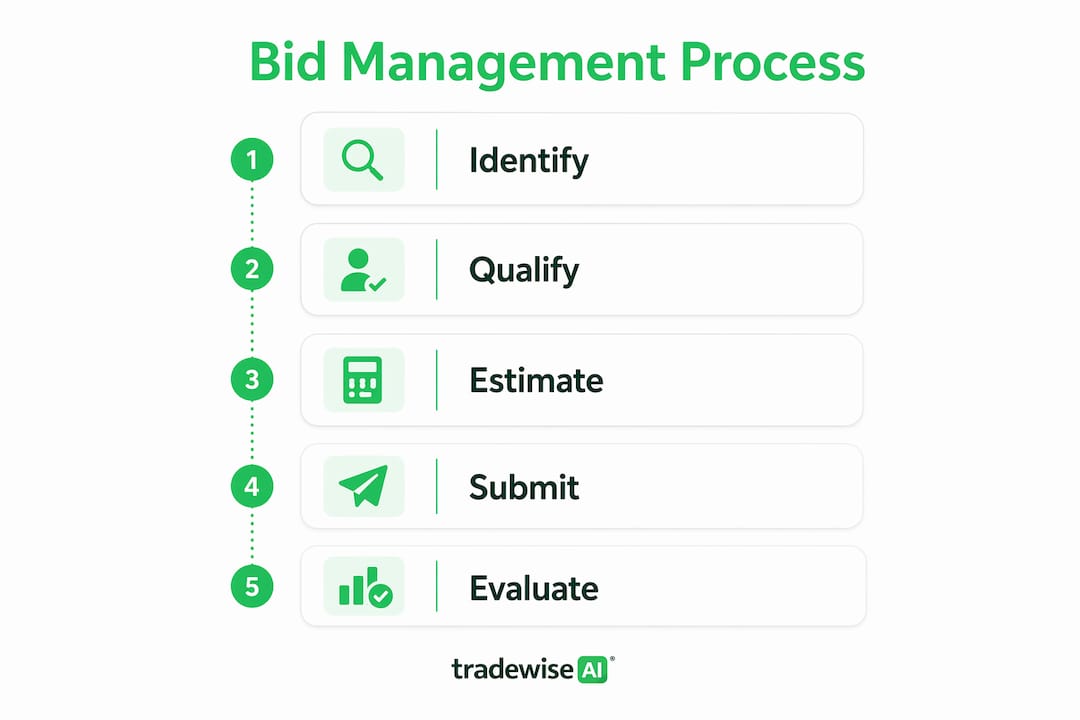
Many UK contractors conflate the two, assigning estimators to manage the entire bid process. This creates a structural problem. Estimators are trained to build accurate cost models. They are rarely trained to write compelling method statements, manage submission deadlines across multiple live bids, or track win-loss patterns over time. When estimating and bid management are separated, each function improves.
The most valuable output of a properly managed bid process is the win-loss feedback loop. Every bid outcome, whether won or lost, contains data. A loss at tender stage tells you something about your pricing, your presentation, or your competitor's positioning. A win tells you which client types and project categories suit your firm's strengths. Feeding that data back into your estimating assumptions and pursuit criteria is what separates firms with consistent pipelines from those lurching between feast and famine.
- Estimating produces a cost model for a specific scope.
- Bid management selects which scopes to price in the first place.
- Bid management packages the cost model into a compelling proposal.
- Bid management tracks the outcome and feeds it back into future decisions.
- Integration of both functions creates a self-improving system.
Pro Tip: Assign a bid manager or coordinator role separately from your lead estimator. Even on small teams, splitting these responsibilities by person, rather than by task, produces measurably better submissions.
What strategic criteria guide effective bid qualification?
Disciplined go/no-go decisions based on profitability, capacity, and core competencies prevent resource waste and bid fatigue. Selecting the right bids to pursue is the single highest-leverage activity in the entire process. It determines your win rate before a single page of the tender is written.
The following table summarises the key qualification criteria and their commercial impact.
| Qualification factor | Why it matters |
|---|---|
| Project size fit | Bids outside your typical contract value carry higher pricing risk and lower win probability |
| Client reputation | Clients with a history of late payment or scope disputes erode margin even on won contracts |
| Geographic reach | Projects beyond your crew's practical radius inflate preliminaries and reduce competitiveness |
| Crew and plant capacity | Bidding work you cannot resource leads to either subcontracting risk or programme failure |
| Margin history by sector | Past profitability in a sector predicts future margin better than any other single variable |
| Contract complexity | Unusual risk transfer clauses require legal review time that must be factored into bid cost |
Bid fatigue is a real and measurable problem. Failing to apply early go/no-go decisions dilutes focus on high-margin work and exhausts your estimating team. Firms that pursue fewer bids with greater rigour consistently achieve higher win rates than those that chase volume. Analysing your bid history by sector, client type, and contract value reveals patterns that sharpen future pursuit decisions considerably.
Pro Tip: Review your last twelve months of bid outcomes quarterly. Calculate your win rate by client type and contract value band. The results will almost certainly show you are wasting effort on one or two categories where you have never won.
How can technology improve construction bid management?
Manual bid management, built on email chains and spreadsheets, creates three specific problems: missed deadlines, duplicated effort, and no audit trail. Centralised dashboards replace these error-prone methods with a single source of truth for every live bid. That shift alone reduces the risk of submitting an outdated version of a document or missing a clarification deadline.
Construction bid management software typically provides the following capabilities:
- Bid tracking dashboards that show every live pursuit, its stage, deadline, and assigned owner at a glance.
- Document management with version control, so the entire team works from the same current drawings and specifications.
- Invitation deduplication, which prevents multiple estimators from pricing the same project independently. This is a hidden inefficiency in many firms and one of the easiest to eliminate with the right tool.
- Deadline alerts that notify the relevant team member when a submission window is approaching.
- Cost estimating integrations that pull live material prices and labour rates into the bid model.
- Win-loss analytics that record outcomes and surface patterns across your bid history.
For UK construction teams, builder software features have expanded significantly. Mobile-first platforms now allow site managers and estimators to collaborate on live bids from the field, not just the office. That matters when a client requests a clarification on a Thursday afternoon and your estimator is on site until Friday. The ability to track multiple construction projects from a single interface is no longer a luxury for larger firms. It is a baseline requirement for any contractor running more than three or four simultaneous pursuits.
Why is post-bid evaluation critical for improving win rates?
Post-bid review is the most frequently skipped step in the entire bid management process, yet it is what separates firms with consistent winning performance from those that plateau. Every submitted bid is a data point. Ignoring the outcome wastes that data entirely.
Effective post-bid evaluation covers three areas. First, pricing comparison: where did your price land relative to the winning bid? If you are consistently 15% above the winner on a particular project type, your cost model for that category needs reviewing. Second, technical feedback: many UK public sector clients are obliged to provide scoring breakdowns on request. That feedback tells you exactly which sections of your submission underperformed. Third, relationship intelligence: who won, and why? Understanding which competitors are active in your target sectors informs both your pricing and your pursuit strategy.
Successful firms treat bid losses as data to sharpen pricing and targeting strategies. The firms that grow contract revenue consistently are those that build a feedback culture, where every loss triggers a short debrief and every win is analysed for what worked. Over time, this produces a self-correcting bid strategy that improves without requiring a complete overhaul of your process. Connecting post-bid learning to your job costing practices closes the loop between estimated and actual costs, making future bids more accurate.
Key takeaways
Effective construction bid management combines disciplined opportunity qualification, integrated estimating, and continuous post-bid learning to build a consistent pipeline of won contracts.
| Point | Details |
|---|---|
| Bid management covers the full lifecycle | It spans opportunity identification, proposal assembly, submission, and post-award review. |
| Win rates average 20%–30% | Contractors who outperform invest in selective bidding and professional documentation. |
| Estimating and bid management are distinct | Separating the two roles produces better submissions and a stronger feedback loop. |
| Go/no-go decisions protect resources | Qualifying bids against margin history, capacity, and client reputation prevents bid fatigue. |
| Post-bid review drives improvement | Analysing pricing comparisons and scoring feedback is what separates consistent winners from the rest. |
The uncomfortable truth about how most UK contractors bid
I have worked with enough construction teams to say this plainly: most firms do not have a bid management process. They have an estimating process with a submission deadline bolted on the end. The bid goes out, the result comes back, and nobody writes anything down. Then the cycle repeats.
The firms I have seen grow their contract revenue year on year share one habit. They treat every bid, won or lost, as a business intelligence exercise. They know their win rate by sector. They know which client types pay on time and which ones erode margin through variations. They know which project sizes suit their crew capacity. That knowledge does not come from instinct. It comes from recording outcomes and reviewing them regularly.
The technology argument is real, but it is secondary. A well-organised spreadsheet beats a poorly used platform every time. Start with the discipline of recording outcomes and qualifying opportunities rigorously. The software makes that discipline faster and more visible, but it cannot substitute for it. If you want to win more builder contracts in a competitive UK market, the answer is not to bid more. It is to bid better, on fewer, better-chosen projects.
— Mateusz
How Tradewisehq supports professional bid management for UK contractors
Construction professionals managing multiple live bids need more than a spreadsheet. Tradewisehq is an AI-powered trade management platform built for builders, contractors, and field teams who need to manage quotes, jobs, and client communication from one place.
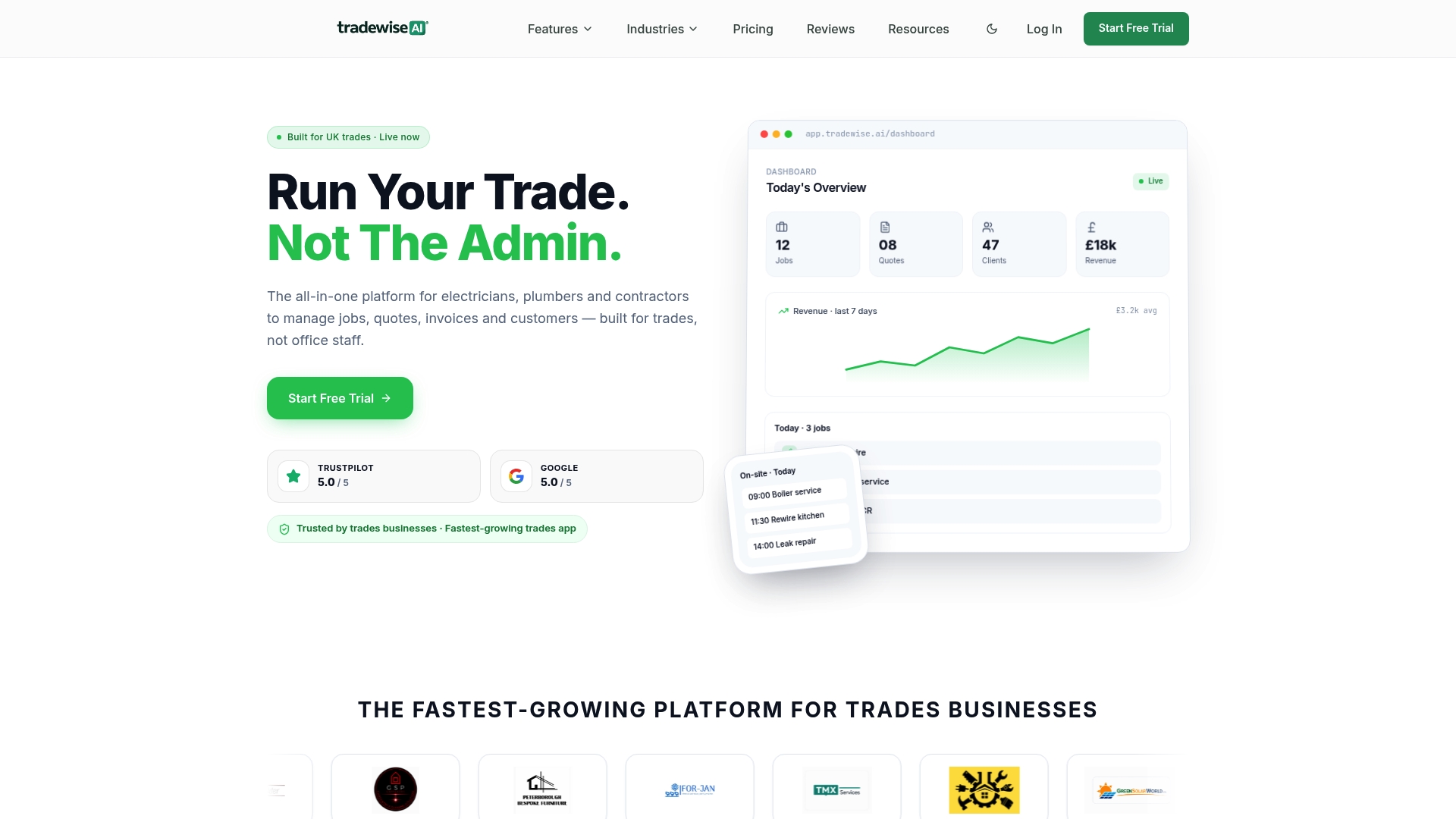
Tradewisehq centralises bid tracking, document control, and job management in a single mobile-first interface. Teams get deadline visibility, quote history, and client records without switching between tools. For contractors looking to build a more disciplined bidding process, Tradewisehq provides the operational foundation that makes consistent winning possible. Explore the full platform at Tradewisehq and see how it fits your current workflow.
FAQ
What is construction bid management?
Construction bid management is the end-to-end process of identifying, qualifying, preparing, and submitting construction tenders, then analysing outcomes to improve future performance. It covers the full bidding lifecycle from opportunity discovery through to post-award review.
How many bids does a typical contractor win?
Most contractors win between 20% and 30% of the bids they pursue. Firms that invest in selective bidding, accurate preconstruction data, and professional documentation consistently achieve higher win rates than this average.
What is the difference between estimating and bid management?
Estimating focuses on projecting the cost of a defined scope of work. Bid management is the broader process that decides which projects to price, packages the proposal, and tracks outcomes to refine future strategy.
What is a go/no-go decision in construction bidding?
A go/no-go decision is a structured assessment made at the solicitation stage to determine whether a bid is worth pursuing. It typically evaluates project size fit, client reputation, crew capacity, geographic reach, and margin history.
Why is post-bid review important?
Post-bid review reveals where your pricing and technical submission ranked against competitors, allowing you to correct weaknesses in future bids. Firms that conduct regular post-bid analysis build a self-improving bid strategy that grows contract revenue over time.