

Construction contract management is the active process of overseeing and enforcing agreements between all project parties to deliver scope, cost, and schedule successfully. Poor contract administration is a leading cause of the industry's persistent delivery failures. KPMG's 2023 Global Construction Survey found that fewer than half of construction projects complete on time. That figure reflects not just poor planning, but a failure to treat contracts as working tools throughout the project lifecycle. This guide covers every critical stage of contract administration, from selecting the right contract form under JCT or NEC frameworks to protecting margins during the buyout phase, managing change, and preventing disputes before they escalate.
What is construction contract management and why does it matter?
Construction contract management is the discipline of actively administering every agreement on a project, from the main contract with the client down to individual subcontract packages. The recognised industry term is "contract administration," though "contract management" is widely used to describe the broader commercial and operational oversight role. Both terms appear in RICS guidance and JCT documentation, and UK project managers use them interchangeably in practice.
The four pillars of effective construction management are planning, monitoring, collaboration, and communication. Failure in any one of them derails schedules and margins. Contract management sits at the intersection of all four, because the contract defines the rules for each pillar.

Treating a contract as a legal document filed away after signing is the single most common mistake on UK construction projects. The contract specifies scope, quality standards, payment terms, notice requirements, and dispute procedures. Every one of those provisions requires active management throughout the project, not just at the point of dispute.
Which contract types are used in UK construction?
The UK construction sector uses several standard forms, each with a distinct risk profile. Choosing the wrong form for your project type creates commercial exposure before work begins.
Lump sum contracts fix the price for a defined scope. JCT Standard Building Contract is the most common lump sum form in the UK. It suits projects with fully developed designs and well-defined scopes, where the client wants cost certainty and the contractor accepts scope risk.
Cost-plus contracts reimburse the contractor's actual costs plus a fee. They suit early-stage or complex projects where the scope cannot be fully defined upfront. The client carries most of the cost risk, so these contracts require rigorous open-book accounting.
Design and build contracts transfer both design responsibility and construction risk to the contractor. JCT Design and Build is widely used for commercial and residential schemes where the client wants a single point of responsibility.
Target cost and guaranteed maximum price (GMP) contracts share risk and reward between client and contractor. NEC4 Option C is the standard target cost form in the UK. These contracts suit complex programmes where collaboration and early contractor involvement are priorities.
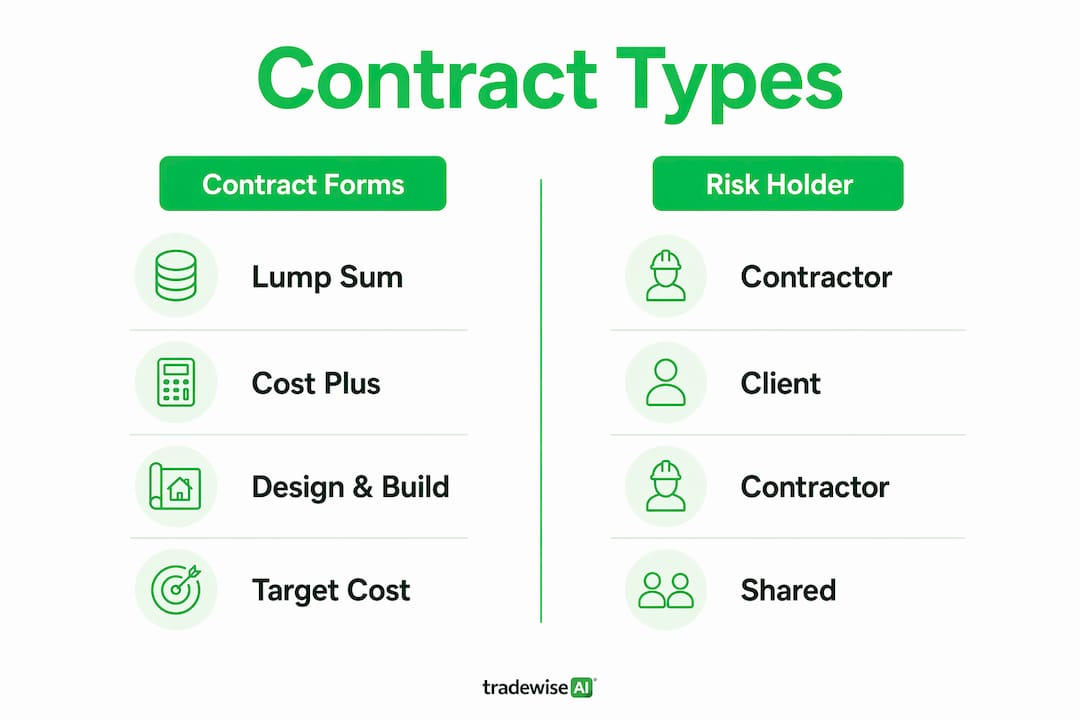
| Contract type | Best suited for | Risk holder |
|---|---|---|
| Lump sum (JCT SBC) | Fully designed schemes | Contractor |
| Cost-plus | Early-stage or undefined scope | Client |
| Design and build (JCT DB) | Single-point responsibility | Contractor |
| Target cost (NEC4 Option C) | Complex, collaborative programmes | Shared |
| GMP | Budget-capped projects | Contractor (above GMP) |
For a detailed breakdown of each form, the UK contract types guide on the Tradewisehq blog covers risk allocation and selection criteria in depth.
Pro Tip: Match the contract form to your scope certainty. If your design is less than 80% complete at tender, a lump sum contract will generate variations and disputes. A target cost or cost-plus form gives you flexibility without sacrificing accountability.
How do you manage the buyout phase to protect margins?
The buyout phase is the most financially critical window of any construction project. Effective buyout execution can improve project margins by 2–5%, while poor buyout can eradicate margins before groundworks begin. Every percentage point recovered during subcontract negotiation goes directly to the bottom line.
The buyout phase runs from main contract award to the execution of all subcontract packages. It is the period when the general contractor converts the tender allowances into actual subcontract commitments. The gap between allowance and commitment is where margin is made or lost.
Follow these steps to run a disciplined buyout process:
- Issue scoped enquiries. Send detailed scope documents to a minimum of three subcontractors per package. Vague enquiries produce incomparable bids and leave money on the table.
- Level the bids. Compare every bid on an apples-to-apples basis by mapping each submission against the full scope. Identify exclusions, qualifications, and assumptions before shortlisting.
- Negotiate on scope, not just price. Use bid levelling to identify gaps, then negotiate to close them. Price reductions without scope clarity create disputes later.
- Agree payment terms in writing. Payment terms directly affect cash flow. Align subcontract payment cycles with the main contract payment schedule to avoid funding gaps.
- Execute subcontracts before mobilisation. Never allow a subcontractor on site without a signed agreement. Clear contracts specifying scope, quality, schedule, and payment terms are the foundation of subcontractor accountability.
- Integrate the subcontract programme. Attach the agreed programme as a contract document. This creates a contractual baseline for performance monitoring.
For practical guidance on subcontractor selection and negotiation, the subcontractor management guide on Tradewisehq covers the full process from enquiry to execution.
Pro Tip: Build a buyout tracker in a shared spreadsheet or project management platform. Record the tender allowance, the best bid received, the negotiated price, and the variance for every package. Review it weekly with your commercial team until all packages are executed.
How do you manage change and allocate risk effectively?
Change is inevitable on construction projects. The question is not whether changes will occur, but whether you have a process to capture, value, and authorise them before they become disputes.
The change management process has four stages: identification, documentation, authorisation, and valuation. Each stage requires a written record. Written instructions prior to executing contract variations ensure clarity and compliance with the contract's valuation rules. Verbal instructions followed by disputed valuations are among the most common sources of contractor claims in the UK.
Key practices for effective change control include:
- Issue formal variation instructions promptly. Under JCT and NEC contracts, the contract administrator must issue written instructions before the contractor proceeds with varied work. Retrospective instructions create valuation disputes.
- Value variations at the time of instruction. Agree rates and sums as close to the instruction date as possible. Deferred valuation allows costs to accumulate and become harder to challenge.
- Maintain a variation register. Record every instruction, its agreed value, and its programme impact. Share the register with the client and subcontractors at each progress meeting.
- Build task-specific contingency buffers. Project managers should avoid blanket schedule buffers and instead build targeted contingency for high-risk activities based on task-specific conditions. A 10% across-the-board buffer is not a risk management strategy.
- Allocate risk to the party best placed to manage it. Fair risk allocation aligns incentives. Pushing all risk to the subcontractor on a poorly defined scope creates adversarial relationships and inflated tender prices.
Pro Tip: Set a variation threshold in your subcontracts. Any instruction above a defined value, say £5,000, requires written authorisation from the client before the subcontractor proceeds. This prevents scope creep and protects your margin.
How do you prevent and resolve construction disputes?
Most construction disputes are preventable. They arise from ambiguous scopes, missed notices, and poor communication, not from genuinely irreconcilable differences. The most fatal contract management failures occur when formal notices related to delays or claims are not issued within strict contractual time limits, resulting in forfeited rights.
"Contracts should be treated as living documents actively used in daily site reports and schedule updates. The project manager who reads the contract only when a dispute arises has already lost the argument."
Active contract governance prevents this. Treat the contract as an operational tool, not a legal archive. The following practices build a dispute-resistant project environment:
- Document every scope, schedule, and cost change formally. Use the contract's prescribed notice forms. Informal emails do not satisfy most JCT or NEC notice requirements.
- Hold pre-mobilisation and weekly coordination meetings. Regular coordination meetings among subcontractors, the prime contractor, and the client reduce blocking issues and improve contract alignment.
- Establish a clear escalation path. Define who has authority to resolve disputes at site level, commercial level, and director level. Most disputes resolve faster when the escalation path is agreed in advance.
- Use the contract's dispute resolution mechanism. JCT contracts provide for adjudication as the primary dispute resolution route. NEC4 contracts include a structured early warning and compensation event process designed to resolve issues before they become claims.
- Seek legal advice early. If a dispute involves a notice that may have been missed or a claim that exceeds your commercial team's expertise, instruct a solicitor with construction law experience before the position hardens.
For guidance on the contracts manager's role in dispute prevention, the contracts manager role guide on Tradewisehq provides a detailed breakdown of responsibilities.
Key takeaways
Effective construction contract management protects project margins, prevents disputes, and delivers scope on time by treating every contract as an active operational tool from award through to closeout.
| Point | Details |
|---|---|
| Buyout phase is critical | Effective buyout execution can improve project margins by 2–5% before groundworks begin. |
| Match contract form to scope | Choose JCT, NEC, or cost-plus based on scope certainty and risk appetite, not habit. |
| Written instructions protect rights | Issue formal variation instructions before work proceeds to comply with valuation rules. |
| Task-specific risk buffers outperform blanket ones | Build contingency around high-risk activities, not arbitrary percentages across the programme. |
| Missed notices forfeit rights | Issue contractual notices within prescribed time limits to preserve delay and claim entitlements. |
Why I think most UK builders underestimate the buyout phase
After years of working with construction businesses across the UK, the pattern I see most often is this: a project team wins a contract, celebrates, and then immediately focuses on mobilisation. The buyout phase gets treated as a procurement formality rather than the commercial event it actually is.
The consequence is predictable. Subcontract packages get awarded on price alone, scopes are left ambiguous, and the variation register starts filling up before the first slab is poured. By the time the project reaches practical completion, the margin that existed at tender has been consumed by disputes, rework, and unrecovered variations.
The builders who protect their margins do something different. They involve their commercial team in the buyout from day one. They level bids rigorously, negotiate scope clarity before price, and execute subcontracts before mobilisation. They also read their contracts. Not just the payment terms, but the notice provisions, the variation procedures, and the dispute resolution clauses.
Technology helps, but it does not replace discipline. A platform like Tradewisehq can centralise documentation and automate reminders for contractual deadlines. That is genuinely useful. But the underlying discipline of treating the contract as a daily working document has to come from the project team first.
The builders who win more contracts and deliver better margins are not the ones with the most sophisticated software. They are the ones who understand that the contract is the project.
— Mateusz
How Tradewisehq supports construction contract management
Managing contracts across multiple projects and subcontractors generates a significant volume of documentation, deadlines, and communication. Tradewisehq is an AI-powered platform built for tradespeople and contractors who need to manage jobs, subcontractors, quotes, invoices, and client communication from a single mobile-first system.
For UK builders managing active contracts, Tradewisehq centralises job records, tracks subcontractor performance, and keeps communication documented in one place. That documentation discipline is exactly what protects you when a dispute arises or a notice deadline approaches. Explore how Tradewisehq trade management can support your contract administration from buyout through to final account.
FAQ
What is construction contract management?
Construction contract management is the active administration of all project agreements to deliver scope, cost, and schedule as agreed. It covers contract selection, subcontractor management, change control, and dispute prevention throughout the project lifecycle.
Which contract form is most common in UK construction?
JCT Standard Building Contract is the most widely used lump sum form in the UK. NEC4 is the preferred form for public sector and infrastructure projects where collaborative risk sharing is a priority.
How much can effective buyout improve project margins?
Effective buyout execution can improve project margins by 2–5%. Poor buyout, by contrast, can eliminate margins entirely before construction begins.
What happens if you miss a contractual notice deadline?
Missing a formal notice deadline under JCT or NEC contracts can result in forfeited rights to claim for delays or additional costs. Always issue notices within the time limits prescribed by the contract.
How do you prevent construction disputes?
Treat contracts as living documents used in daily project administration, issue written instructions before variations proceed, and hold regular coordination meetings to surface issues early. Most disputes arise from ambiguous scopes and missed notices, both of which are preventable.