

A contracts manager in UK construction is the professional responsible for owning the entire lifecycle of every contract on a project, from initial drafting through to final close-out. Without this function, construction businesses face revenue leakage averaging 9% annually, with 92% of contract management errors traced directly to human error. The role sits at the intersection of law, finance, and operations, and it is one of the most commercially consequential positions on any major build. Understanding what a contracts manager actually does, and what separates a good one from an average one, is the starting point for any UK construction professional serious about project compliance and delivery.
What are the core responsibilities of a contracts manager in UK construction?
The contracts manager job description in UK construction covers far more than paperwork. The role owns the full contract lifecycle: drafting, negotiation, execution, performance monitoring, variation management, and renewal or termination. On a live project, this means reviewing subcontractor agreements, tracking milestone obligations, and flagging non-compliance before it becomes a dispute.

Contracts management responsibilities also extend to regulatory compliance. In the UK, this includes adherence to the Housing Grants, Construction and Regeneration Act 1996, the Construction Act payment provisions, and JCT or NEC contract frameworks. A contracts manager must know these instruments well enough to spot when a clause conflicts with statutory requirements.
The core skills of a contracts manager reflect this breadth:
- Negotiation and commercial awareness: Reading a contract through a commercial lens, not just a legal one, is the defining skill. Contracts managers prioritise deal viability and operational delivery over pure legal liability, which separates them from in-house lawyers.
- Contract literacy: Understanding JCT, NEC3, NEC4, and bespoke forms of agreement used across UK construction projects.
- Risk identification: Spotting ambiguous clauses, missing obligations, or unrealistic programme commitments before they are signed.
- Stakeholder communication: Translating complex contractual language into clear instructions for site teams, procurement, and finance.
- Data and systems management: Maintaining contract registers, tracking renewals, and managing obligations across multiple live projects simultaneously.
Contracts manager qualifications in the UK typically include a degree in quantity surveying, law, construction management, or a related discipline. Professional membership of the Chartered Institute of Procurement and Supply (CIPS), the Royal Institution of Chartered Surveyors (RICS), or the Chartered Institute of Building (CIOB) strengthens credibility considerably. Many senior practitioners also hold the IACCM (now World Commerce and Contracting) certification.
Pro Tip: If you are researching how to become a contracts manager in UK construction, prioritise gaining site-level commercial experience before moving into a pure contracts role. Understanding how projects actually run on the ground makes you a far more effective negotiator and risk spotter than any qualification alone.
How does a contracts manager reduce legal and commercial risk on a project?
The contracts manager's primary commercial function is prevention, not cure. Good contracts managers proactively identify gaps and contradictions in project requirements before contract signing, which prevents disputes that would otherwise cost far more to resolve than they would have to avoid.
The practical approach to risk reduction follows a clear sequence:
- Pre-contract review: Scrutinise every draft for ambiguous scope definitions, unrealistic payment terms, and clauses that conflict with UK statutory requirements.
- Risk register alignment: Cross-reference contractual obligations against the project risk register so that commercial exposure is visible to the project director and finance team.
- Contract register setup: Building a centralised contract register is non-negotiable. It tracks milestones, payment dates, notice periods, and renewal windows across every active agreement.
- Obligation monitoring: Assign ownership for each contractual obligation and set automated reminders for critical dates. Missed notice periods under JCT or NEC contracts can forfeit claims worth significant sums.
- Variation control: Document every change to scope, programme, or specification with a formal variation order before work proceeds. Verbal agreements are the single most common source of final account disputes in UK construction.
"The most commercially effective contracts managers provide strategic value by translating complex legal terms into actionable commercial instructions specific to project teams." — University of California Center for Contract Management
The importance of contracts management becomes clearest at project close-out. Businesses that lack disciplined contract oversight consistently find that final accounts are disputed, retentions are not recovered on time, and subcontractor claims eat into margins that were already tight. Proactive contract management, grounded in KPI reviews and continuous improvement, is what separates profitable project delivery from a break-even scramble.
What tools do contracts managers use in UK construction?
Contract lifecycle management (CLM) software has moved from a nice-to-have to a practical necessity for any contracts manager handling significant volumes. The global CLM software market is projected to reach $3.5 billion by 2033, which reflects how rapidly the construction and professional services sectors are adopting technology to replace manual tracking.
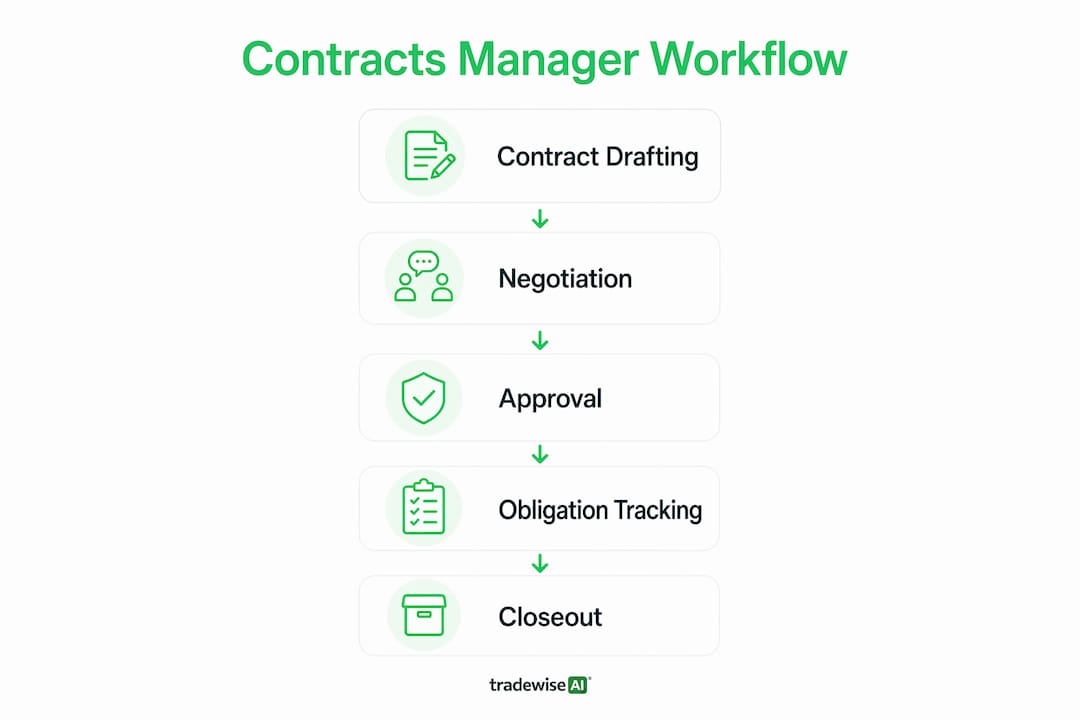
The tools most commonly used by contracts managers in UK construction fall into three categories:
| Category | Examples | Primary benefit |
|---|---|---|
| CLM platforms | Ironclad, Agiloft, ContractWorks | Centralised storage, automated workflows, obligation tracking |
| Project management integration | Procore, Asite | Links contract milestones to programme and cost data |
| Document management | SharePoint, Viewpoint | Version control and audit trail for contract documents |
Automated approval workflows within CLM platforms are particularly valuable. Effective contracts managers target turnaround times under 24 hours for standard agreements, and manual email-based approvals make that target almost impossible to hit consistently. Platforms like Ironclad and Agiloft allow contracts managers to set up pre-approved templates, route documents to the correct approvers automatically, and track where each agreement sits in the process at any moment.
Obligation tracking is the feature that delivers the most day-to-day value on construction projects. When a contracts manager is responsible for dozens of subcontractor agreements simultaneously, a spreadsheet-based register is a liability. Automated reminders for notice periods, payment milestones, and performance review dates reduce the risk of missed obligations that would otherwise result in contractual claims or lost entitlements.
Pro Tip: Before investing in a CLM platform, audit your current contract register. If you cannot answer within 60 seconds how many contracts are due for renewal in the next 90 days, your existing system is already costing you money.
How does the contracts manager role intersect with other functions on a UK construction project?
The contracts manager does not operate in isolation. The role sits at the centre of a web of functions, and its effectiveness depends entirely on how well it connects with each of them. Understanding types of construction contracts is only the starting point. Applying them across a live project requires constant coordination.
The key functional relationships include:
- Project managers and site teams: The contracts manager translates contractual obligations into practical instructions for site. This includes communicating programme obligations, notice requirements, and variation procedures so that site managers do not inadvertently waive contractual entitlements through inaction.
- Procurement and supply chain: Subcontractor and supplier agreements must align with the main contract terms. A contracts manager working closely with subcontractor management ensures that back-to-back provisions are correctly applied and that payment terms flow down appropriately.
- Legal counsel: Contracts managers are operational leaders, not legal drafters. When a clause requires original legal language or the project faces a formal dispute, the contracts manager briefs and works alongside legal counsel rather than attempting to draft independently.
- Finance and commercial teams: Contract payment milestones, retention release dates, and variation valuations feed directly into cash flow forecasting. The contracts manager is the primary source of contractual data for the commercial team's monthly reporting.
- Health, safety, and compliance: Many contractual obligations in UK construction relate directly to CDM 2015 requirements, insurance provisions, and statutory compliance. The contracts manager monitors these obligations alongside the health and safety team.
The role of a contracts manager in UK construction is, at its core, a coordination function. Its commercial value is multiplied when it operates as a genuine link between disciplines rather than as a standalone administrative function.
What are the biggest challenges contracts managers face in UK construction?
The workload alone is formidable. A single contracts manager handling 200 to 600 contracts annually is a realistic expectation in a mid-sized construction business, and each of those agreements carries its own set of obligations, deadlines, and risks. This is the reality that separates contracts management as a discipline from contracts management as a job title.
The most common challenges, and the practical responses to each, are:
- Volume and complexity: Use a centralised contract register from day one of each project. Categorise contracts by risk level and prioritise review time accordingly. High-value or bespoke agreements warrant detailed scrutiny; standard subcontract orders can be processed against pre-approved templates.
- Tight negotiation deadlines: Develop a playbook of pre-approved fallback positions for common negotiation points. Knowing in advance which clauses are non-negotiable and which have approved alternatives removes the need to escalate every point to legal, which compresses turnaround times significantly.
- Overstepping into legal drafting: Contracts managers should use approved templates and avoid drafting original legal clauses. This is not a limitation; it is a discipline that prevents bottlenecks and protects the business from poorly worded provisions that create unintended liability.
- Maintaining visibility across multiple projects: A contracts manager working across several concurrent projects needs a system, not a memory. Milestone tracking within a CLM platform or a well-maintained register is the only reliable way to avoid missed obligations.
- Stakeholder resistance: Site teams and project managers sometimes view contractual processes as bureaucratic obstacles. The contracts manager's job is to demonstrate that compliance with contractual procedures protects the project team as much as the business. Framing notice requirements as tools for recovering legitimate entitlements, rather than as administrative burdens, changes the conversation.
Pro Tip: Standardise your contract templates for the most common agreement types you use, whether that is domestic subcontracts, supply-only orders, or professional appointments. Every hour spent on template development saves three hours of negotiation on every subsequent deal.
Key takeaways
Effective contracts management in UK construction requires disciplined lifecycle ownership, proactive risk identification, and close coordination across project, commercial, and legal functions.
| Point | Details |
|---|---|
| Revenue protection | Poor contract management costs businesses an average of 9% of annual revenue through leakage and errors. |
| Workload scale | A single contracts manager may handle 200 to 600 contracts per year, making centralised registers non-negotiable. |
| Commercial focus | Contracts managers prioritise deal viability and operational delivery, not legal liability. |
| Technology adoption | CLM platforms like Ironclad and Agiloft reduce cycle times and automate obligation tracking across live projects. |
| Cross-functional role | The contracts manager connects project, procurement, legal, and finance teams to protect contractual entitlements throughout delivery. |
Why the contracts manager role is more strategic than most people realise
I have worked with construction businesses where the contracts manager was treated as a senior administrator, someone who filed agreements and chased signatures. That framing is not just inaccurate. It is commercially dangerous.
The contracts managers who genuinely protect project margins are the ones who sit in pre-tender meetings, challenge scope definitions before a price is agreed, and refuse to let a subcontract order go out the door without back-to-back provisions properly applied. They are the ones who know that a missed notice under an NEC contract can forfeit a legitimate extension of time claim worth more than the contracts manager's annual salary.
What I find most underappreciated is the translation function. The most commercially effective practitioners I have seen do not just manage documents. They convert contractual obligations into language that a site manager or a quantity surveyor can act on without needing a law degree. That skill, the ability to make a contract legible to the people who have to live by it, is what separates a contracts manager who adds value from one who simply processes paperwork.
Technology is changing the role faster than most practitioners realise. CLM platforms are removing the administrative burden of tracking and chasing, which means the contracts managers who thrive in the next five years will be the ones who use that freed-up time for commercial analysis and stakeholder engagement rather than spreadsheet maintenance. The role is becoming more strategic, not less. The professionals who recognise that shift early will define what contracts management looks like in UK construction for the next decade.
— Mateusz
How Tradewisehq helps construction teams manage contracts and compliance
Managing contracts across multiple live projects is one of the most operationally demanding tasks in UK construction. Tradewisehq is an AI-powered platform built specifically for tradespeople and contractors, designed to bring job management, scheduling, compliance tracking, and client communication into a single mobile-first system. For construction businesses looking to reduce the administrative burden on their contracts function, Tradewisehq automates approval workflows, centralises job and contract data, and keeps the whole team aligned in real time. If your current process relies on spreadsheets and email chains, explore Tradewisehq to see how the platform supports faster, more accurate contract and project management at every stage of delivery.
FAQ
What does a contracts manager do in UK construction?
A contracts manager in UK construction manages the full lifecycle of project contracts, from drafting and negotiation through to performance monitoring, variation control, and close-out. The role protects the business commercially by tracking obligations, managing risk, and coordinating with project, legal, and procurement teams.
What qualifications does a contracts manager need in the UK?
Most contracts managers hold a degree in quantity surveying, construction management, or law, supported by professional membership of bodies such as RICS, CIOB, or CIPS. World Commerce and Contracting (formerly IACCM) certification is increasingly recognised as a specialist qualification for the role.
What is the contracts manager salary in the UK?
Contracts manager salaries in UK construction typically range from £45,000 to £75,000 depending on experience, employer size, and project complexity, with senior roles in major contractors or infrastructure programmes often exceeding £80,000.
How many contracts does a contracts manager handle at once?
A contracts manager in a mid-sized business can be responsible for between 200 and 600 contracts per year. Centralised contract registers and CLM software are the standard tools for managing this volume without missing critical obligations or deadlines.
How does a contracts manager differ from a project manager in construction?
A project manager focuses on programme, resources, and delivery. A contracts manager focuses on the contractual framework that governs how that delivery is measured, paid for, and protected. The two roles work closely together, but the contracts manager's primary accountability is commercial and contractual compliance rather than operational execution.