

Workforce scheduling in construction is the strategic process of assigning the right workers to the right tasks at the right times to maintain project flow, control costs, and meet legal obligations. Known formally as construction labour resource planning, it combines structured scheduling frameworks with site-level flexibility to keep projects on programme. The two most widely used methods are the Critical Path Method (CPM) and the Last Planner System (LPS). Get this wrong and the consequences are severe. Poor scheduling can be the difference between a 12% and a 3% project margin, with idle equipment alone costing up to $2,000 per day. That figure should focus the mind of every UK construction manager.
What are the main workforce scheduling methods used in UK construction?
Construction workforce scheduling sits on two primary frameworks: CPM and LPS. Understanding how each works, and when to use them together, is the foundation of effective labour coordination.
1. Critical Path Method (CPM)
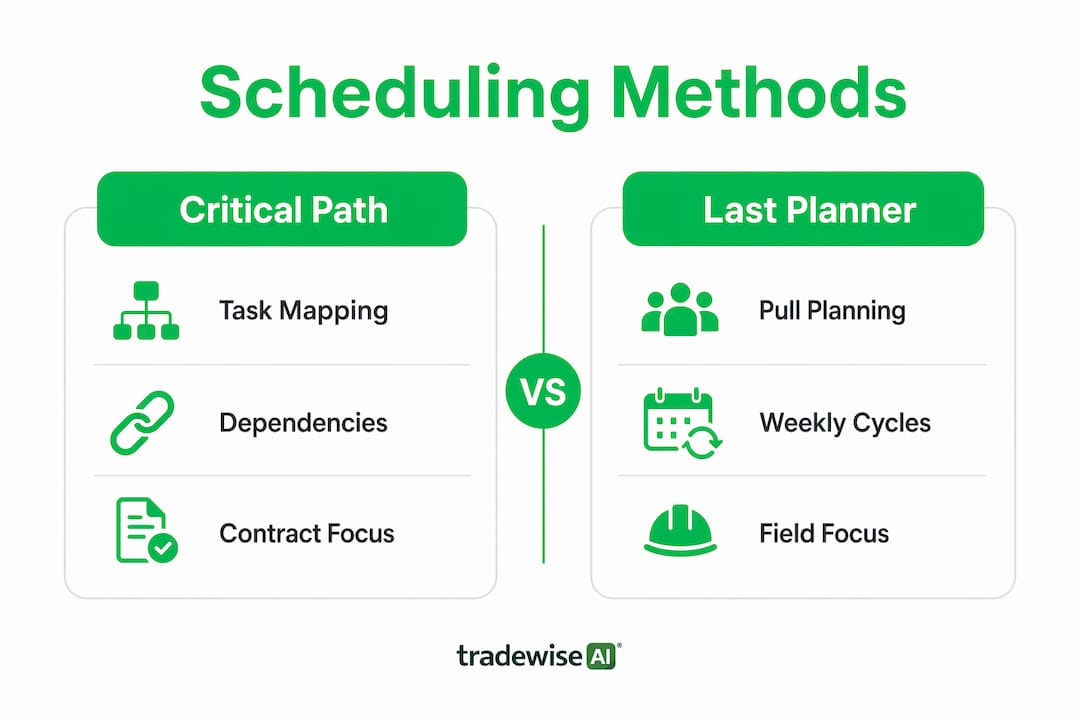
CPM maps every task in a project, identifies dependencies between them, and calculates the longest sequence of dependent activities. That sequence is the critical path. Any delay to a task on the critical path delays the entire project. Tasks off the critical path carry "float," meaning they can slip slightly without affecting the end date. CPM is the contract-level framework most UK main contractors use to produce their master programme and report progress to clients.

2. Last Planner System (LPS)
LPS is a field-level planning method built around pull planning and weekly work cycles. Rather than a top-down schedule handed to trades, LPS asks foremen and subcontractors to commit only to work they can genuinely complete that week. The key metric is Percent Plan Complete (PPC). A PPC below 80% signals that weekly commitments are being made without fully removing the constraints causing delays. That is a reliable early warning sign of schedule slippage.
3. Using CPM and LPS together
Mid-sized commercial projects benefit most from combining both methods. CPM is updated monthly to maintain the contract forecast, while LPS drives daily and weekly decisions through its rolling planning cycle. Pull planning addresses trade coordination risks by engaging crews in constraint identification and realistic commitment-making, which CPM's top-down approach cannot achieve alone. For smaller domestic projects, CPM alone is usually sufficient. For large infrastructure or phased commercial builds, both methods working in tandem produce the most reliable outcomes.
Pro Tip: Run a pull planning session with all trade foremen at the start of each four-week lookahead. Ask them to identify constraints before committing to tasks, not after. This single habit raises PPC scores faster than any software change.
How does UK working time legislation affect construction scheduling?
UK Working Time Regulations 1998 set a hard ceiling of 48 hours average weekly working time, calculated over a 17-week reference period. For construction managers, this is not a background compliance detail. It is a live scheduling constraint that shapes how you build your weekly programmes.
The key obligations for scheduling purposes are:
- 48-hour average: Workers cannot exceed 48 hours per week on average over 17 weeks unless they have signed a valid written opt-out.
- Opt-out management: Opt-outs must be voluntary and documented. Overreliance on opt-outs is a genuine risk. Scheduling must actively manage actual hours, not assume opt-outs cover all overruns.
- Rest entitlements: Workers are entitled to 11 consecutive hours of rest per day and at least 24 hours off per week. Night shift patterns and early starts must account for these minimums.
- Record-keeping: Employers must maintain records of hours worked. Accurate timesheet data for field crews is not optional. It is your compliance evidence.
- Fatigue risks: Sustained long hours increase accident rates on site. The Health and Safety Executive (HSE) treats fatigue as a foreseeable risk, meaning inadequate scheduling can become a health and safety liability.
The practical scheduling response is to build your weekly programme around realistic hour budgets per trade, not maximum theoretical capacity. If a crew is already at 44 hours by Thursday, scheduling a full Friday shift creates a compliance and safety problem, not just an overtime cost.
Pro Tip: Use a rolling 17-week hours tracker for each worker, not just weekly totals. This gives you early visibility of workers approaching the 48-hour average before they breach it, rather than discovering the problem in a payroll audit.
What strategies help manage weather and trade coordination challenges?
Weather and trade sequencing are the two most disruptive variables in UK construction scheduling. Both are manageable with the right tactics built into your programme from the outset.
Managing weather disruption
Pre-defining rain-day rules and scheduling contingency indoor tasks reduces lost productivity significantly. The standard approach is a go or no-go decision made by 5 AM each morning, based on forecast conditions, with makeup days already identified in the programme. Weather buffers built into schedules via makeup days prevent overtime spiralling when disruption occurs. Two common work pattern options are the 4x10 model (four ten-hour days with Friday as a makeup day) and the 5x8 model with a designated recovery day later in the programme. The 4x10 pattern works well in summer months when daylight allows longer days. The 5x8 pattern suits winter schedules where daylight is the limiting factor.
Coordinating multiple trades
Zone-based scheduling is the most effective method for managing trade conflicts on busy sites. Divide the site into zones and assign each trade a zone for a defined period before rotating. This reduces crowding, prevents trades from blocking each other's access, and makes it far easier to track progress by area. Combine zone scheduling with a three-week lookahead programme, updated weekly, so every trade foreman knows what is coming and can flag constraints before they become delays.
Automated scheduling tools now manage multiple variables including trade roles, union rules, and weather contingencies to build optimised schedules quickly. AI-based platforms can redistribute labour for overtime cost control, reassign tasks instantly after delays, and maintain compliance with working time rules. For managers running more than two or three active trades simultaneously, digital tools are no longer a luxury. They are the only practical way to maintain schedule accuracy. The role of AI tools for builders in 2026 extends well beyond simple Gantt charts into real-time labour reallocation.
How do managers integrate scheduling with resource allocation?
Linking your scheduling logic to your resource allocation is where construction workforce management moves from planning to execution. The two must work together, not in separate silos.
Critical path analysis reveals the tasks with zero float that directly affect project duration. Resource allocation must prioritise crew readiness for these tasks above all others. Non-critical tasks with float allow labour smoothing, meaning you can shift workers between tasks to balance demand without affecting the end date. This is called resource smoothing, and it is one of the most underused tools in UK construction scheduling.
The table below compares the two primary resource management techniques:
| Technique | How it works | Best used when |
|---|---|---|
| Resource smoothing | Adjusts task timing within available float to level labour demand | Labour supply is constrained but the end date is fixed |
| Resource levelling | Extends the programme to eliminate resource peaks | Labour supply is the binding constraint and the end date has flexibility |
For repetitive work such as fit-out across multiple floors or housing units, BIM combined with Line of Balance offers a flow-based approach that coordinates crews across space and time simultaneously. Case studies show workforce plans involving 10 to 72 workers coordinated effectively using BIM-LOB frameworks, detecting spatiotemporal overlaps before they occur on site. The Line of Balance technique reduces start-stop cycles, stabilises crews, and boosts productivity in repetitive construction sequences.
The critical discipline is translating your office schedule into crew-ready packages. Every task handed to a foreman must have its constraints explicitly checked and removed beforehand. Materials confirmed. Access cleared. Preceding trades complete. Effective scheduling translates CPM task logic into crew-ready packages with explicit constraint removal before weekly commitments, avoiding the unrealistic promises that drive low PPC scores.
Pro Tip: Run a weekly coordination meeting with all trade foremen every Monday morning. Limit it to 20 minutes. The agenda is simple: what was completed last week, what is planned this week, and what constraints need removing before Friday. This single meeting catches more problems than any software dashboard.
Key takeaways
Effective construction workforce scheduling requires combining CPM for contract-level control with LPS for field-level execution, while actively managing legal hour limits, weather contingencies, and trade sequencing to protect both project margins and worker welfare.
| Point | Details |
|---|---|
| Use CPM and LPS together | CPM sets the contract framework; LPS drives weekly field commitments and raises PPC scores. |
| Manage hours proactively | Track rolling 17-week averages per worker to stay within Working Time Regulations 1998 limits. |
| Build weather buffers in | Pre-define go or no-go rules and schedule makeup days to prevent overtime spiralling after disruption. |
| Prioritise critical path tasks | Allocate crew readiness to zero-float tasks first; use float on non-critical tasks for resource smoothing. |
| Translate schedules into crew packages | Remove all constraints before handing tasks to foremen to avoid unrealistic commitments and low PPC. |
Why most scheduling problems start in the planning room, not on site
I have seen a pattern repeat itself across dozens of construction projects. The site team gets blamed for delays, but the root cause is almost always a schedule that was never realistic in the first place. CPM programmes built in isolation, without trade input, routinely underestimate constraint removal time. The result is a programme that looks credible on paper and falls apart in week three.
The fix is not better software. It is earlier and more honest conversation with subcontractors. Subcontractor management in UK construction is often treated as a procurement function rather than a scheduling function. That is a mistake. The trades who will actually execute the work know where the constraints are. Involving them in pull planning sessions before the programme is finalised produces commitments that hold, rather than commitments that look good in a tender submission.
On working time compliance, the industry still treats the 48-hour opt-out as a scheduling tool rather than an emergency provision. I understand the commercial pressure. But a fatigued workforce is a slower and more dangerous workforce. The projects I have seen run most efficiently are the ones where the scheduler treats legal hour limits as a design constraint, not an afterthought. When you build the programme around realistic capacity, you stop burning through your float in the first month.
The other underrated discipline is weather contingency. UK construction managers know the weather is unpredictable, yet most programmes treat every day as a full working day. Pre-defining your rain-day protocol and your makeup day schedule takes less than an hour. It saves weeks of reactive firefighting.
— Mateusz
How Tradewisehq helps you schedule smarter

Tradewisehq is an AI-powered platform built specifically for trade businesses and construction teams. It automates the complex variables in workforce scheduling including trade roles, working time compliance, weather contingencies, and real-time labour reallocation, so you spend less time rebuilding your programme after every disruption. Managers using Tradewisehq report fewer scheduling errors, better margin control, and faster response to site changes. If you are ready to move beyond spreadsheets and disconnected Gantt charts, Tradewisehq's trade management platform gives you live workforce syncing, automated scheduling, and compliance monitoring in one mobile-first tool. It is the practical next step for any UK construction manager serious about project efficiency.
FAQ
What is workforce scheduling in construction?
Workforce scheduling in construction is the process of assigning workers to specific tasks at defined times to maintain project flow and meet programme deadlines. It combines scheduling frameworks like CPM and LPS with resource allocation to manage labour efficiently across a project.
How does the Last Planner System differ from CPM?
CPM is a top-down contract-level framework that maps task dependencies and calculates the critical path. LPS is a field-level method where trade foremen commit only to work they can genuinely complete that week, with PPC used to track execution quality.
What are the working time rules for construction workers in the UK?
The Working Time Regulations 1998 limit average weekly hours to 48 over a 17-week reference period. Workers must also receive 11 consecutive hours of daily rest. Opt-outs are permitted but must be voluntary, written, and actively managed rather than assumed.
How can construction managers reduce weather-related schedule delays?
Pre-define a go or no-go decision protocol by 5 AM each day and identify contingency indoor tasks in advance. Schedule makeup days within the programme so weather disruption is absorbed without triggering overtime or cascading trade delays.
What is resource smoothing in construction scheduling?
Resource smoothing adjusts the timing of non-critical tasks within their available float to level labour demand without extending the programme end date. It is the preferred technique when the completion date is fixed but labour supply is limited.