

Few roles in UK construction are as misunderstood as the main contractor. Clients assume the principal designer runs health and safety throughout the build. Site managers think the contractor just manages labour. Neither is correct. The role of a main contractor in UK construction is far more structured, legally grounded, and operationally significant than most people outside the industry realise. This article cuts through the confusion, covering what main contractors actually do, what CDM 2015 requires of them, how they interact with principal designers, and why getting this right determines whether a project succeeds or unravels.
Table of Contents
- Key takeaways
- The role of a main contractor in UK construction explained
- The construction phase plan: what it is and why it matters
- HSE notification: when it applies and who is responsible
- Principal contractor vs principal designer: getting the relationship right
- Benefits and challenges of appointing a main contractor
- My view: why this role deserves more serious attention
- Run your main contractor business with Tradewisehq
- FAQ
Key takeaways
| Point | Details |
|---|---|
| Single contracting point | Main contractors manage all subcontractors and interfaces, keeping escalation away from the client. |
| CPP ownership | The principal contractor is legally responsible for preparing and maintaining the Construction Phase Plan throughout the build. |
| HSE notification | Projects over 500 person-days or 30 working days with 20+ simultaneous workers must notify the HSE via the F10 form. |
| Distinct roles matter | Principal designers handle pre-construction risk; principal contractors own construction-phase safety management. |
| Competence is everything | Appointing a capable main contractor is the single biggest lever a client has over project outcome. |
The role of a main contractor in UK construction explained
The term "main contractor" is widely used across the industry, but the recognised regulatory term is principal contractor, defined under the Construction (Design and Management) Regulations 2015, commonly known as CDM 2015. Both phrases describe the same function: the organisation appointed by the client to take control of the construction phase of a project. Understanding this distinction matters because CDM 2015 sets out specific legal duties, not just general expectations.
So what does a main contractor do? At its core, the general contractor role involves three things: coordinating the overall project, managing health and safety on site, and acting as the single contracting point between the client and all specialist subcontractors. A main contractor on a commercial fit-out, for example, will appoint electricians, plumbers, and joiners separately, manage their programmes, resolve clashes between trades, and take responsibility for the outcome as a whole.
Main contractor duties under UK construction contracts go well beyond physical supervision. They include:
- Planning and managing the construction phase so work proceeds safely and without unnecessary risk
- Ensuring all workers have site inductions and appropriate training before starting work
- Liaising with the principal designer over design information and pre-construction hazard data
- Controlling site access and maintaining a robust site rules document
- Appointing subcontractors through contracts that clearly pass down relevant health and safety obligations
Under the dutyholder framework, clients must appoint competent teams, and the main contractor must demonstrate compliance throughout the build. This is not a box-ticking exercise. It is a documented, ongoing obligation.
Pro Tip: When reviewing a potential main contractor's track record, ask specifically for examples of Construction Phase Plans they have prepared and maintained. A contractor who produces a generic template rather than a site-specific document is a red flag before you have even started.
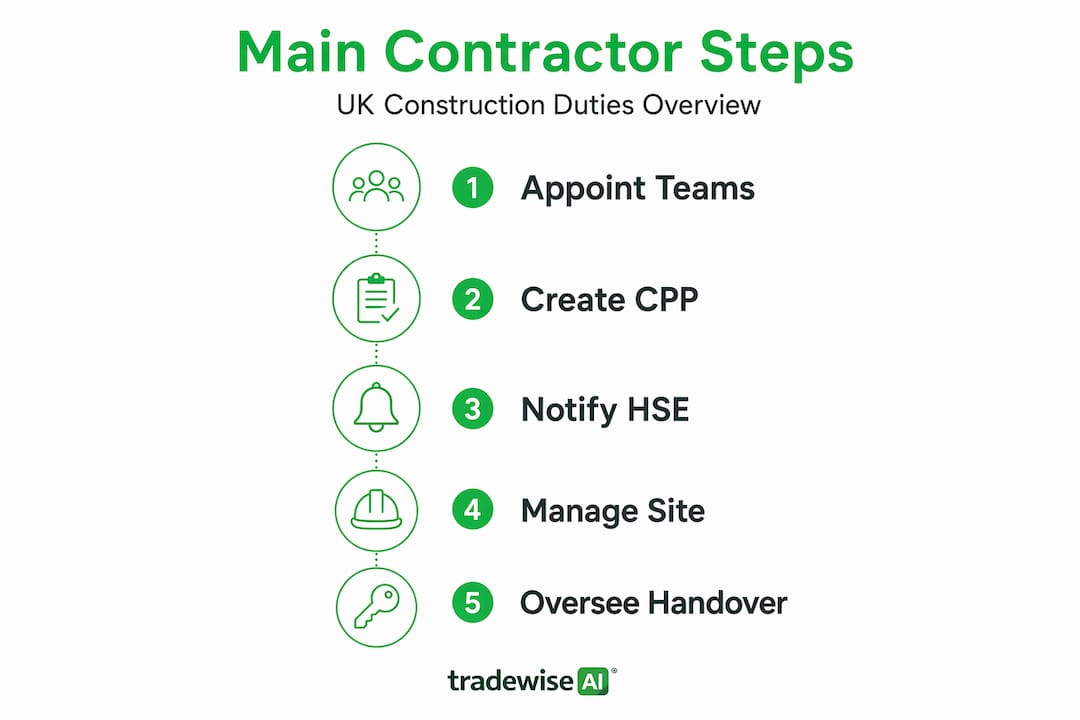
The single contracting point function is one of the most practical advantages the main contractor provides. Rather than a client managing ten separate trade contracts, the main contractor absorbs that complexity, consolidates risk management within the supply chain, and reports back through one professional relationship. For clients without in-house construction expertise, this is not a luxury. It is the difference between a manageable project and a chaotic one.
The construction phase plan: what it is and why it matters
The Construction Phase Plan, known as the CPP, is the cornerstone document of any notifiable UK construction project under CDM 2015. It is not a filing exercise. It is a live management tool that the principal contractor must prepare before construction starts and keep under active review throughout the build.

Think of the CPP as the site's operating manual. It sets out health and safety arrangements, day-to-day routines, how risks are identified and controlled, and how interface conflicts between trades are resolved. A well-written CPP reflects the actual site, the actual build sequence, and the actual risks. A poor one is twenty pages of standard clauses that could apply to any project anywhere.
The key elements a principal contractor must address in the CPP include:
- Site description and project-specific constraints (access, ground conditions, proximity to the public)
- Health and safety management structure, including responsibilities and escalation routes
- Arrangements for controlling significant site risks identified during design
- Procedures for managing simultaneous operations (SIMOPS), where different trades work in overlapping zones
- Inspection frequencies, audit schedules, and action close-out procedures
- Welfare arrangements, emergency procedures, and first aid provisions
- Communication pathways and version control for document updates
The quality of a CPP is judged not by length but by how well it drives practical coordination on site. Does it specify when a scaffold inspection must happen? Does it define who approves overlapping crane and groundworks operations? Does it set out reporting frequencies for near-miss incidents? If it does not, it is not fit for purpose.
The CPP is also not the same as a Risk Assessment and Method Statement (RAMS). RAMS are task-specific documents produced by subcontractors for individual operations. The CPP sits above these, providing the governance framework within which all RAMS operate. The principal designer provides pre-construction information to inform the CPP but does not write it. That responsibility sits squarely with the principal contractor.
Pro Tip: Treat the CPP as a live control system with formal review triggers. Any significant change to programme, scope, or risk profile should prompt an update. A CPP reviewed once at the start and never touched again is not a management tool. It is a liability.
HSE notification: when it applies and who is responsible
Not all construction projects require formal notification to the Health and Safety Executive. CDM 2015 sets clear thresholds, and understanding them is a core part of contractor project management on any medium to large UK build.
A project becomes notifiable when it meets either of the following criteria:
- The construction phase will last longer than 30 working days and will have more than 20 workers working simultaneously at any point
- The construction phase will involve more than 500 person-days of construction work in total
The notification is submitted via the F10 form and must be submitted before construction work begins. The principal contractor holds primary responsibility for this, though the client must confirm the notification has been made. Critically, the F10 is not a one-off submission. If project scope, duration, or workforce numbers change materially, the notification must be updated.
A common mistake in practice is calculating person-days based only on peak headcount. The correct approach is to model person-days across the full planned programme. Ten workers on site for 50 days equals 500 person-days, triggering notification even if the peak workforce never exceeds ten at any one time. Many contractors have submitted late notifications precisely because they only checked the simultaneous worker count and missed the cumulative threshold.
The completed F10 notice must be displayed visibly on site throughout the construction phase. Keeping it current and accessible is a straightforward duty, but one that is regularly overlooked during busy project delivery.
Principal contractor vs principal designer: getting the relationship right
This is where confusion causes the most damage. Clients, and sometimes contractors themselves, conflate the role of the principal contractor with that of the principal designer. These are separate appointments with distinct responsibilities that must work in parallel, not in competition.
| Aspect | Principal designer | Principal contractor |
|---|---|---|
| Phase of responsibility | Pre-construction design phase | Construction phase |
| CPP responsibility | Provides pre-construction info; does not write CPP | Prepares and owns the CPP throughout the build |
| Health and safety focus | Design risk identification and coordination | On-site risk management and worker safety |
| Regulatory trigger | Appointed before detailed design begins | Appointed before construction starts |
| Ongoing duty | Can carry duties into construction if still involved | Holds all construction phase safety obligations |
The handover between these two roles is one of the most critical moments on any project. The principal designer passes pre-construction information, including design hazard registers and residual risks, to the principal contractor. From that point, the principal contractor owns the safety management of the construction phase entirely.
Problems arise when this handover is poorly documented, when the principal designer's hazard information is incomplete, or when the main contractor assumes the designer has already resolved risks that have simply been passed down. Clear handovers and documented responsibilities are what separate projects that run safely from those that encounter avoidable incidents. Both parties need to know exactly where their duties start and end.
Benefits and challenges of appointing a main contractor
The practical case for appointing a main contractor on any project above a certain scale is strong. The advantages of managing subcontractor coordination through a single professional are real and measurable.
The main benefits include a single point of accountability, reduced complexity for the client, integrated risk management across the supply chain, and a clearer route to resolving disputes between trades. For projects involving multiple specialist subcontractors working in sequence or simultaneously, a competent main contractor is what keeps the programme intact.
The challenges are equally real, however. The client becomes highly dependent on the competence and integrity of one organisation. A contractor who underprices a job and then manages costs by cutting corners on health and safety, or one who fails to communicate effectively with the design team, can cause project delays, cost overruns, and regulatory failures that are difficult to unpick after the fact.
Contract clarity is the single most effective protection. UK construction contracts, whether based on JCT, NEC, or bespoke forms, should define the main contractor's scope precisely, specify CPP obligations, and set out clear mechanisms for reporting, change management, and dispute resolution. Ambiguity in contract language almost always resolves in favour of the contractor, not the client.
Pro Tip: Before appointing a main contractor, use live job tracking tools to benchmark your current project oversight. If you cannot track work in real time, you will not catch problems early enough to act on them.
My view: why this role deserves more serious attention
I have watched projects go wrong at the point where roles are assumed rather than agreed. The main contractor role in UK construction is legally defined, practically significant, and still widely misunderstood by the clients who appoint them and sometimes by the contractors who hold the title.
What I find most telling is how often a CPP is treated as an administrative requirement rather than a management tool. I have seen substantial commercial builds where the CPP was finalised on day one and never reviewed again, despite programme changes, scope additions, and significant subcontractor turnover on site. That is not compliance. That is theatre. A CPP should behave like a living document with version history, scheduled review dates, and direct ties to site routines.
My strongest advice to clients is this: do not treat your main contractor as a proxy for your own oversight. The dutyholder model under CDM 2015 places duties on clients directly. You are not absolved of responsibility by making an appointment. You are required to verify that appointment is working. Ask for CPP updates at every progress meeting. Understand what is on the F10 notification. Know who your principal designer is and when their involvement ended. That level of engagement does not make you a micromanager. It makes you a competent client under UK law.
The principal contractor and principal designer relationship is where I have seen the most preventable failures. Both parties assume the other has handled something. That assumption is how hazard information gets lost in transition. The solution is structured, documented handover with sign-off from both parties. It takes less than a day to set up properly. It can save a project from months of disruption.
— Mateusz
Run your main contractor business with Tradewisehq
Managing the volume of coordination, compliance, and communication that comes with the main contractor role is genuinely demanding. Tradewisehq is built specifically for trade and construction businesses who need more than a spreadsheet.

Tradewisehq brings together job management, subcontractor scheduling, workforce tracking, and client communication in one mobile-first platform. Whether you are managing CPP review cycles, coordinating multiple trade packages, or keeping clients informed at every stage, the platform removes the administrative friction that slows most site teams down. For contractors serious about scaling their operations and maintaining compliance without the paperwork overhead, Tradewisehq is the operating system your business needs. See how it works and take control of your next project from day one.
FAQ
What does a main contractor do in the UK?
A main contractor, formally known as the principal contractor under CDM 2015, manages the construction phase of a project. Their core duties include coordinating subcontractors, producing and maintaining the Construction Phase Plan, managing health and safety on site, and acting as the single contracting point between the client and the supply chain.
Who is responsible for the Construction Phase Plan?
The principal contractor is responsible for preparing the CPP before construction starts and keeping it under live review throughout the build. The principal designer provides pre-construction hazard information to inform the CPP but does not prepare it.
When does a UK construction project need to notify the HSE?
A project must notify the HSE via the F10 form when it will last more than 30 working days with 20 or more simultaneous workers, or when total construction work exceeds 500 person-days. The principal contractor holds primary responsibility for submitting and updating this notification.
What is the difference between a main contractor and a principal designer?
The principal designer coordinates health and safety during the design phase, while the principal contractor owns all safety management during the construction phase. These are separate appointments with separate duties, and the handover between them must be clearly documented.
What should clients check when appointing a main contractor?
Clients should verify the contractor's CDM 2015 competence, review examples of previous Construction Phase Plans they have produced, confirm their approach to subcontractor management, and check that the contract clearly defines scope, CPP obligations, and reporting requirements.