

Job costing is the process of assigning every cost and every pound of revenue to a single construction project so you can see exactly what it made or lost. Not what the company averaged. Not what the division returned. What that job actually did. Done properly, it covers direct labour, materials, plant and equipment, allocated overheads, and soft costs like permits and design fees. A Profitability Index (PI) above 1.0 signals a project is generating positive return on investment, making it a useful early filter when prioritising which jobs to pursue.
The benefits of tracking job profitability this way are concrete:
- You catch cost overruns while there is still time to act, not after the final invoice.
- Estimating improves because you are calibrating against real historical data, not gut feel.
- You can identify which project types, clients, or site managers consistently deliver margin and which consistently erode it.
- Change orders become a managed process rather than a source of quiet losses.
- Close-out decisions are driven by numbers, not optimism.
Why job costing is critical for UK construction businesses
Construction margins are thin. Net profit in well-run UK firms sits in a narrowband, meaning a single loss-making project can wipe out the gains from several successful ones. That is not a theoretical risk. It is the lived reality for builders who manage profitability at the company level rather than the job level.
External pressures make this worse. Material prices have been volatile since 2021, subcontractor rates have risen sharply in many trades, and planning delays add overhead without adding revenue. Any of these can turn a 6% margin job into a loss before the final fix is complete.
The discipline that protects against this is continuous job-level tracking, from the moment a bid goes in through to final account. UK firms that treat job costing as a one-off calculation at project end are essentially flying blind for the duration. The firms that protect margin are the ones watching cost-to-complete figures weekly, not quarterly.
Key reasons UK construction businesses must prioritise job costing:
- Thin margins leave almost no buffer for untracked cost growth.
- Material price volatility can shift job economics mid-project.
- Labour shortages push up subcontractor rates after contracts are signed.
- Scope changes without formal change orders erode bid-day margin silently.
- HMRC and Companies House reporting requirements make accurate job-level records a compliance necessity, not just a management preference.
- Lenders and bonding companies increasingly require project-level financial data.
What cost components does a construction job actually include?
Getting the cost breakdown right is where most margin erosion starts. Builders who track labour and materials but miss overheads and soft costs are systematically underpricing their work. Soft costs and overhead allocation are essential to ensure the markup on bids truly covers business costs.

Direct labour covers your own operatives and any subcontractors whose time is charged to the job. This includes not just wages but National Insurance contributions, holiday pay, and any site-specific allowances. Tracking labour accurately means capturing actual hours against each cost code, not just total payroll.
Materials should be recorded at delivered cost, including waste allowance. A 10–15% waste factor on certain trades is standard, and ignoring it means your material budget is wrong before work starts.
Plant and equipment costs need to be allocated whether the kit is owned or hired. For owned plant, a day-rate based on depreciation and maintenance is the standard approach. Hired plant is simpler: the invoice is the cost.
Overheads are the share of indirect business costs allocated to the job. Office rent, management salaries, insurance, vehicles, and software all need to recover through project margins. A common method is to express overheads as a percentage of direct costs and apply that rate to every job.
Soft costs include design fees, structural engineering, planning applications, building control fees, and any surveys. These are real costs that affect job profitability and must be assigned to the project that incurred them.
Cost components at a glance:
- Direct labour (wages, NI, subcontractors)
- Materials (delivered cost plus waste allowance)
- Plant and equipment (hired or owned day-rate)
- Allocated overheads (indirect business costs)
- Soft costs (design, permits, surveys, engineering)
How to calculate job profitability: a step-by-step example
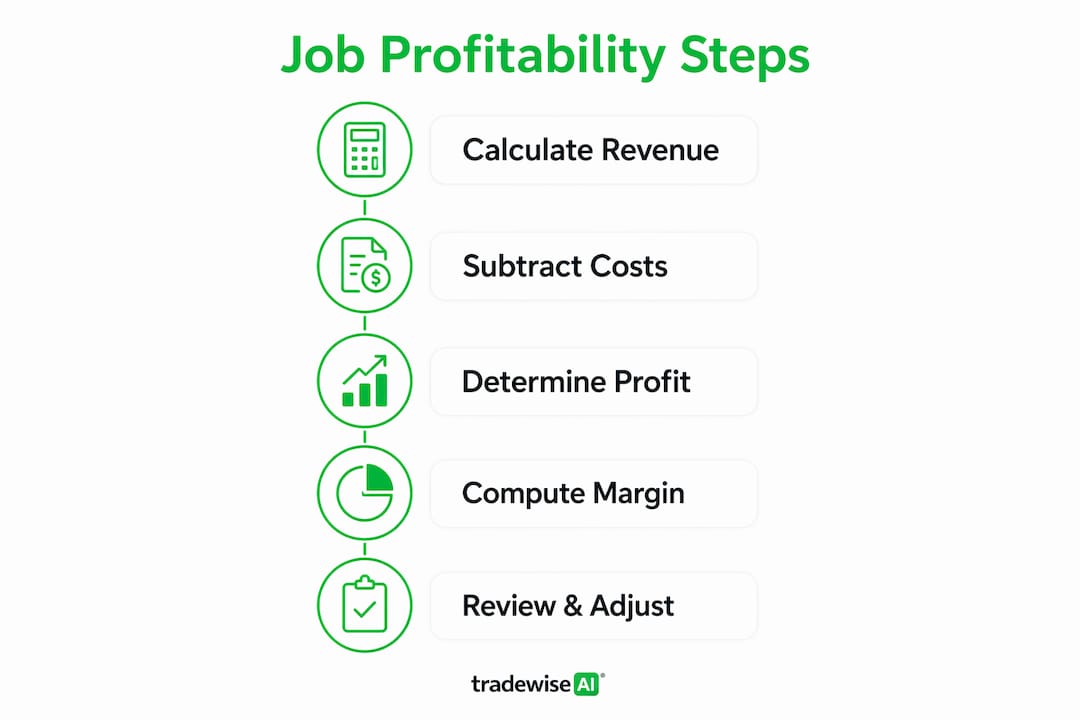
The core formula is straightforward:
Job Revenue – (Direct Costs + Allocated Overheads) = Gross Profit
Gross margin percentage is then: (Gross Profit ÷ Job Revenue) × 100
Here is a worked example for a UK residential extension:
| Item | Amount |
|---|---|
| Contract value (revenue) | a substantial amount typical for residential extensions |
| Direct labour | a significant portion of the budget including wages and related costs |
| Materials | costs including delivered price and waste allowance |
| Plant and equipment | costs for hired or owned equipment allocated as per standard methods |
| Subcontractors | expenses for subcontracted trades required for the project |
| Soft costs (planning, surveys) | typical fees incurred for design and approvals |
| Total direct costs | the sum of all direct expenses as above |
| Allocated overheads expressed as a percentage of total direct costs, applied to each job | |
| Total costs | £77,280 |
| Gross profit | £17,720 |
| Gross margin | 18.7% |
That 18.7% looks healthy at first glance. But if the project runs four weeks over programme, overhead keeps accruing against a job that has stopped generating revenue. Extended project duration may erode margins further due to ongoing overhead accumulation
Steps to perform this calculation on a live project:
- Set up a cost code structure before work starts, covering each cost category above.
- Record actual costs against each code as invoices and timesheets arrive.
- At each reporting period, calculate actual costs to date by code.
- Run a cost-to-complete estimate: how much will each remaining scope item cost to finish?
- Add actual costs to date plus cost-to-complete to get projected final cost.
- Subtract projected final cost from contract value to get projected final margin.
- Compare projected final margin to bid-day margin. The gap is called fade. Any positive fade figure means the job is trending below estimate and needs attention.
Pro Tip: Set your cost-to-complete estimates based on actual productivity rates observed on the job, not the rates you used at bid stage. If your bricklayers are laying 15% fewer courses per day than planned, your remaining brickwork budget needs to reflect that reality, not the original assumption.
How to build an effective job costing process
A job costing process only works if it runs continuously, not as a month-end exercise. Profitability management is an ongoing cycle of monitoring, reporting, and adjustment, not a one-time calculation.

The process has five stages:
Pre-planning and estimation. Before a bid goes out, build the cost breakdown from historical job data. Use actual unit rates from completed projects, not published price books, which often lag market rates by 12–18 months in a volatile period.
Budget allocation. Once the contract is won, convert the estimate into a live budget with cost codes. Lock in subcontractor and supplier prices at buyout so your cost-to-complete starts from real numbers.
Ongoing monitoring. Assign clear ownership. The project manager is responsible for cost performance on site. The commercial manager or quantity surveyor owns the cost report. Finance processes the invoices and timesheets. Without defined ownership, costs slip through unrecorded.
Variance analysis. Run a cost variance report at least fortnightly. Flag any code where actual spend exceeds budget by more than a defined threshold, say 5%, and investigate immediately. Small variances caught early are manageable. The same variance discovered at practical completion is not.
Forecasting and close-out. Update the projected final margin every reporting period. At close-out, pursue outstanding change orders, clear the punch list promptly, and release retainage as fast as the contract allows. Overhead continues to accrue until the project is formally closed.
Best practices for building this process:
- Use a consistent cost code structure across all projects so data is comparable.
- Capture timesheets daily, not weekly. Weekly timesheets introduce errors and delays.
- Reconcile purchase orders against invoices before approving payment.
- Hold a brief weekly cost review meeting with the site manager and commercial lead.
- Archive completed job cost reports as a reference library for future estimating.
For firms managing multiple concurrent projects, tracking across projects requires a platform that consolidates data rather than relying on separate spreadsheets per job.
UK best practices for tracking building job profitability in 2026
The firms consistently delivering profitable projects share a few habits that go beyond basic job costing. These are the practices worth adopting if you want to move from reactive to genuinely proactive margin management.
Use historical job data as your primary estimating reference. Published price books are a starting point, not a source of truth. Your own completed projects, with their actual labour productivity rates and material waste factors, are far more accurate for your workforce, your region, and your typical project type.
Recover overheads comprehensively. Many UK builders undercharge overheads because they calculate the rate on direct labour alone rather than total direct costs. If your overhead rate is 15% of direct labour but your materials spend is twice your labour spend, you are recovering far less overhead than the business actually incurs. Accounting for soft costs alongside hard costs ensures bids reflect the true cost of business.
Implement cost-to-complete forecasting from week one. Do not wait until a job is 70% complete to discover the margin has faded. A forward-looking projection updated every two weeks gives you time to intervene: accelerate a trade, renegotiate a subcontract, or have a commercial conversation with the client before the situation becomes a dispute.
Use AI-powered platforms for real-time insight. Tradewisehq integrates job management, invoicing, timesheets, and materials tracking in a single mobile-first platform, giving site managers and commercial teams a shared view of costs without manual reconciliation. That real-time visibility is what turns a weekly cost report from a historical document into a management tool.
Manage close-out aggressively. Delays in finalising change orders or completing punch list work reduce margins, because overhead keeps accruing against a project that has effectively stopped generating revenue. Treat close-out as a commercial priority, not an administrative afterthought.
Advanced tactics for 2026:
- Set a minimum acceptable margin threshold per project type and use it as a bid-no-bid filter.
- Track fade by project manager to identify training or process gaps.
- Review your overhead recovery rate quarterly as business costs change.
- Use AI pattern recognition to flag cost codes that consistently overrun across projects.
- Build a contingency reserve into every budget, sized to the risk profile of the job.
Pro Tip: Treat job costing as a continuous loop, not a project-end report. The firms that protect margin are the ones reviewing cost-to-complete every fortnight, adjusting forecasts, and acting on variances before they compound. A single review at practical completion tells you what happened. Fortnightly reviews let you change what happens.
How to handle change orders and their impact on job profitability
Change orders are one of the most consequential variables in construction profitability. Managed well, they can actually improve a job's margin, because change order pricing often carries a higher markup than the original bid. Managed poorly, they become uncompensated scope that quietly destroys the margin you estimated on day one.
The core discipline is simple: nothing gets built outside the original scope without a signed variation order and an agreed price. In practice, site pressure and client relationships make this harder to enforce. A client asks for a small change, the site manager agrees verbally to keep things moving, and the cost never gets captured. Multiply that across a 40-week project and the cumulative effect is significant.
A practical change order process has three steps. First, identify the scope change as soon as it is requested. Second, price it using your actual cost rates plus the same overhead and profit margin as the original contract. Third, get written approval before the work starts. Xero's job costing guidance for UK construction firms reinforces that continuous tracking through every stage, including change events, is what separates firms that protect margin from those that erode it.
For construction contract management, having a clear variation clause in your contract is the foundation. Without it, recovering the cost of legitimate changes becomes a negotiation rather than a contractual right.
How to analyse and interpret job profitability reports
A job profitability report is only useful if you know what to look for. The raw numbers matter less than the patterns they reveal.
The most important metric on any active project is projected final margin: the estimated margin at completion, calculated by combining actual costs to date with the cost-to-complete. This tells you where the job is actually headed, not where it started. Gross margin percentage, cost variance by code, and fade (the gap between bid-day margin and projected final margin) round out the core set.
When reading a cost report, look first at the codes with the largest absolute variance, not the largest percentage variance. A 20% overrun on a £500 cost code is noise. A 5% overrun on a £40,000 labour package is a problem worth investigating immediately. Then look at the trajectory: is the variance growing each period or stabilising? A growing variance on a code that is only 30% complete is a serious signal.
Company-wide averages hide the distribution. If your business averaged a healthy gross margin last year, that figure could be masking a cluster of projects that came in well below target while a few strong jobs pulled the average up. Project-level reporting, reviewed regularly, is what surfaces those patterns.
Using job profitability data to improve bidding and project management
Historical job cost data is the most underused asset in most construction businesses. Every completed project is a calibration exercise for the next estimate, but only if you capture and review the data systematically.
Start with a post-project review for every job above a threshold value. Compare bid-day unit rates against actual rates for labour, materials, and plant. Where did you over-estimate? Where did you under-estimate? Which subcontract packages came in on budget and which ran over? Over time, these reviews build a reference library that makes your estimating progressively more accurate.
The same data improves bid selection. If your records show that a particular project type, say design-and-build residential work for private clients, consistently delivers above-target margins while commercial fit-out for main contractors consistently fades, that is a strategic signal. You can bid the former more competitively and price the latter to reflect the actual risk, or decline it altogether.
For project management, profitability data identifies which site managers and project teams consistently deliver margin and which consistently fade. That is not a blame exercise. It is a training and process conversation. If one team consistently overruns on labour while another consistently hits budget, the difference is usually a specific practice: daily timesheet capture, weekly cost reviews, or proactive subcontractor management. Spreading those practices across the business is how you lift average performance.
Tradewisehq's platform supports this by linking job management software with real-time cost data, so the insight from one project feeds directly into the next estimate without a manual data transfer exercise.
Try Tradewisehq for real-time job profitability tracking

Tradewisehq is built for exactly this: giving builders and contractors a single platform to manage jobs, track costs, capture timesheets, and see project profitability in real time. No spreadsheet reconciliation. No end-of-month surprises. Just a clear view of where every job stands, updated as work happens.
If you are ready to move from reactive cost management to proactive margin protection, explore Tradewisehq and see how it fits your business.
Key takeaways
Accurate job costing, applied continuously from bid day through close-out, is the single most reliable way to protect and improve construction project profitability.
| Point | Details |
|---|---|
| Job costing covers all cost types | Labour, materials, plant, overheads, and soft costs must all be assigned to each job to get an accurate margin figure. |
| Projected final margin is the key metric | Track the estimated margin at completion every fortnight, not just at project end, to catch fade early. |
| Change orders need written approval | Unmanaged scope changes are the most common source of uncompensated work and margin erosion. |
| Historical data sharpens future bids | Post-project cost reviews build a reference library that makes estimating progressively more accurate over time. |
| Close-out is a profitability decision | Delays in finalising change orders and punch list work reduce margin because overhead keeps accruing without corresponding revenue. |