

A works order in construction is an official document that authorises specific tasks within a project, setting out the scope of work, responsible parties, timelines, and cost estimates. Think of it as the bridge between a client's request and a contractor's spade in the ground. Without one, you have verbal agreements, shifting expectations, and no paper trail when things go wrong.
What does a works order mean in construction?
A works order is more than a task list. It is a formal authorisation that converts a high-level instruction into a defined, trackable piece of work. Every party on site knows exactly what is expected, who approved it, and when it must be finished.
The construction work order definition used across UK projects typically includes:
- Requestor — who raised the need for the work
- Scope of work — a clear description of tasks to be carried out
- Location — the specific site or area where work takes place
- Timelines — start date, expected completion date, and any milestones
- Responsible parties — the contractor, subcontractor, or operative assigned
- Cost estimates — labour, materials, and any associated fees
- Approval authority — the person who signed off the order
- Priority level — how urgently the work must be completed
A works order is not the same as a work request, which is simply a proposal awaiting approval. Nor is it a purchase order, which itemises materials to be bought rather than tasks to be performed. Confusing the three is a common source of disputes on UK sites.
Pro Tip: Number every works order sequentially and store copies in a shared digital folder accessible to your site manager and contracts administrator. Disputes over scope are far easier to resolve when both parties can pull up the same signed document within seconds.

Why works orders matter on UK construction projects
Works orders transform maintenance requests into clear, accountable instructions with defined success criteria. On a busy UK construction project, that clarity prevents the kind of scope creep that quietly inflates costs and delays handover.
The practical benefits are concrete:
- Communication — everyone from the quantity surveyor to the groundworker reads from the same document
- Scheduling — works orders feed directly into your workforce scheduling, so labour and plant arrive when needed
- Resource allocation — costs and materials are committed before work starts, not after
- Audit trails — documentation supports accountability and simplifies post-project reviews
- Quality assurance — completion criteria are written in before a single task begins
The AIA A221 framework demonstrates how works orders operate within master agreements, allowing multiple scopes of work to be issued rapidly without renegotiating contract terms each time. UK builders working under JCT or NEC contracts follow the same logic.
How to create and issue a works order
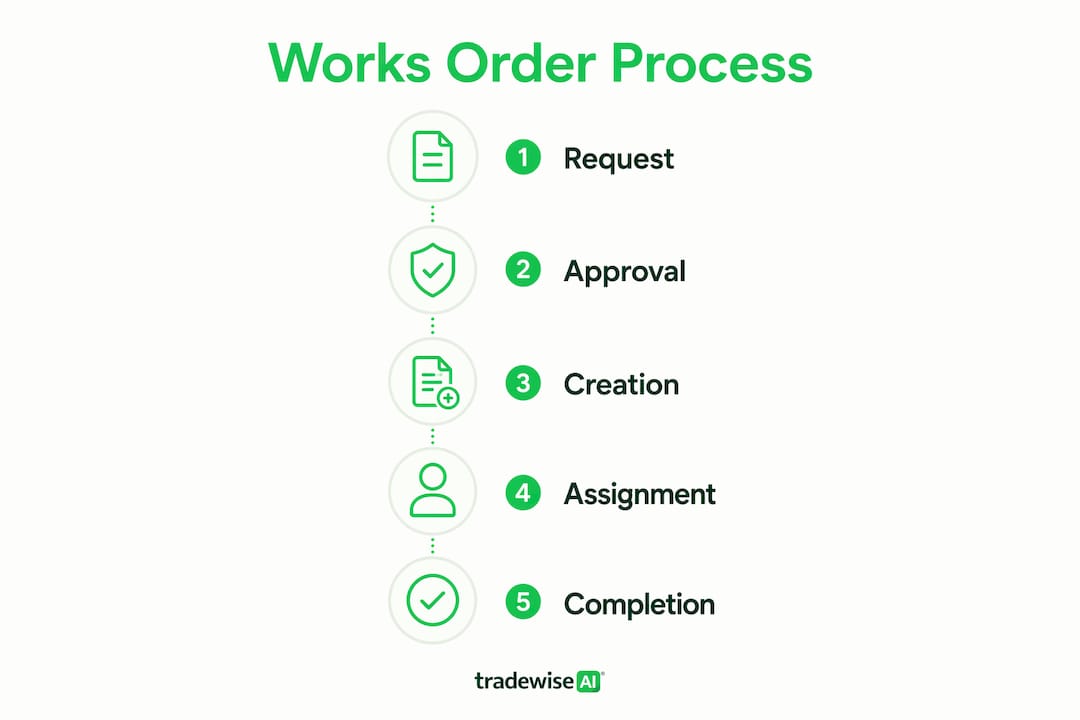
The works order process follows five clear steps: submission of the request, approval and creation, assignment and scheduling, execution and monitoring, and finally completion with record-keeping. Each step produces a document or sign-off, so the trail never breaks.
Common challenges include incomplete scope descriptions, missing approval signatures, and no system for tracking status once work is underway. Digital platforms address all three. Tradewisehq, for example, lets builders issue, assign, and monitor works orders from a mobile device, with live syncing across the whole team. For a broader look at works order management software, several platforms now offer construction-specific workflows worth comparing.

Tradewisehq brings works order management into the same platform you use for quotes, invoices, and scheduling. Explore Tradewisehq to see how it fits your operation.
Key takeaways
A works order is the single most important document for maintaining accountability and clarity on a UK construction project.
| Point | Details |
|---|---|
| Core definition | A works order authorises specific tasks, setting out scope, timelines, costs, and responsible parties. |
| Not a purchase order | Works orders define tasks to be performed; purchase orders cover materials to be bought. |
| Five-step process | Every works order moves through submission, approval, assignment, execution, and completion. |
| Audit trail value | Documentation of approval authority and completion dates supports accountability and dispute resolution. |
| Digital management | Platforms like Tradewisehq sync works orders across teams in real time, reducing errors and delays. |