

A works programme is a time-based construction plan that sequences every task, assigns durations, maps dependencies, and allocates resources across a project's full lifecycle. In UK construction, it serves as the primary coordination roadmap for contractors, project managers, and subcontractors alike. The industry term most commonly used alongside this is "construction programme," and both phrases describe the same document. Understanding what a works programme is, and how to use one properly, separates projects that finish on time from those that spiral into costly overruns.
What is a works programme and what does it include?
A works programme is defined as a time-based construction plan detailing task sequences, resources, and durations, serving as the primary project coordination roadmap. It is not a wish list or a rough timeline. It is a structured document that every member of the project team relies on to understand what happens, when, and in what order.
The core components of a works programme are:
- Task list: Every activity on site, from groundworks to snagging, with defined start and finish dates.
- Sequence and dependencies: The logical order in which tasks must occur, including which activities cannot start until others are complete.
- Project milestones: Key dates such as practical completion, handover, or regulatory inspections.
- Resource allocation: Labour gangs, plant, materials, and subcontractor packages assigned to each activity.
- Critical path: The longest sequence of dependent tasks that determines the earliest possible completion date.
- Float: The amount of time an activity can be delayed without affecting the overall programme end date.
- Baseline programme: The agreed original plan against which progress is measured.
- Calendar considerations: Working days, bank holidays, and seasonal restrictions built into the schedule.
Float management and critical path identification are key to understanding where delays impact the completion date and where scheduling flexibility exists. Terminal float, in particular, is a significant concept in UK contract management because its ownership directly affects Extension of Time claims under standard forms such as JCT and NEC.
| Component | Purpose |
|---|---|
| Critical path | Identifies the sequence of tasks that controls project completion |
| Float | Shows scheduling flexibility and absorbs minor delays |
| Milestones | Marks contractual and commercial key dates |
| Baseline programme | Provides the benchmark for progress measurement |
| Resource allocation | Confirms labour, plant, and materials are available when needed |

Pro Tip: Always build your baseline programme before site mobilisation. Agreeing it with the client and key subcontractors at the outset gives you a defensible reference point for any future Extension of Time claim.
How does a works programme differ from a schedule of works?
The distinction between a programme and a schedule of works is one of the most misunderstood areas in UK construction planning. Getting it wrong causes real misalignment between site teams and senior management.
A works programme versus a schedule of works breaks down as follows: the programme is a strategic timeline that may span multiple workstreams and shows the sequence and timing of all activities. A schedule of works details the operational execution within a specific package or trade, often listing items of work without time-based sequencing.
| Document | Scope | Primary audience | Time-based? |
|---|---|---|---|
| Works programme | Whole project, all workstreams | Project manager, client, contractor | Yes |
| Schedule of works | Specific package or trade | Subcontractor, quantity surveyor | Not always |
| Project plan | Overall project governance | Senior management, client | Partially |
The confusion between these documents creates disconnects between strategic and operational planning. A contracts manager presenting a schedule of works when a client expects a full programme will face immediate credibility issues. Use the correct term and the correct document for the correct audience.
- A works programme answers: When does each task happen, and in what order?
- A schedule of works answers: What work is included in this package?
- A project plan answers: How is the project governed, resourced, and delivered overall?
Understanding these distinctions also matters commercially. During tendering, the programme underpins your cost build. During delivery, the schedule of works informs subcontractor procurement. They serve different purposes and should never be conflated.
How to prepare a works programme
Preparing a works programme requires foundational data: contract documents, scope of work, and realistic activity duration estimates with site-specific productivity rates. Guessing durations from memory is the single fastest way to produce a programme that bears no resemblance to site reality.
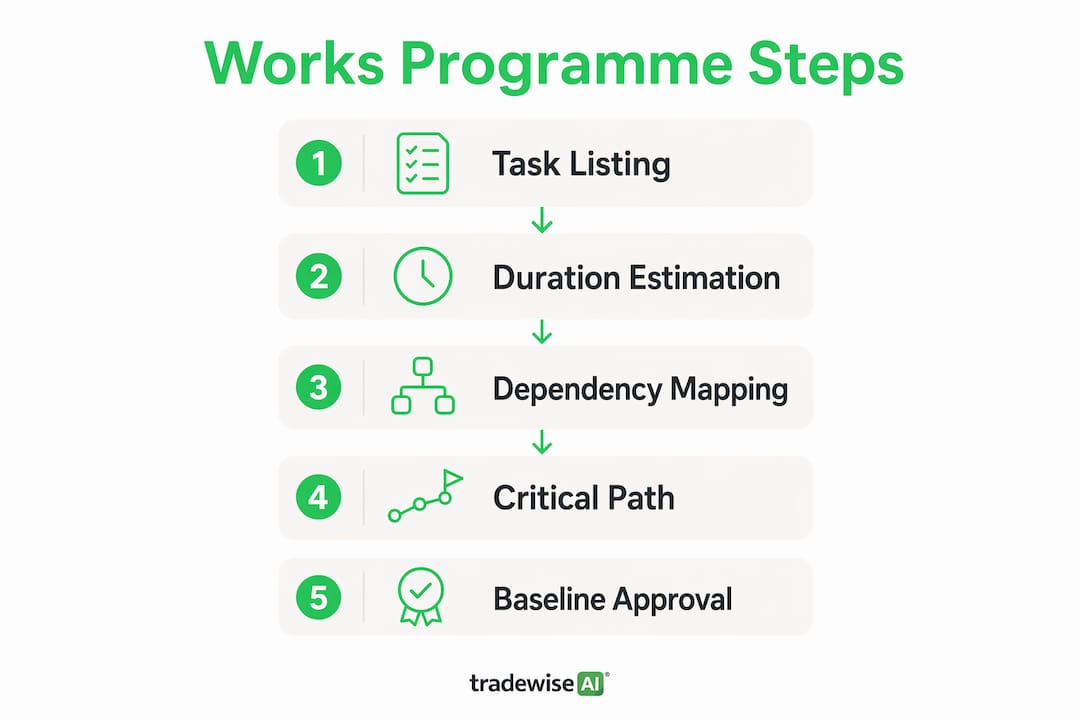
Follow this sequence when building a programme from scratch:
- Gather contract documents. Review the contract conditions, drawings, specifications, and Bills of Quantities. These define the scope and any contractual dates you must hit.
- Define the Work Breakdown Structure (WBS). Break the project into logical work packages before you sequence anything. A WBS prevents tasks from being missed.
- Estimate activity durations. Use productivity rates specific to your workforce and site conditions. A bricklaying gang on a tight urban site works differently from one on an open greenfield plot.
- Identify dependencies. Map which tasks are logically dependent and which are constrained by resources. Shared equipment creates effective dependencies that are just as real as logical ones.
- Apply resource constraints. Confirm that the labour, plant, and materials you need are actually available on the dates you have scheduled them.
- Set the project calendar. Input working days, bank holidays, and any site-specific restrictions such as noise curfews or access limitations.
- Run critical path analysis. Identify the critical path and calculate float for non-critical activities.
- Agree and baseline the programme. Get sign-off from the client and key subcontractors before work starts.
Pro Tip: Never copy a programme from a previous project and adjust the dates. Site conditions, subcontractor capacity, and supply chain lead times change constantly. Build each programme from the ground up using current data.
How a works programme functions as a live management tool
A works programme is not a document you produce, submit, and file. Treating the programme as a static report is a widespread misconception in UK construction. The programme should be a living document, proactively maintained to reveal constraints and navigate daily challenges such as adverse weather, material shortages, and subcontractor absences.
The practical management functions of a live programme include:
- Progress monitoring: Comparing actual progress against the baseline to identify slippage early.
- Early warning: Flagging delays before they become contractual issues, enabling resource reallocation or programme recovery.
- Float consumption tracking: Watching how float is being used on non-critical activities to prevent them from drifting onto the critical path.
- Subcontractor coordination: Giving trade contractors clear visibility of when their work starts and what must be complete before they arrive on site. Effective subcontractor coordination through the programme prevents the costly downtime that comes from trades arriving before their predecessors have finished.
- Decision support: Providing the project manager with data to make informed decisions about acceleration, resequencing, or scope changes.
"A programme updated only to show progress is a reporting tool. A programme used to drive procurement, manage float, and issue early warnings is a management tool. The difference between the two is the difference between reacting to problems and preventing them."
The domino effect of cascading delays is the most common cause of programme failure. One late delivery pushes a trade start, which pushes a follow-on trade, which pushes practical completion. Meeting programme deadlines is critical to maintaining cost projections and preventing this cascade. Timely reporting enables interventions such as resource reallocation or renegotiation before a delay escalates into a formal claim.
The programme's purpose changes with project phase. At tender stage, it validates your cost build and demonstrates competence to the client. During delivery, it becomes a dynamic tool for managing float consumption and reflecting site conditions. Understanding this shift is what separates a competent programme manager from one who simply produces Gantt charts. Effective workforce scheduling in construction depends entirely on a programme that is kept current and shared with the whole team.
Key takeaways
A works programme is the single most important planning document in UK construction, combining task sequencing, resource allocation, and critical path analysis to control project delivery from start to finish.
| Point | Details |
|---|---|
| Core definition | A works programme sequences tasks, durations, dependencies, and resources into a time-based project plan. |
| Critical path and float | Identifying the critical path and managing float determines where delays affect completion and where flexibility exists. |
| Programme vs schedule of works | A programme covers the whole project timeline; a schedule of works details what is included in a specific package. |
| Preparation requires real data | Use site-specific productivity rates, current resource availability, and contract documents to build an accurate programme. |
| Live management tool | Update the programme regularly to track progress, manage float, and issue early warnings before delays escalate. |
The mistake I see on almost every site
The most damaging habit I encounter among UK project managers is producing a programme for the client and then never opening it again. The document gets submitted, approved, and forgotten. Six weeks later, the project is two weeks behind and nobody saw it coming because nobody was watching the programme.
The real value of a works programme is not in its creation. It is in its use. A programme that is updated weekly, shared with subcontractors, and used to drive procurement decisions will catch a delay when it is still a two-day slippage rather than a two-week crisis. I have seen projects recover from significant early setbacks purely because the programme manager was running the document as a live model rather than a historical record.
The other misconception worth challenging is that a more detailed programme is always a better programme. Excessive detail creates administrative burden without adding control. A programme with 2,000 activities that nobody maintains is far less useful than one with 200 activities that the whole team understands and updates. Calibrate the level of detail to what your team can realistically manage on site.
The 2026 construction environment, with its supply chain pressures and labour constraints, demands that project managers treat the programme as their primary management instrument. The teams that do this consistently finish projects closer to time and budget than those who treat it as a contractual formality.
— Mateusz
How Tradewisehq supports works programme management
Managing a live works programme across multiple trades, subcontractors, and job sites is genuinely difficult without the right tools. Tradewisehq is an AI-powered platform built for UK tradespeople and contractors, combining job management, scheduling, and team coordination in one mobile-first system.

Tradewisehq gives project managers real-time visibility of job progress, workforce availability, and task status, so the programme reflects what is actually happening on site rather than what was planned three weeks ago. Teams can update job stages, reassign resources, and flag delays from the field without waiting for an end-of-week report. For builders managing multiple subcontractors and tight programme deadlines, trade management software like Tradewisehq removes the administrative friction that causes programmes to fall out of sync with reality.
FAQ
What is the purpose of a works programme?
A works programme sequences every project task with durations, dependencies, and resources to coordinate delivery and track progress. It serves as the primary management tool for avoiding delays and controlling costs.
What is the difference between a works programme and a schedule of works?
A works programme is a time-based plan covering the whole project. A schedule of works lists the items of work within a specific package, often without time sequencing.
What does the critical path mean in a works programme?
The critical path is the longest sequence of dependent tasks that determines the earliest possible project completion date. Any delay to a critical path activity directly delays the project finish.
How often should a works programme be updated?
A works programme should be updated at least weekly during active construction. Regular updates allow the project manager to track float consumption, issue early warnings, and keep subcontractors aligned with current sequencing.
What information do you need to prepare a works programme?
You need contract documents, drawings, a scope of work, Bills of Quantities, realistic productivity rates, resource availability data, and the contractual start and completion dates.