

Daywork in construction is a method of valuing work based on the actual labour, plant, and materials consumed rather than pre-agreed unit rates or lump sums. Recognised under RICS standards and referenced in FIDIC contracts, daywork applies when the scope of work cannot be measured or valued by any other means. It is not a pricing preference. It is a last-resort valuation mechanism for instructed work where conventional measurement is impractical. Understanding how daywork functions protects your budget, prevents disputes, and keeps your site records legally sound.
What is daywork in construction and when does it apply?
Daywork is defined as payment for additional or varied construction work valued on the basis of actual resources used, including labour hours, plant time, and materials consumed. It differs fundamentally from measured work, where quantities are agreed in advance and priced against a bill of quantities. Daywork applies when scope definition is impossible before the work starts.
Typical scenarios include emergency repairs discovered mid-project, minor variations instructed verbally on site, and unforeseen ground conditions requiring immediate response. A contractor breaking out an unexpected concrete obstruction during excavation cannot price that work in advance. Daywork provides the mechanism to record and recover those costs fairly. The key word is "instructed." Daywork must be formally instructed by the contract administrator or engineer before work begins, not claimed retrospectively.

The distinction between daywork and a standard day rate matters enormously. A day rate is an informal arrangement, often used for casual labour. A daywork rate is a contractually agreed schedule of costs, pre-loaded with overheads and profit, forming part of the contract documents. Confusing the two leads to disputes and unrecoverable costs.
How is daywork recorded and validated on site?
Daywork sheets are the legal record of work performed under daywork instructions. Each sheet must capture the names and trades of operatives, hours worked, plant deployed, and materials used. Without this data, the sheet has no commercial validity under RICS valuation practice.
The single most important rule in daywork administration is timing. Contractors must submit daywork records within 7 days of the work being performed. That 7-day window is not a guideline. Delays beyond it are a leading cause of disputes in final account settlements. A sheet submitted three weeks after the event is almost impossible to verify and is routinely rejected.
Signatures are equally critical. The sheet must be signed by an authorised site supervisor or contract administrator at the time of, or immediately after, the work. Unsigned daywork sheets are frequently rejected in final account negotiations, leaving contractors with unrecoverable costs. Getting a signature on the day is not a bureaucratic formality. It is financial protection.
Common pitfalls in daywork recording include:
- Submitting sheets late, beyond the contractual 7-day window
- Failing to name individual operatives and their specific trades
- Recording plant as a generic category rather than specifying the equipment and hire rate
- Omitting material delivery notes or invoices as supporting evidence
- Allowing sheets to accumulate unsigned before seeking authorisation
Pro Tip: Assign one person on site, typically the site foreman or site manager, sole responsibility for completing and obtaining signatures on daywork sheets the same day work is performed. Treat each unsigned sheet as an unpaid invoice.
Good daily site reporting practices run parallel to daywork administration. A site diary that records labour deployment, plant on site, and instructions received provides corroborating evidence if a daywork sheet is later challenged.
What are the components and rates in daywork calculations?
Daywork rates are not the same as a worker's take-home wage. They are loaded rates that bundle together multiple cost elements into a single figure. Understanding what sits inside a daywork rate prevents underpricing and protects margin.
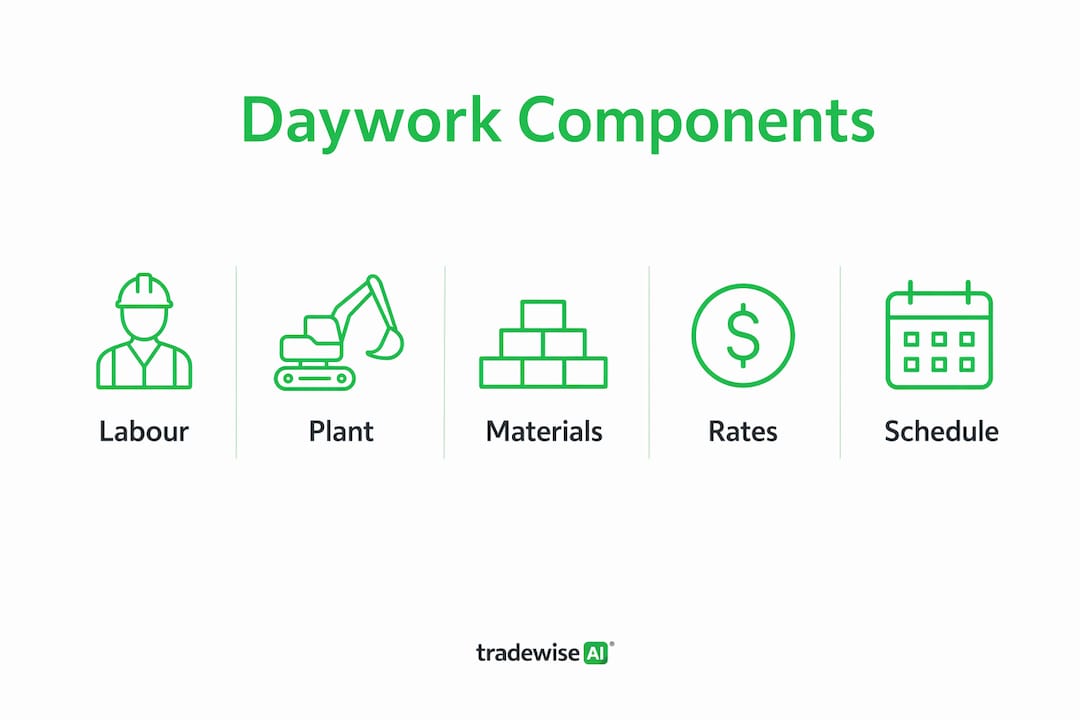
The three core components are labour, plant, and materials. Labour rates include the operative's basic wage, employer's National Insurance contributions, holiday pay, and a percentage addition for overheads and profit. Plant rates cover the hire cost of equipment, fuel, operator costs where applicable, and an overhead addition. Material costs carry a percentage markup, typically in the range of 10–30%, to cover procurement costs, handling, and profit.
These rates are set out in a daywork schedule, which forms part of the contract at tender stage. Both parties agree the schedule before work starts. This pre-agreement is what separates daywork from an open-ended cost-plus arrangement. The schedule is the commercial baseline.
| Cost component | What it includes | Typical basis |
|---|---|---|
| Labour | Wages, NI, holiday pay, overheads, profit | Hourly rate per trade |
| Plant | Hire rate, fuel, operator (if applicable) | Hourly or daily rate |
| Materials | Net cost plus agreed percentage uplift | Invoice cost plus 10–30% |
| Overheads and profit | Built into labour and plant rates | Percentage addition |
One nuance that catches contractors out: RICS guidance cautions explicitly against overlapping recovery methods. If a variation has already been valued through a measured rate or a lump sum instruction, the same resource cannot also be claimed through daywork. Double recovery is not just commercially wrong. It is a breach of contract transparency obligations.
Pro Tip: At tender stage, price your daywork schedule carefully. Underpriced daywork rates become a liability the moment unforeseen work is instructed. Treat the schedule as a mini contract within the contract.
When and why is daywork used in construction projects?
Daywork is a tool of last resort, not a preferred commercial arrangement. Contractors favour it because it transfers financial risk to the client by recovering actual costs. Clients accept it because some work genuinely cannot be priced any other way. The tension between these two positions defines how daywork is managed in practice.
The situations that legitimately justify daywork fall into three categories:
- Unforeseen physical conditions. Encountering unexpected services, contaminated ground, or buried structures during excavation. The contractor cannot price what they cannot see. Daywork provides a fair recovery mechanism.
- Minor variations with unclear scope. A contract administrator instructs a small change verbally on site. The scope is too minor or too urgent to go through a formal variation order process before work starts. Daywork captures the cost in real time.
- Emergency repairs. A structural failure or safety-critical defect requires immediate response. Stopping work to price the repair is not an option. Daywork allows work to proceed and costs to be recovered afterwards.
Daywork is not appropriate for large-scale variations where scope can be defined and measured. Using daywork for significant works that could be valued by measurement signals poor contract administration and invites scrutiny. Clients and quantity surveyors will challenge daywork claims that should have been priced as variations.
The risk of treating daywork as a profit opportunity is real. Without strict controls, it becomes a mechanism for recovering inefficiency rather than genuine additional cost. Effective workforce scheduling reduces the frequency of daywork situations by improving pre-planning and scope definition before work starts.
What are the best practices for managing daywork effectively?
Effective daywork management is a discipline, not an afterthought. The contractors who recover daywork costs consistently are those who treat record-keeping as a commercial priority from day one of a project.
The non-negotiable practices are:
- Submit daywork sheets within the contractual period, typically 7 days, without exception
- Obtain authorised signatures contemporaneously, not retrospectively
- Attach supporting evidence: timesheets, plant logs, and material delivery notes
- Cross-reference each sheet against the formal instruction that authorised the work
- Maintain a daywork register tracking all sheets issued, signed, and submitted
Job costing discipline extends directly into daywork management. Every daywork sheet is a cost event. Treat it with the same rigour as a subcontractor invoice or a materials order.
For project managers, the challenge is monitoring daywork exposure in real time. A project where daywork claims are accumulating rapidly is signalling a scope definition problem. That signal requires a commercial response, not just administrative processing.
Pro Tip: Set a monthly daywork expenditure threshold with your quantity surveyor. When cumulative daywork costs approach that threshold, trigger a formal review of whether remaining works can be re-scoped and valued by measurement instead.
Site managers carry significant responsibility in daywork administration. Their signature on a sheet is an authorisation of cost. Training site supervisors to understand what they are signing, and what it commits the client to, reduces disputes and improves the quality of records across the project.
How does daywork affect project budgets and final accounts?
Daywork is a reliable indicator of scope definition quality. A project with high daywork expenditure almost always reflects inadequate pre-contract design or poor variation management during construction. RICS guidance is explicit: daywork should not function as a profit centre. Its presence in volume signals a problem upstream.
At final account stage, daywork sheets face the most intense scrutiny of any cost category. Quantity surveyors assess each sheet against the agreed daywork schedule, verify signatures, and check supporting evidence. Daywork valuation involves cross-referencing verified records against agreed rates to certify substantiated costs. Sheets that fail this process are rejected, and the costs become unrecoverable for the contractor.
| Final account risk | Cause | Consequence |
|---|---|---|
| Sheet rejection | Missing or unauthorised signature | Unrecoverable cost for contractor |
| Rate dispute | Daywork schedule not agreed at tender | Prolonged negotiation, reduced payment |
| Duplication challenge | Overlap with measured variation | Cost deducted from final account |
| Expenditure cap breach | No not-to-exceed clause enforced | Client liability dispute |
Daywork contracts often include a maximum expenditure cap, sometimes called a not-to-exceed clause, to limit the client's financial exposure. A cap of £500,000 plus VAT, for example, gives both parties a ceiling for planning purposes. When daywork costs approach that cap, the contract administrator must instruct a formal review of remaining scope.
Well-managed daywork protects both parties. The contractor recovers genuine additional costs. The client receives transparent, auditable records that support fair payment. The quantity surveyor's role in this process is to act as the independent verifier, ensuring that what is claimed matches what was actually performed.
Key takeaways
Daywork in construction is a last-resort valuation method that requires contemporaneous records, authorised signatures, and pre-agreed rates to be commercially enforceable.
| Point | Details |
|---|---|
| Daywork definition | Payment based on actual labour, plant, and materials used for instructed work that cannot be measured in advance. |
| 7-day submission rule | Daywork sheets must be submitted within 7 days of work performed to remain valid for final account recovery. |
| Loaded rates, not wages | Daywork rates include wages, overheads, and profit; material costs carry a 10–30% uplift above net invoice cost. |
| Signatures are financial protection | Unsigned sheets are routinely rejected at final account; obtain authorisation on the day work is performed. |
| Daywork signals scope problems | High daywork expenditure indicates poor pre-contract scope definition and requires a commercial management response. |
Daywork in practice: what the paperwork never tells you
I have reviewed final accounts where daywork disputes consumed more time and legal cost than the original daywork value itself. That is not an unusual outcome. It is what happens when site teams treat daywork sheets as an administrative task rather than a commercial document.
The most consistent mistake I see is contractors who perform excellent work, record it accurately, and then fail to get a signature because the contract administrator was not on site that day. The work is real. The cost is real. But without that signature, the sheet is worthless in a final account negotiation. The lesson is not to chase signatures harder. It is to build signature collection into the daily site routine so it never becomes a chase at all.
Daywork also reveals something about a project's commercial health that no programme or budget report captures as clearly. When daywork claims start arriving in volume, the project has a scope problem. The right response is not to process the sheets faster. It is to stop, review what is driving the instructions, and ask whether the remaining work can be re-scoped and valued properly. Daywork managed well is a fair and transparent tool. Daywork used as a substitute for proper contract administration is expensive for everyone.
— Mateusz
Tradewisehq: built for the way construction sites actually work
Managing daywork records manually, chasing signatures, and reconciling sheets against schedules at month end is a process that breaks down under site pressure. Tradewisehq is an AI-powered trade management platform that helps construction professionals capture labour hours, plant usage, and material costs in real time from a mobile device on site.

With Tradewisehq, site teams can log daywork activity as it happens, attach supporting evidence, and flag records for supervisor sign-off before the end of the working day. That removes the 7-day submission risk entirely. Project managers get a live view of daywork expenditure against budget, so cost overruns are visible before they become final account disputes. If you want tighter control over daywork and job costs, Tradewisehq is built for exactly that.
FAQ
What is daywork in construction?
Daywork is a method of valuing construction work based on actual labour, plant, and materials used rather than pre-agreed unit rates. It applies when the scope of work cannot be measured or priced in advance.
How is daywork calculated?
Daywork is calculated using pre-agreed loaded rates for labour, plant hire rates, and material costs plus a percentage uplift, typically 10–30%, as set out in the contract's daywork schedule.
What is the difference between daywork and a day rate?
A daywork rate is a contractually agreed, overhead-loaded rate forming part of the contract documents. A day rate is an informal arrangement for casual labour and carries no contractual standing in a formal construction contract.
How long do contractors have to submit daywork sheets?
Contractors must submit daywork sheets within 7 days of the work being performed. Delays beyond this period are a leading cause of disputes and sheet rejection at final account stage.
Why are unsigned daywork sheets rejected?
Unsigned sheets lack contemporaneous authorisation from an approved supervisor, which means there is no independent verification that the work was performed as claimed. Without a valid signature, the sheet cannot be certified for payment.