

A site manager in UK construction is the person directly responsible for the day-to-day running of a building site, from the first spade in the ground to final handover. The role of site manager UK sits at the intersection of safety compliance, programme control, quality assurance, and workforce coordination. Site managers act as the critical link between the project management team and the on-site workforce, translating strategic project goals into daily operational reality. Understanding this role is fundamental for anyone working in or moving into site management roles UK.
What are the primary responsibilities of a site manager on a UK construction site?
Site managers coordinate the day-to-day running of UK construction sites, acting as the link between project management and the workforce, ensuring work is completed safely, on time, and to specification. The job description of a site manager is broader than most people outside construction realise. It covers operational planning, people management, documentation, and regulatory compliance simultaneously.
Day-to-day site coordination
The site manager controls the daily rhythm of the site. That means managing deliveries, sequencing trades, resolving clashes between subcontractors, and keeping the programme on track. A site manager on a large residential development might coordinate bricklayers, groundworkers, electricians, and plumbers all working within metres of each other on the same day.

Site manager duties UK also include maintaining site records and documentation throughout the build. Site diaries, inspection records, and correspondence are essential tools for tracking quality and variations. These records protect the contractor in disputes and provide evidence for any defects claims after handover.
Programme and quality management
Maintaining the construction programme is one of the most visible site manager responsibilities in the UK. A site manager tracks progress against the master programme, identifies delays early, and adjusts sequencing to recover lost time. Failing to manage the programme actively leads to costly overruns and subcontractor disputes.
Quality control is equally non-negotiable. Embedding quality inspections and maintaining detailed audit trails throughout the build helps site managers avoid last-minute snagging and supports dispute resolution later. A site manager who only checks quality at the end of a phase will always find problems that are expensive to fix.
Key site manager duties UK include:
- Managing subcontractor programmes and attendance on site
- Coordinating material deliveries to avoid storage conflicts and delays
- Conducting or overseeing quality inspections at each stage of the build
- Maintaining the site diary and all associated records
- Chairing progress meetings with subcontractors and reporting to the project manager
- Managing site security, welfare facilities, and housekeeping standards
Pro Tip: Keep your site diary entries factual and dated every single day. A well-maintained diary is your strongest defence if a subcontractor disputes progress or a client raises a defects claim months after handover.
How does a site manager ensure CDM 2015 compliance on site?
Under CDM 2015, the principal contractor holds overall responsibility for site safety management, but the site manager enforces the construction phase plan operationally, day to day. This distinction matters. The principal contractor sets the framework; the site manager makes it real on the ground.
Site managers are crucial in converting statutory health and safety obligations into actionable daily site processes, significantly influencing project safety culture and outcomes. A site manager who treats CDM as a paperwork exercise rather than a live management tool puts workers and the business at serious risk.
Managing the construction phase plan
The construction phase plan (CPP) is not a document you write once and file. A live construction phase plan is a control framework that site managers must update to reflect actual site conditions and sequencing changes. When a new trade arrives on site or work phases overlap, the CPP must be reviewed and updated promptly.
The practical steps a site manager takes to maintain CDM compliance include:
- Preparing or reviewing the construction phase plan before any work begins on site
- Conducting site inductions for every worker before they start, covering site rules, emergency procedures, and welfare arrangements
- Maintaining welfare facilities to the standard required under CDM 2015, including toilets, washing facilities, and rest areas
- Issuing and monitoring permits to work for high-risk activities such as hot works, confined space entry, and working at height
- Scheduling toolbox talks at phase changes or when new plant arrives on site
- Keeping all safety documentation current, including scaffold inspection records, LOLER certificates, and accident records
Site managers hold operational responsibility for safety documents including inductions, permits, scaffold and LOLER certificates, and accident records. HSE inspectors routinely check these records on site, and missing documentation can lead to improvement notices or prosecution.
Pro Tip: Treat the construction phase plan as a living document, not a filing exercise. Review it every time a new trade starts or a phase changes. A plan that reflects yesterday's site conditions is not managing today's risks.
The role of a site inspector in the UK overlaps with the site manager's quality and safety duties, but they are distinct positions. A site inspector typically focuses on checking compliance with drawings and specifications, whereas the site manager holds broader operational and managerial accountability for the whole site.
What qualifications and skills does a UK site manager need?
The job description of a site manager in UK construction consistently lists a combination of formal qualifications, practical experience, and leadership ability. Employers and principal contractors expect site managers to hold recognised credentials before taking charge of a site.
Core qualifications and skills include:
- SMSTS (Site Management Safety Training Scheme): The SMSTS certification is the most widely recognised qualification for UK site managers, covering legislation, risk management, CDM duties, and environmental management. It is valid for five years, with a two-day refresher required before expiry.
- CSCS Black Card (Site Manager): The Construction Skills Certification Scheme Black Card confirms a site manager's competence and is required on most UK sites managed by major contractors.
- HNC, HND, or degree in construction management: Most site managers hold a higher national certificate, higher national diploma, or a degree in construction management, civil engineering, or a related discipline.
- First aid at work certificate: A legal requirement for the person responsible for site welfare under CDM 2015.
- Strong communication and leadership skills: Site managers direct trades, resolve conflicts, and report upward to project managers. Technical knowledge alone is not enough.
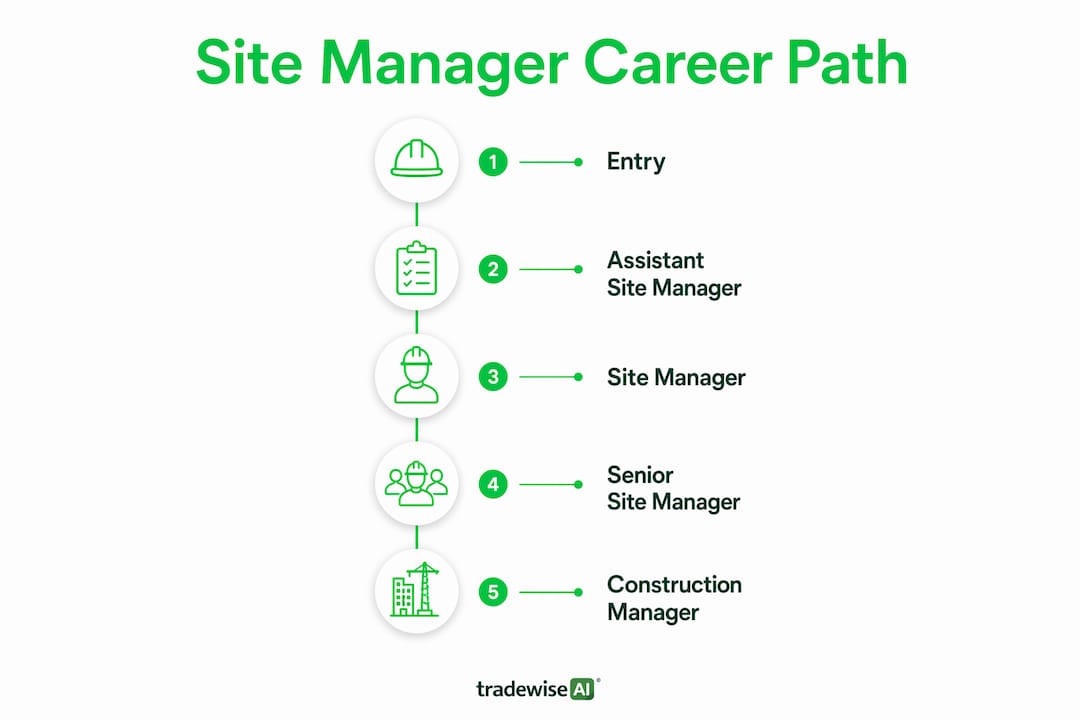
Career progression in site management roles UK typically follows a clear ladder. Most site managers begin as assistant site managers or site supervisors, gaining experience across different project types before taking full responsibility for a site. From there, progression moves to senior site manager, then project manager or contracts manager on larger programmes. Understanding the role of contracts manager UK helps site managers plan their next career step effectively.
How do site managers coordinate multiple subcontractors and manage trade interfaces?
Active management of trade interfaces is one of the most demanding parts of the site manager's role. Passive handover between trades causes accidents, delays, and quality failures. The site manager's job is to anticipate where trades will clash and resolve those clashes before they become incidents.
Continuous and active management of trade sequences is essential to meet CDM 2015's "plan, manage and monitor" duties effectively on site, beyond documentation compliance alone. Scheduling risk control checkpoints such as toolbox talks and permits aligned with phase changes or new plant arrivals addresses the highest-risk moments of interface overlap.
The table below shows how passive versus active interface management plays out in practice:
| Scenario | Passive approach | Active approach |
|---|---|---|
| Roofers and scaffolders on site simultaneously | Each trade works independently, risks unaddressed | Site manager holds joint toolbox talk, defines exclusion zones, issues permits |
| Electricians first fix while plasterers start | No coordination, trades clash over access | Site manager sequences work by zone, confirms programme with both trades |
| New groundwork subcontractor arrives mid-project | Existing site rules assumed to be known | Full site induction completed before work starts, CPP updated |
| Structural steel erection alongside groundworks | Overhead risk not communicated | Exclusion zone established, communicated in writing, and monitored daily |
The comparison above illustrates why subcontractor management is a skill in its own right. A site manager who coordinates workforce scheduling proactively keeps the programme moving and keeps workers safe.
Key takeaways
The site manager in UK construction is the operational backbone of every project, turning plans into safe, compliant, and quality-assured reality on the ground.
| Point | Details |
|---|---|
| Core operational role | Site managers coordinate trades, manage the programme, and maintain quality from groundworks to handover. |
| CDM 2015 compliance | Site managers enforce the construction phase plan daily, not just at project start, updating it as site conditions change. |
| Safety documentation | Induction records, permits, LOLER certificates, and accident records must be current; HSE inspectors check these on every visit. |
| Qualifications required | SMSTS and CSCS Black Card are the minimum expected credentials for a site manager on most UK projects. |
| Trade interface management | Active coordination of overlapping trades prevents accidents and programme delays; passive handover is a leading cause of both. |
The paperwork will not save you if you are not on the ground
The most common mistake I see from site managers who are new to the role is believing that having the right documents in place means the site is safe and well-run. It does not. A construction phase plan sitting in a folder on the site office desk is not managing risk. A site induction record signed by a worker who did not understand a word of it is not protecting anyone.
The site manager's real value is presence and judgement. You need to be walking the site, talking to the trades, spotting the hazard before it becomes an incident. The paperwork matters, and it will protect you legally, but it follows from good site management rather than replacing it. I have seen projects with immaculate documentation and a genuinely dangerous site culture, and I have seen the opposite.
For anyone considering how to become a site manager, my honest advice is to spend as much time as possible working alongside an experienced site manager before taking your own site. The SMSTS course gives you the framework. The site gives you the judgement. You need both before you are ready to run a project independently.
— Mateusz
How Tradewisehq supports site managers in UK construction
Running a site means tracking dozens of moving parts at once: trades, deliveries, inspections, documentation, and client communication. Tradewisehq is built for exactly that kind of operational complexity.

Tradewisehq gives site managers and contractors a single mobile-first platform to manage jobs, schedule trades, track materials, and keep documentation current in real time. The AI-powered tools handle scheduling conflicts, automate job updates, and keep the whole team aligned without the back-and-forth of phone calls and spreadsheets. For site managers who need to stay on top of daily site reporting and live job tracking, Tradewisehq removes the administrative burden so you can focus on the site itself. Find out more at Tradewisehq.
FAQ
What is the main role of a site manager in UK construction?
A site manager is responsible for the day-to-day running of a construction site, coordinating trades, maintaining the programme, enforcing safety compliance, and ensuring work meets the required quality standards.
What qualifications does a UK site manager need?
The SMSTS certificate and a CSCS Black Card are the most widely required qualifications. Most employers also expect an HNC, HND, or degree in construction management alongside relevant site experience.
What is the difference between a site manager and a site inspector in the UK?
A site manager holds overall operational responsibility for the site, including safety, programme, and team management. A site inspector focuses specifically on checking that work complies with drawings, specifications, and quality standards.
How does CDM 2015 affect the site manager's role?
CDM 2015 requires the site manager to enforce the construction phase plan operationally, conduct worker inductions, maintain welfare facilities, and keep all safety documentation current throughout the project.
How do you become a site manager in the UK?
Most site managers start as assistant site managers or site supervisors, gain experience across different project types, complete the SMSTS course, and obtain a CSCS Black Card before taking full responsibility for a site.