

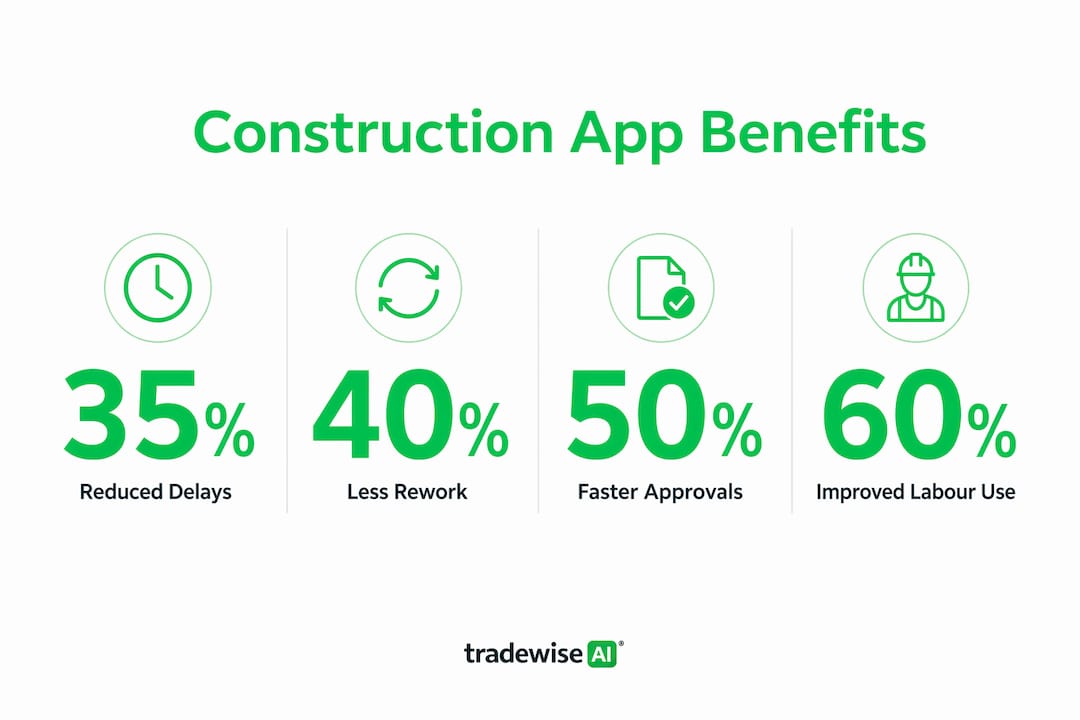
UK construction firms use mobile apps because they cut delays, reduce costly rework, and keep field and office teams working from the same live data. The core benefits driving adoption include improved efficiency through real-time task tracking, faster communication via instant messaging and annotated photos enabling site issues to be resolved in minutes, reduced rework by using current drawing versions, better labour utilisation from on-site time logging, standardised quality control with digital checklists and punch lists, enhanced safety reporting with immediate incident logging, and stronger client satisfaction through real-time progress updates.
Research published in the Journal of Building Construction and Planning Research confirms that large construction firms have directly increased productivity, quality, and owner satisfaction through mobile and web-based quality management software. Tradewisehq is one platform built specifically for UK trades professionals to deliver exactly these gains.
How apps drive efficiency on UK construction sites
Apps replace the fragmented cycle of phone calls, printed plans, and end-of-day data entry that slows most sites down. When a site manager can log progress photos, update a punch list, and approve a variation order from the same device on site, the office receives that information the moment it is created, not hours later.

Cloud-based construction platforms eliminate duplicate data entry and give every stakeholder immediate project status visibility. The practical result: fewer missed updates, fewer contradictory instructions, and far less time spent chasing confirmations by phone.
Key functional improvements apps deliver on UK sites:
- Real-time task assignment and progress tracking
- Blueprint and drawing management with version control
- Instant messaging and annotated photo sharing
- Automated daily reports and health and safety checklists
- Time and labour logging directly from the job site
- Offline data capture that syncs automatically once connectivity returns
Pro Tip: Require field staff to log hours, photos, and site conditions in real time rather than at the end of a shift. After-the-fact data entry raises the risk of inaccurate invoicing and lost billable hours, two problems that compound quickly across a busy project.
Mobile apps also resolve design misalignments within minutes rather than days by replacing phone tag with instant messaging and annotated images. That speed alone preserves project momentum at the moments it is most at risk.
Common challenges in adopting construction apps and how to fix them
Adoption rarely fails because the technology is wrong. It fails because the rollout is poorly managed.
The most common barriers UK firms encounter, and the practical responses:
- Licensing costs: start with a pilot on one project team before committing to a full licence; the productivity gains usually justify the spend within a single project cycle
- Staff resistance: involve site managers in tool selection early; people adopt software they helped choose
- Training gaps: short, role-specific sessions beat a single all-hands demonstration; a site operative needs different training from a project manager
- Integration with existing software: prioritise apps that connect to your current accounting or ERP system via open APIs to avoid creating a second data silo
- Data security concerns: verify that any app stores data on UK or EU servers and complies with UK GDPR before signing a contract
- Device fragmentation: choose cross-platform apps that run on both iOS and Android so no crew member is excluded
Software costs and licensing remain the most cited reason firms delay adoption, but the financial case strengthens considerably once rework and delay costs are factored in. Leadership endorsement matters too. When a director or contracts manager visibly uses the app, resistance from the wider team drops quickly.
The long-term ROI from construction app adoption
The upfront cost of a construction app is real. The return is larger and arrives faster than most firms expect.
Reduced rework, fewer delays, accurate labour utilisation, and standardised quality control are the four financial levers that consistently deliver ROI for firms that sustain app use beyond the initial rollout. Each one compounds: fewer errors mean less rework, which means fewer delays, which means tighter labour costs.
Client communication is an underappreciated part of the financial picture. Research from New Zealand construction professionals found that better client relationship management is the single strongest predictor of overall productivity and profit improvement among all the benefits mobile apps deliver. Repeat business and referrals follow firms that keep clients genuinely informed.
The cost savings from reduced paperwork and faster approvals are more immediate. Managers who can review invoices and approve requests from any location cut the administrative lag that stalls payments and delays procurement decisions.
Tradewisehq: a mobile-first platform built for UK trades
Tradewisehq is an AI-powered operating system designed specifically for UK tradespeople and contractors. It brings job management, staff scheduling, quoting, invoicing, materials handling, and client communication into a single mobile-first platform, so nothing falls through the gap between field and office.
Key platform capabilities:
- Live workforce syncing: see where every team member is and what they are working on, in real time
- AI-assisted job management: automate routine scheduling and follow-up tasks to reduce admin time
- Integrated quoting and invoicing: generate quotes on site and convert them to invoices without re-entering data
- Client communication tools: keep customers updated automatically at each project milestone
- Materials and navigation: manage supply lists and route planning from the same app
For UK builders and contractors exploring construction app advantages, Tradewisehq removes the need to stitch together separate tools for scheduling, billing, and communication. The compliance support and localised workflows make it a practical fit for firms operating under UK building regulations and CDM requirements.
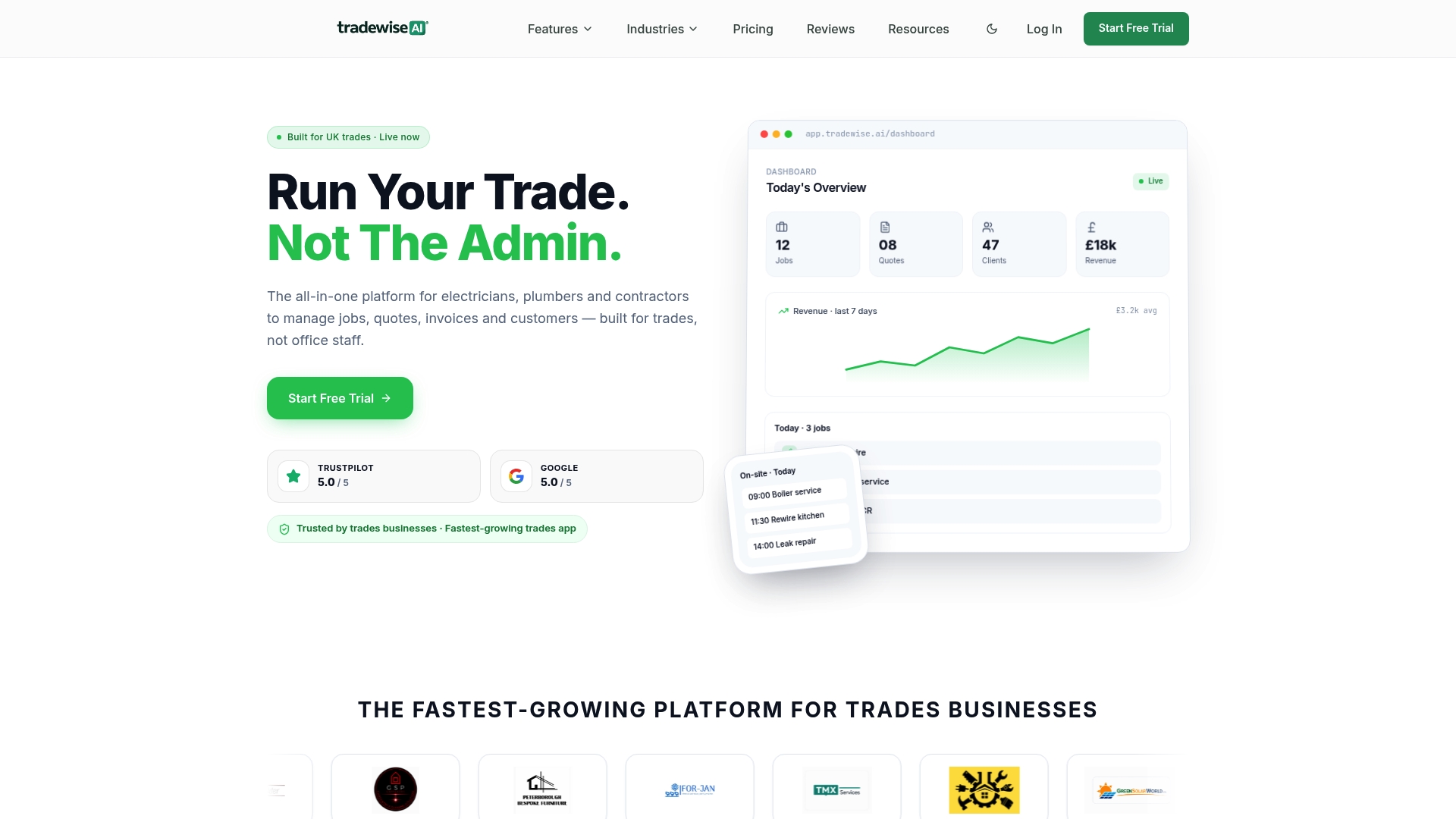
Ready to see it in action? Visit Tradewisehq to explore how the platform works for UK trades businesses.
What types of construction apps do UK firms actually use?
Construction apps broadly fall into six functional categories, and most firms use a combination rather than a single tool.
Project and task management apps handle scheduling, drawing distribution, and punch list tracking. Budgeting and estimating tools let teams price jobs accurately and track costs against budget in real time, which is where digital quoting tools for builders add particular value. Safety and compliance apps run daily checklists, log near-misses, and help teams maintain health and safety standards with incident reporting that reaches the right people immediately. Time and workforce management tools track labour hours on site, reducing payroll disputes and improving billing accuracy. Document management platforms store drawings, specifications, and contracts in one place with version control. All-in-one platforms like Tradewisehq combine several of these categories, which suits smaller firms that cannot justify multiple specialist subscriptions.
Data security and privacy: what construction firms need to check
Construction apps handle commercially sensitive data: contract values, client details, subcontractor pricing, and site access records. A breach carries both financial and reputational consequences.
Before deploying any app, verify three things. First, confirm that data is stored on servers located in the UK or European Economic Area, which keeps it within UK GDPR jurisdiction. Second, check that the provider offers role-based access controls so site operatives cannot view financial data they have no reason to see. Third, review the provider's data retention and deletion policy, particularly for client information held after a project closes. Firms working on public sector or infrastructure contracts may also face additional requirements under the Government Security Classifications framework, so check contractual obligations before selecting a platform.
How apps support regulatory compliance and reporting in UK construction
Construction apps make compliance less of a burden and more of a by-product of normal site activity. When safety checklists and incident reports are completed digitally on site, the audit trail builds itself without anyone needing to compile a separate report at the end of the week.
For UK firms, this matters under CDM 2015, which requires principal contractors to maintain a health and safety file throughout a project. Apps that log daily site conditions, near-misses, and toolbox talk attendance create exactly the kind of contemporaneous record that satisfies an HSE inspection. Reporting to clients and principal designers also becomes faster when the data already exists in a structured digital format rather than scattered across paper forms and email threads.
Key takeaways
Construction firms that sustain mobile app use beyond the initial rollout consistently see reduced rework, fewer delays, and stronger client retention, making the long-term return on investment clear.
| Point | Details |
|---|---|
| Real-time data entry matters | Logging hours and photos on site prevents inaccurate invoicing and lost billable hours. |
| Client satisfaction drives profit | Research shows better client relationship management is the strongest predictor of productivity improvement. |
| Offline capability is non-negotiable | Apps must capture and sync data on sites with poor connectivity to remain useful in the field. |
| Adoption depends on leadership | Visible use by directors and contracts managers reduces staff resistance faster than training alone. |
| Security checks come first | Verify UK GDPR compliance, server location, and role-based access before deploying any platform. |