
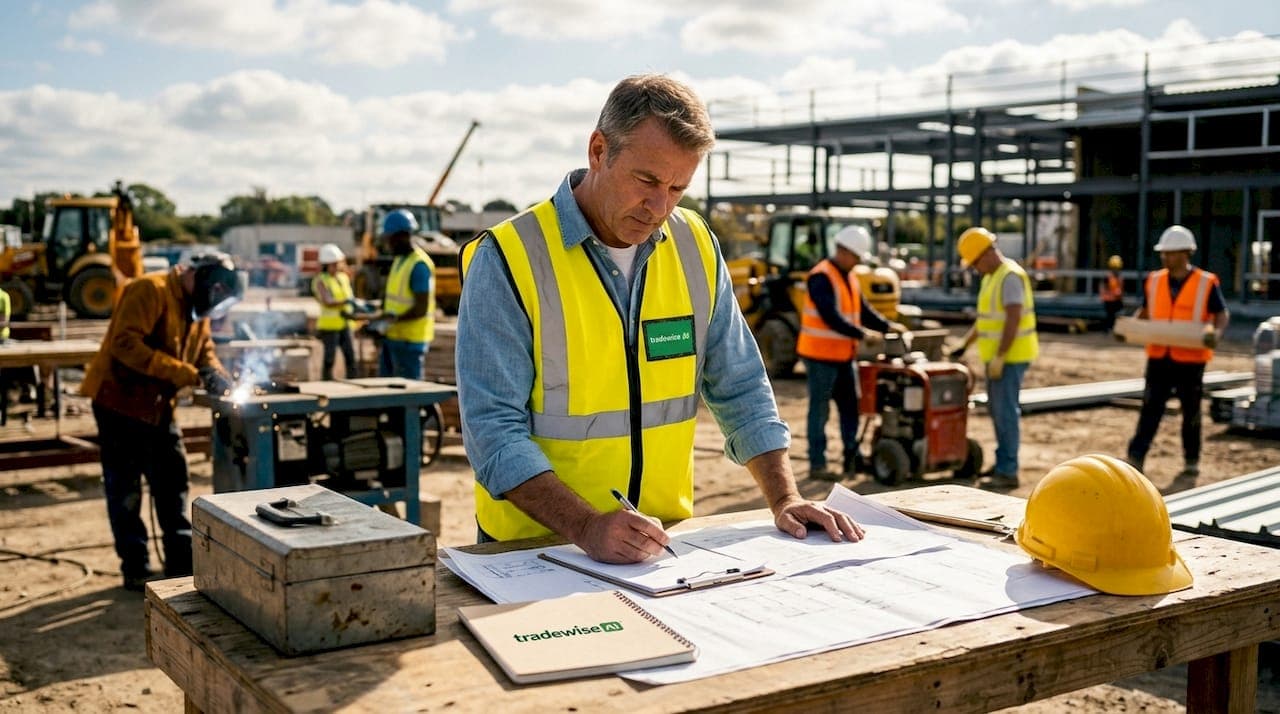
Construction automation is the application of digital tools, AI systems, and robotic processes to replace manual, repetitive tasks across the full project lifecycle. The role of automation in construction firms has shifted from a competitive advantage to an operational necessity. Firms that adopt it report 18–35% higher project margins and 25–40% lower administrative overhead. That gap is widening. UK builders who continue relying on spreadsheets and manual coordination face mounting pressure from labour shortages, rising material costs, and clients who expect faster, more accurate delivery.
What are the main types of automation used by construction firms?
Construction automation falls into four broad categories. Each addresses a different layer of operational friction, and the most effective firms deploy more than one.
Bid management and solicitation automation removes the manual effort of chasing subcontractors for quotes, tracking responses, and compiling comparisons. Automated systems send bid invitations, log replies, and flag gaps without a coordinator touching a single email thread.
Robotic and onsite machinery covers autonomous surveying drones, concrete-laying robots, and AI-guided excavators. These tools reduce physical risk and improve accuracy on repetitive site tasks.

Administrative workflow automation handles document routing, lien waiver collection, RFI triage, and compliance checklists. These are the tasks that consume hours of a project manager's week without producing any direct site value.
AI-driven analysis tools assess constructability, flag design conflicts, and model project risk before a spade hits the ground. 81% of contractors report measurable benefits from automated constructability analysis. That figure reflects how quickly AI has moved from novelty to standard practice.
| Task | Manual time | Automated time |
|---|---|---|
| Material takeoff | Over 8 hours | Under 2 minutes |
| Bid management cycle | Full week | 60–75% faster |
| Safety reporting | Standard duration | 50–65% reduction |
| Lien waiver collection | Ongoing manual chase | 65–80% faster |
The time savings above are not marginal. They represent entire working days returned to project managers every week.
Pro Tip: Start with one administrative process, not the whole operation. Automating lien waiver collection or bid solicitation first gives you a measurable win within weeks and builds internal confidence for broader adoption.
How does automation improve efficiency in UK construction firms?
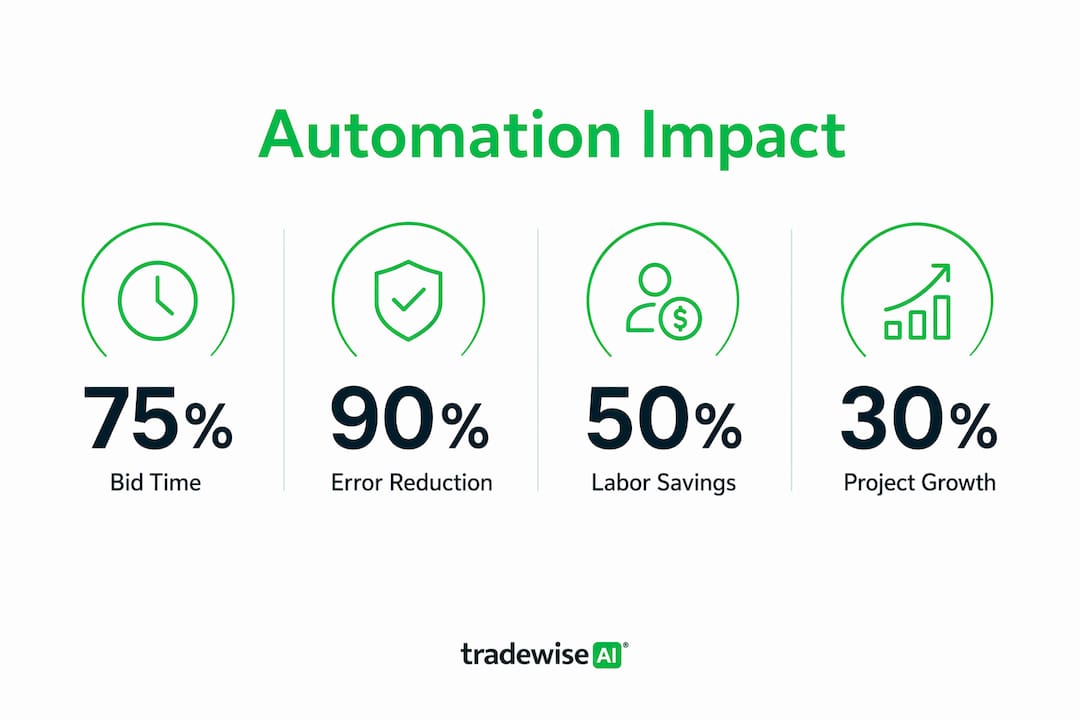
The impact of automation in construction is clearest in the numbers. Manual coordination errors cost firms 14–22% of project revenue. Eliminating those errors through automated workflows is not a technology upgrade. It is a direct margin recovery exercise.
The benefits compound across the project lifecycle:
- Faster bid turnaround. Automated bid management cuts cycle times by 60–75%. A firm that previously submitted four bids a month can now submit six or seven with the same team.
- Fewer rework incidents. AI constructability tools catch design conflicts before mobilisation. Rework is one of the most expensive line items in UK construction, and catching conflicts early removes it almost entirely.
- Reduced admin overhead. Safety reporting time drops by 50–65% when automated. Project managers spend that recovered time on site decisions, not paperwork.
- Better subcontractor onboarding. Automated document workflows mean subcontractors receive, complete, and return compliance documents faster. Subcontractor management becomes a process rather than a chase.
- Improved cash flow visibility. Lien waiver collection, when automated, closes 65–80% faster. That speed directly reduces payment delays and improves working capital.
"Automation connects data, technology, and expertise, enabling smarter, more predictable decisions and reducing risk across the project." — Construction Dive
The quote above captures the real shift. Automation does not replace the judgement of an experienced site manager. It gives that manager better information, faster, so their decisions land with more precision.
Automation also addresses the UK's persistent labour shortage. Automation helps firms contend with labour shortages by freeing experienced people for higher-value decisions rather than administrative tasks. A skilled estimator spending three hours on a material takeoff is a misallocation of expertise. Automation corrects that.
What challenges do construction firms face when adopting automation?
Adoption is not frictionless. The firms that struggle most share three common problems: poor training investment, fragmented data systems, and unrealistic expectations about what automation can do autonomously.
- Training gaps. Training is critical for automation success. Firms that invest in structured onboarding see faster adoption, fewer errors, and consistent productivity gains. Firms that skip it see tools abandoned within months.
- Legacy system conflicts. Most UK construction firms run a patchwork of disconnected software. Accounting sits in one system, project management in another, and site reporting in a third. Automation cannot function across silos. Data integration between platforms like Procore and QuickBooks is a prerequisite, not an afterthought.
- Overestimating autonomy. The construction technology market is full of claims about fully autonomous systems. The reality is that bounded AI features addressing specific pain points deliver the strongest immediate return. Chasing fully autonomous solutions before your workflows are even digitised is a costly mistake.
- ROI timeline misalignment. Automation investment does not pay back in week one. Firms need to set realistic expectations: administrative automation typically shows clear ROI within three to six months, while hardware-based site automation takes longer.
- Workflow misalignment. Automation built around how a vendor thinks construction works, rather than how your firm actually operates, creates more friction than it removes. The tool must fit the workflow, not the other way around.
Pro Tip: Before purchasing any automation tool, map the exact process you want to automate in writing. If you cannot describe the current workflow in five steps, the tool will not fix it. Clarity before technology.
How can small to midsize construction firms maximise automation?
The role of automation for small build firms is different from enterprise adoption. Large contractors can absorb the cost of failed experiments. Smaller firms cannot. The approach must be targeted and sequenced.
The highest return comes from automating high-friction processes like lien waiver collection and bid solicitation first. These are repetitive, rule-based, and time-consuming. They are also the processes where errors cause the most downstream damage.
AI estimation tools offer a specific advantage for smaller firms. AI tools allow estimators to bid on 30–50% more projects without adding headcount. That is a direct revenue multiplier for a firm with a team of two or three estimators. The tool does not replace the estimator's judgement. It removes the mechanical work so the estimator can apply that judgement to more opportunities.
Data integration is the hidden lever most small firms overlook. Integrating data across platforms like Procore and QuickBooks reduces manual reconciliation and the errors that come with it. The highest ROI often comes not from new automation hardware but from connecting systems that already exist.
| Approach | Best for | Cost level | Time to ROI |
|---|---|---|---|
| Bid solicitation automation | Firms bidding 5+ projects monthly | Low to medium | 1–3 months |
| AI estimation tools | Firms with 1–3 estimators | Medium | 2–4 months |
| Data platform integration | Firms using Procore or QuickBooks | Low | 1–2 months |
| Robotic site machinery | Large sites, high-volume groundworks | High | 12+ months |
| Full workflow automation suites | Enterprise contractors | Very high | 6–18 months |
Small firms should avoid enterprise-level automation suites. These tools are built for organisations with dedicated IT teams and complex multi-site operations. A firm running 10–20 projects a year needs targeted tools, not a platform designed for 200. AI tools for builders are increasingly available at price points that suit smaller operations, and the gap between enterprise and SME capability is closing fast.
The practical starting point for any small firm is a process audit. List every task your team repeats weekly. Rank them by time cost and error frequency. The top three items on that list are your automation priorities. Start there, prove the return, then expand.
Key takeaways
Automation in construction firms delivers the strongest results when targeted at specific, high-friction processes rather than applied broadly across the entire operation.
| Point | Details |
|---|---|
| Start with high-friction tasks | Automate lien waivers, bid solicitation, and material takeoffs first for the fastest return. |
| Training drives adoption | Structured workforce training is the difference between tools that stick and tools that get abandoned. |
| Data integration unlocks ROI | Connecting existing platforms like Procore and QuickBooks removes hidden costs before adding new tools. |
| AI accelerates, not replaces | AI estimation tools let small firms bid on 30–50% more projects without increasing headcount. |
| Bounded AI beats full autonomy | Targeted automation features addressing specific pain points outperform expensive enterprise-wide systems. |
Why I think most construction firms are automating in the wrong order
Most firms I speak with want to start with the visible stuff. Drones, robots, AI dashboards. The technology that looks impressive in a board presentation. That instinct is understandable, but it is backwards.
The firms getting the clearest return from automation in 2026 are not the ones with the most sophisticated hardware. They are the ones that fixed their document workflows first. Lien waivers. Bid solicitation. Safety checklists. The unglamorous back-office processes that nobody talks about but everyone drowns in.
The uncomfortable truth is that most construction firms are not ready for advanced automation because their data is a mess. Spreadsheets that only one person understands. Accounting systems that do not talk to project management software. Site reports filed in email threads. You cannot automate chaos. You have to organise it first.
My practical advice: spend the first month mapping your workflows before you spend a pound on technology. The job management software conversation should come after you understand exactly where your time is going. Automation built on a clear foundation delivers. Automation bolted onto a broken process just breaks faster.
The future of construction automation in the UK is not about replacing skilled tradespeople. It is about giving them back the hours currently consumed by administration, so they can do what they were actually hired to do.
— Mateusz
How Tradewisehq supports construction automation for UK firms
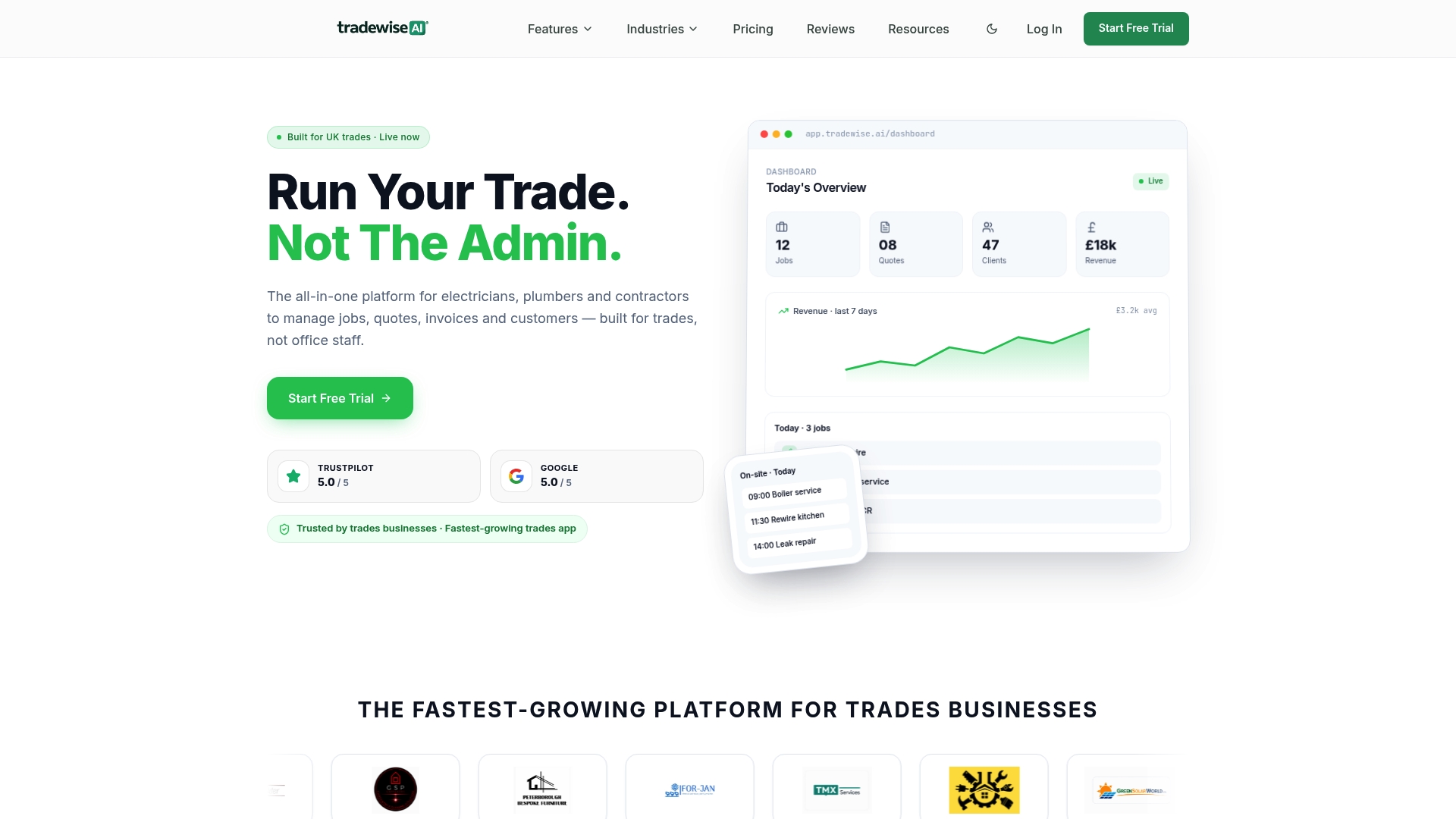
Tradewisehq is built for exactly the kind of automation that UK construction firms need in 2026. The platform brings job management, scheduling, quoting, invoicing, and client communication into one mobile-first system. There is no patchwork of disconnected tools to reconcile. Everything your team needs is in one place, synced in real time. For builders looking to reduce admin overhead and bid on more work without adding headcount, Tradewisehq's trade management platform is worth exploring. It is designed for tradespeople and contractors who want the benefits of automation without the complexity of enterprise software.
FAQ
What is the role of automation in construction firms?
Automation in construction firms replaces manual, repetitive tasks with digital and AI-driven processes across bidding, project management, safety reporting, and document handling. The result is lower administrative overhead, fewer errors, and higher project margins.
How much time can automation save on construction tasks?
Material takeoffs drop from over 8 hours to under 2 minutes with automation. Bid management cycles reduce by 60–75%, and lien waiver collection closes 65–80% faster.
Is automation suitable for small construction firms in the UK?
Targeted automation is highly suitable for small firms. AI estimation tools allow estimators to bid on 30–50% more projects without extra headcount, and data integration between existing platforms delivers ROI within one to three months.
What is the biggest challenge in adopting construction automation?
Training is the most commonly cited barrier. Firms that invest in structured onboarding see consistent productivity gains, while those that skip training see tools abandoned quickly.
Does automation replace workers in construction?
Automation does not replace skilled construction workers. It removes administrative burden so experienced staff can focus on higher-value decisions, directly addressing the UK's labour shortage rather than worsening it.