
For UK electricians, plumbers, builders, and trade contractors, the most practical AI tool for construction operations is a mobile-first, AI-enabled field-service platform. Tradewisehq is the standout choice for trades businesses that need job management, quoting, invoicing, and admin automation working together in one place, including offline on site.
- Who it fits: sole traders through to small fleets of 20+ operatives
- Why it wins: offline-capable mobile-first design, AI-assisted quoting and invoice chasing, live workforce sync, and integrated materials ordering
- Immediate next step: start a 14-day free trial or book a demo at Tradewisehq
The CITB-funded 'Solving Tech for Small Builders' programme, delivered through partners including Construction Coach and the Federation of Master Builders, piloted with 50 builders and showed measurable financial benefits. That real-world evidence matters when evaluating any AI software for construction.
Table of Contents
- How do AI-powered, mobile-first tools actually change daily operations for UK trades?
- What should you look for in an AI field-service operations tool?
- How does Tradewisehq meet the checklist?
- What does it cost, and how long does adoption take?
- Practical 30/60/90 adoption plan for busy trades teams
- Key takeaways
- Where AI actually helps trades most in 2026
- Tradewisehq: try it for 14 days, with no commitment
- Useful sources and further reading
How do AI-powered, mobile-first tools actually change daily operations for UK trades?
The fastest, most measurable return from AI tools for project management comes from automating the processes that leak money every single day: missed calls, slow quotes, and unpaid invoices sitting in a spreadsheet.
Responding to a lead within a minute converts dramatically better than following up an hour later. An AI receptionist that answers, qualifies, and logs an enquiry while you are under a floorboard is not a luxury. For a busy electrician or plumber, it is the difference between winning and losing a job.
The single most persuasive adoption stat: Mobile-first site management app adoption has grown significantly since 2023, and 68% of construction respondents cite poor site connectivity as a major concern. Offline-first design is not a nice feature. It is a requirement.
AI document generation, including quote drafting from voice notes and automated invoice chasing, has grown even faster. The table below shows how adoption is moving.
| Technology | Adoption trend | Key driver |
|---|---|---|
| Mobile-first site management apps | significant growth since 2023 | Workforce mobility and remote oversight |
| AI document generation (quotes, job notes) | rapid growth in recent years | Admin time reduction and speed to lead |
| Offline-capable field apps | Rapid growth | 68% connectivity concern on UK sites |
| Integrated materials/supplier ordering | Increasing | Reduce procurement delays and price errors |
The CITB pilot with 50 builders showed measurable financial benefits from digital adoption, which gives these numbers real grounding rather than vendor marketing.
What should you look for in an AI field-service operations tool?
Start with the non-negotiables, then layer in the differentiators.
Questions to ask any vendor
- How does offline mode work? What happens to queued jobs when connectivity returns?
- Can I draft a quote from a voice note or photo on my phone?
- Does the platform integrate directly with Xero, and is that included or an add-on?
- Where is my data stored, and how does the platform handle GDPR?
- What UK-based training or onboarding support is available?
Red flags
- Requires a constant internet connection for basic job management
- Pricing is opaque or changes significantly after onboarding
- No UK-based support or training partners
- No mention of GDPR compliance or data residency
Matching platform complexity to business size
Software stack needs vary significantly by headcount. A sole trader needs a clean job app plus accounting. A team of 6–20 should prioritise job costing, integrations, and automation. At 20+, live workforce sync, custom automations, and materials workflows become the priority.

How does Tradewisehq meet the checklist?
Tradewisehq maps directly to every criterion above.
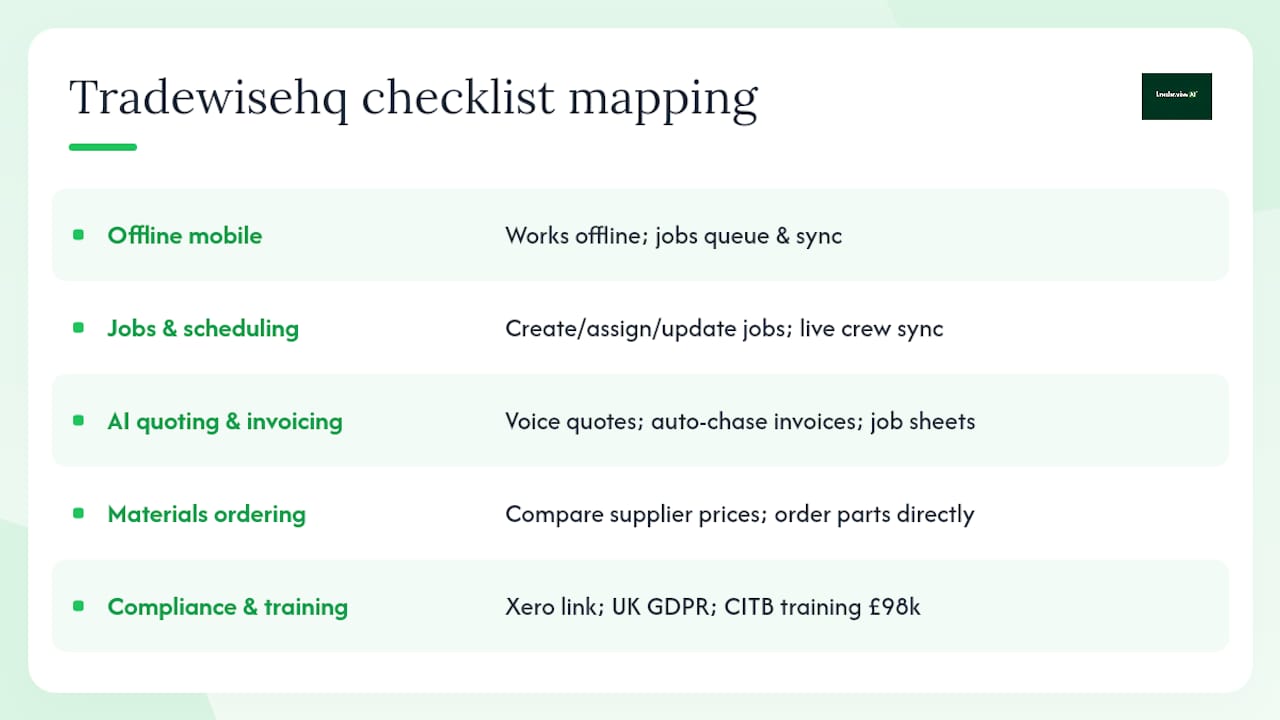
Offline mobile capability: the app works on site without a signal. Jobs queue and sync when connectivity returns. Read more about why offline matters for construction teams.
Jobs and scheduling: create, assign, and update jobs from any phone. Live workforce sync shows crew location and job status in real time.
AI-assisted quoting and invoicing: draft quotes from voice notes, auto-chase overdue invoices, and generate job sheets without touching a keyboard.
Materials ordering: compare supplier prices and order parts directly from the platform, reducing procurement delays and pricing errors.
Xero integration: connects directly to Xero for UK-standard accounting without manual data entry.
GDPR compliance: UK-compliant data storage and processing, with clear data protection statements available on the platform.
UK training and support: Tradewisehq links into the CITB-funded 'Solving Tech for Small Builders' programme, delivered through Construction Coach and the Federation of Master Builders. The £98,000 IIF/CITB-funded programme means funded training is available for eligible UK builders.
Trust signal: the CITB pilot ran with 50 builders and produced measurable financial benefits, giving Tradewisehq's training links real credibility beyond vendor claims.
Pro Tip: During your 14-day trial, track three numbers only: missed calls before and after enabling AI lead capture, average quote turnaround time, and how many days invoices sit unpaid. Those three figures will tell you whether the platform earns its subscription.
What does it cost, and how long does adoption take?
Tradewisehq uses a tiered subscription model: Starter, Pro, Business, and Enterprise, priced per user on monthly or annual terms. Specific pricing is available on the product page. Budget for per-user seats, any telephony or AI call-handling add-ons, and a short onboarding period.
The staged digital transformation roadmap for UK trades recommends starting with writing and call handling before layering in scheduling automation and predictive features. That sequence maps directly to a 30/60/90 adoption plan.
What to budget for:
- Per-user monthly or annual seat licence
- Telephony/AI receptionist add-on if required
- Xero or accounting integration (included in higher tiers)
- Onboarding time: typically a few hours for a small team
ROI signals to watch:
- Reduction in missed calls and unqualified enquiries
- Quote turnaround time (from days to hours)
- Reduction in admin hours per week
- Days sales outstanding on invoices
CITB-funded training through Construction Coach and the Federation of Master Builders reduces the setup burden for small builder teams and accelerates adoption.
Practical 30/60/90 adoption plan for busy trades teams
First 7 days
- Set up AI lead capture and phone/call handling
- Create three quote templates covering your most common job types
- Connect Xero and import existing client data
- Train two staff members on job creation and scheduling
Days 8–30
- Run your first AI-assisted quotes from voice notes
- Activate automated invoice chasing for overdue payments
- Measure call response time and quote conversion against your baseline
- Review missed call logs and adjust AI receptionist settings
Days 31–90
- Add materials ordering and supplier price comparison to your workflow
- Expand crew scheduling to full workforce sync
- Build custom automations for recurring job types
- Review admin time reduction and adjust workflows
Five metrics to track weekly:
- Missed calls (before and after AI lead capture)
- Quote turnaround time (hours from enquiry to sent quote)
- First-time fix rate (parts availability and scheduling accuracy)
- Days sales outstanding on invoices
- Admin hours saved per week
Common obstacles: poor site connectivity (solved by offline mode), staff resistance (solved by keeping the first week simple), and messy existing data (clean client records before import, not after).
Key takeaways
Mobile-first AI field-service platforms deliver the fastest measurable ROI for UK trades when they automate the single biggest operational leak first, whether that is missed calls, slow quoting, or unpaid invoices.
| Point | Details |
|---|---|
| Offline capability is non-negotiable | Many UK construction respondents cite connectivity as a concern; your platform must work without a signal. |
| Lead response speed drives conversion | Replying to an enquiry within a minute converts far better than following up later; AI lead capture closes that gap. |
| Start narrow, then expand | Automate one high-leak process first (calls or quoting), then add scheduling and materials in months two and three. |
| CITB funding reduces adoption risk | The IIF-funded 'Solving Tech for Small Builders' programme offers free training for eligible UK builders. |
| Tradewisehq covers the full checklist | Jobs, scheduling, AI quoting, materials ordering, Xero integration, and GDPR compliance in one mobile-first platform. |
Where AI actually helps trades most in 2026
The trades businesses getting the clearest return from AI in 2026 are not the ones that have automated everything. They are the ones that identified their single biggest measured leak and fixed it first.
For most electricians, that leak is the phone. A missed call at 8am while you are on a first fix is a job gone to whoever picked up. An AI receptionist that answers, qualifies, and books the callback costs a fraction of what that lost job is worth.
For plumbers, it tends to be quoting. Drafting a quote from memory at 9pm after a full day on site is slow, error-prone, and often just does not happen. AI that turns a two-minute voice note into a formatted quote changes that completely.
Builders face a different version of the same problem: admin accumulates until it becomes a crisis. Invoice chasing, job notes, materials orders, and crew scheduling all compete for the same hour at the end of the day. Automating even two of those tasks frees up time that goes straight back into billable work.
The AI in construction guide on the Tradewisehq blog covers these use cases in practical detail, including setup steps for trades teams at different stages of digital adoption.
Tradewisehq: try it for 14 days, with no commitment
Fewer missed calls, faster quotes, and less time on admin at the end of the day. That is what Tradewisehq delivers for UK electricians, plumbers, builders, and HVAC teams, through a single mobile-first platform that works on site, offline, and at scale.
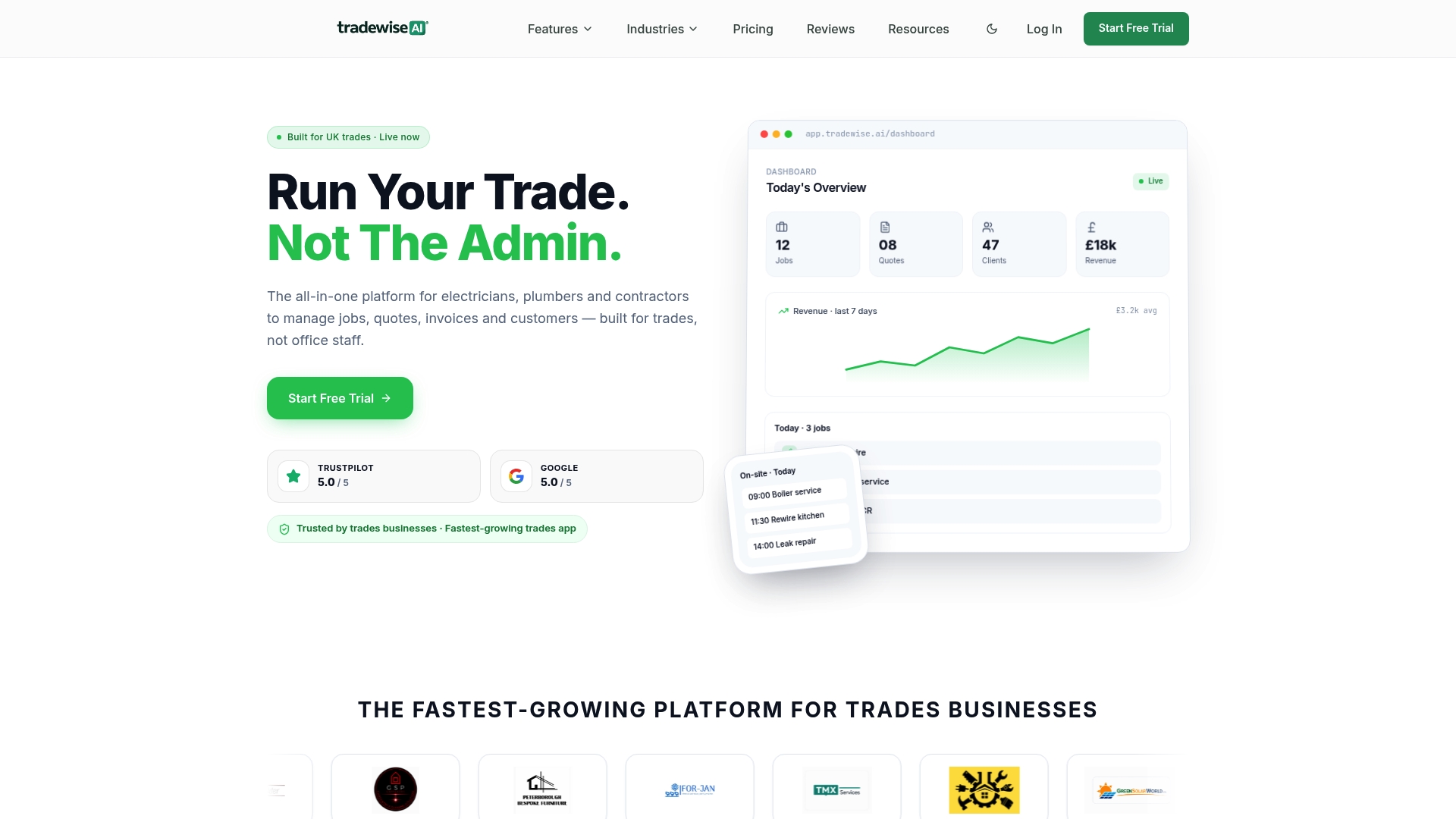
- AI lead capture answers and qualifies enquiries while you work
- Quote drafting from voice notes cuts turnaround from days to hours
- Live workforce sync keeps you across your crew without the phone calls
- Materials price comparison and ordering built into the same app
- Xero integration and GDPR-compliant UK data storage included
Start your 14-day free trial and see the numbers move in the first week. For funded training, the CITB 'Solving Tech for Small Builders' programme, delivered through Construction Coach and the Federation of Master Builders, is available for eligible UK builders.
Useful sources and further reading
| Source | What it contains |
|---|---|
| CITB 'Solving Tech for Small Builders' | Details of the £98,000 IIF-funded programme, pilot results, and how to access free digital training |
| Forge Command UK Construction Technology Report 2026 | Adoption statistics including mobile-first growth and connectivity concerns across UK construction |
| How Small UK Trades Use AI in 2026 (ConstructionX) | Practical AI use cases for trades: lead response, quoting, invoice chasing, and tool recommendations |
| Digital transformation roadmap for UK trades 2026–2028 (TrainAR) | Staged roadmap for introducing AI features, from job management through to predictive scheduling |
| Field service management software UK (Dynamics Hub) | Vendor evaluation criteria, FSM benefits, and operational benchmarks for UK field service teams |
| Trades software stacks by company size 2026 (TrainAR) | Recommended software combinations and pricing guidance for sole traders through to scaling businesses |
| AI in construction UK: Tradewisehq blog | Practical how-to articles on AI adoption, automation workflows, and mobile-first setup for UK builders |