
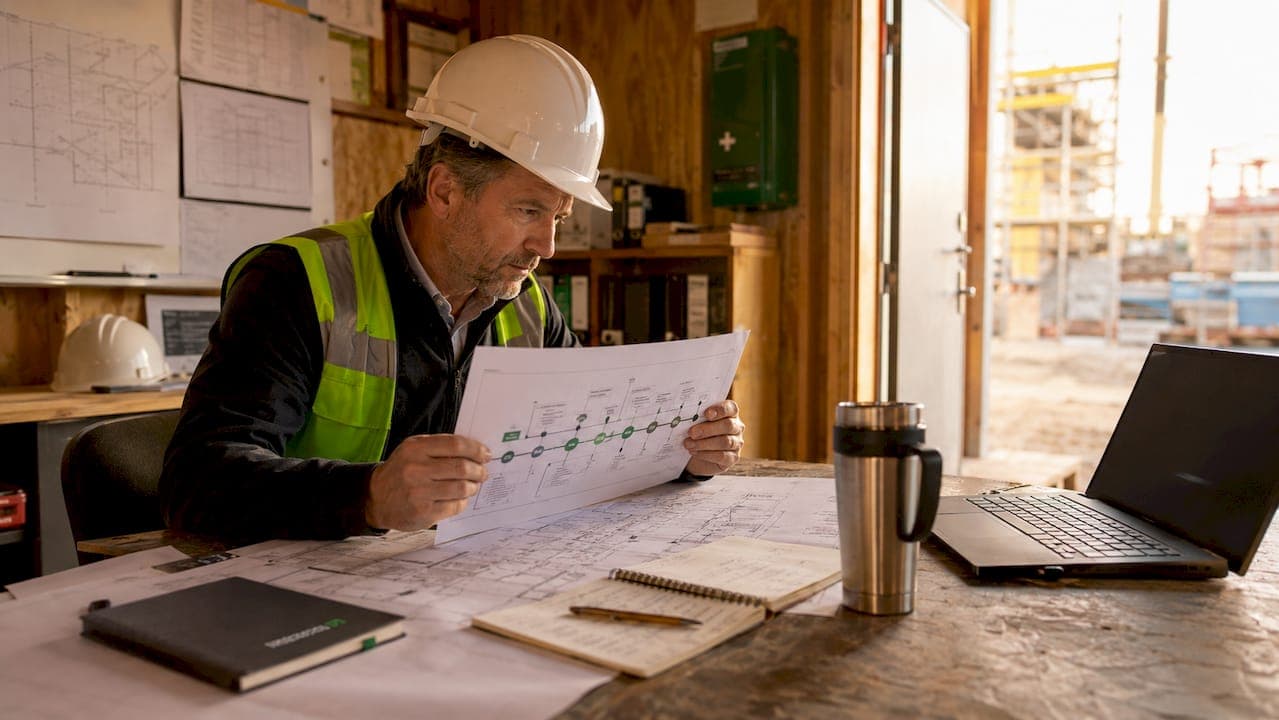
Artificial intelligence in construction is now the primary driver of efficiency, safety, and compliance across UK building projects. The role of AI in construction UK spans document intelligence, automated site reporting, and computer vision, moving well beyond the robotics hype of previous years. Over 76% of AECO leaders are actively increasing AI investment, a rise of 9% year on year. That figure signals a shift from experimentation to operational deployment. UK contractors who understand where AI delivers real value, and where it introduces risk, will hold a measurable advantage in 2026.
What are the primary AI applications in UK construction?
UK contractors in 2026 concentrate AI deployment on three core functions: document intelligence, automated reporting, and computer vision. Each addresses a specific operational pressure that UK construction firms face daily.
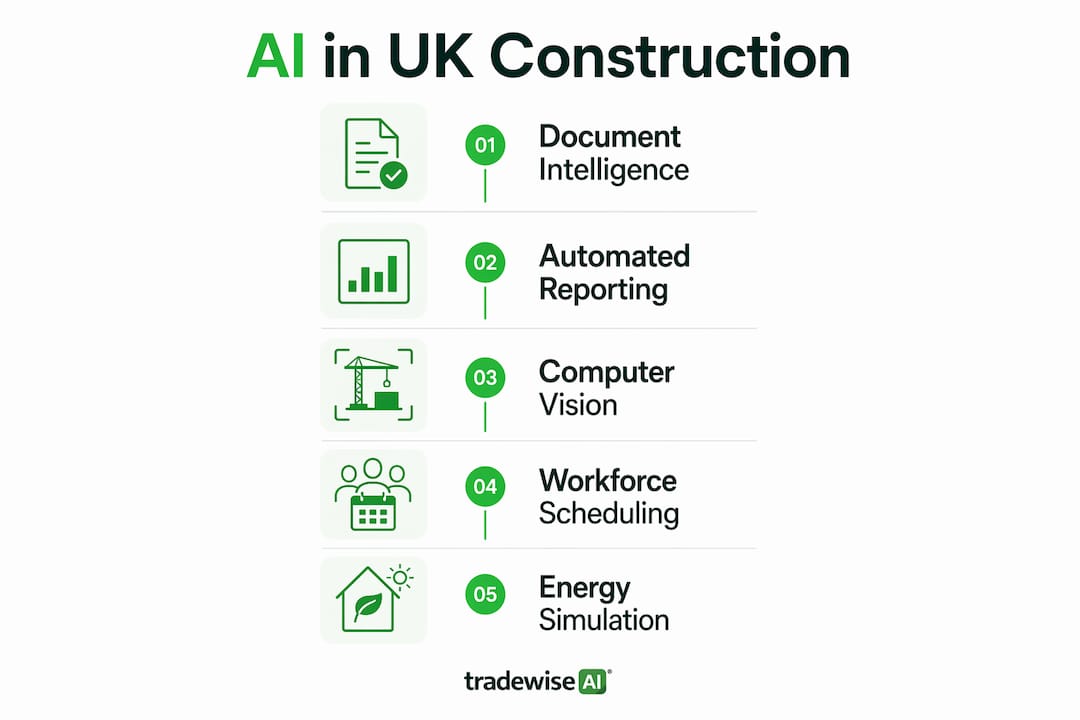
Document intelligence is the fastest-growing application. AI tools interrogate specifications, contracts, and compliance documents at word level, surfacing gaps and inconsistencies that manual review misses. Firms using tools like Forma Build report faster specification analysis and fewer costly errors at tender stage. For contracts managers working with NEC or JCT frameworks, this means AI can flag non-compliant clauses before they become disputes.

Automated reporting reduces the administrative burden that consumes site managers' time. Voice-to-text tools and AI-assisted progress reporting generate structured daily records from spoken updates. This matters for construction site daily reporting requirements under the Building Safety Act, where evidence trails must be accurate and timestamped.
Computer vision is the most visible application on live sites. Cameras and AI models monitor PPE compliance, track exclusion zones, and validate progress against programme milestones. Tools like Truelens® deploy this on UK projects, providing real-time alerts rather than end-of-day reviews.
Pro Tip: Start with document intelligence before deploying computer vision. The ROI is faster, the integration is simpler, and it builds internal confidence in AI outputs before you commit to hardware-heavy site installations.
The shift away from robotics hype is deliberate. Physical automation on UK sites faces constraints around ground conditions, listed structures, and labour relations. Practical AI functions, running on existing software and mobile devices, deliver results without those barriers.
How does AI improve safety on construction sites?
AI-powered computer vision is the most direct safety application in UK construction today. Research shows that YOLO-based detection models achieve mAP values around 0.8 for PPE violation detection. That level of accuracy supports targeted safety training, because the system can map violation frequency by zone and time of day within a BIM model.
The practical safety workflow looks like this:
- Cameras capture live footage across defined site zones.
- The AI model identifies workers without helmets, high-visibility vests, or safety boots.
- Alerts are sent to the site manager in real time, not at end of shift.
- Violation data is logged and mapped against BIM zone references.
- Safety briefings are updated based on which zones and tasks generate the most violations.
This approach directly supports compliance with the Building Safety Act and RAMS documentation requirements. It creates an auditable evidence trail that principal contractors can present to the Health and Safety Executive.
Effective implementation requires more than installing cameras. Site-specific calibration is non-negotiable. Class definitions must reflect your actual PPE requirements. Worker tracking across zones reduces false positives, which are the single biggest cause of site teams losing trust in AI safety tools. Multi-stage validation, where the AI flags and a human confirms before any enforcement action, keeps professional accountability intact.
The Building Safety Act 2022 has raised the stakes for evidence handling on higher-risk buildings. AI safety monitoring, when properly configured, turns compliance from a reactive process into a continuous one.
What are the data and workforce challenges for AI adoption?
AI adoption in UK construction faces three persistent blockers: fragmented data, security risks, and workforce skill gaps. A systematic review of AI in construction covering 2015 to 2025 identifies these as the primary reasons AI projects fail to deliver expected returns.
The data fragmentation problem is structural. Most UK construction firms operate with project data spread across spreadsheets, email chains, PDF drawings, and disconnected software platforms. AI tools require clean, consistent, and accessible data to function reliably. Without a single source of truth, machine learning models produce outputs that site teams cannot trust.
Security risks are less visible but equally serious. Silent AI features embedded in trusted software, such as design platforms or project management tools, can process sensitive project data without explicit consent or governance. Supply-chain threat modelling and third-party assurance are not optional extras. They are baseline requirements before any AI tool touches live project data.
The workforce challenge is about skills, not resistance. Most site managers and project engineers have not been trained to interpret AI outputs, challenge model assumptions, or identify when a system is producing unreliable results. The UK Government's AI Assurance Stakeholder Consortium was established specifically to address this, providing guidance and training frameworks for industry-wide adoption.
Pro Tip: Budget for integration, governance, and training as separate line items when procuring AI tools. Firms that treat these as afterthoughts consistently underperform against those that plan for them from the outset.
Key barriers to address before deployment:
- Data governance: Establish a single source of truth for project data before introducing AI tools.
- Security assurance: Require vendors to provide third-party security assessments and data processing agreements.
- Workforce training: Allocate time for site teams to understand AI outputs and their limitations.
- Interoperability: Confirm that AI tools integrate with your existing project management and BIM platforms.
How can UK firms practically integrate AI into project workflows?
The adoption sequence matters. Firms that attempt to deploy computer vision before establishing reliable data infrastructure consistently struggle. The recommended order is document intelligence first, automated reporting second, and computer vision third.
| AI Application | Primary Benefit | Key Requirement | Typical Timeline |
|---|---|---|---|
| Document intelligence | Faster specification and compliance review | Structured document library | 1–3 months |
| Automated reporting | Reduced admin, better evidence trails | Mobile-first site access | 2–4 months |
| Computer vision | Real-time safety and progress monitoring | Site camera infrastructure | 4–8 months |
| Predictive scheduling | Reduced programme overruns | Integrated project data | 6–12 months |
Pre-submission AI checking is one of the clearest current wins. AI performs systematic word-level review of building control submissions, helping firms meet Gateway 2 evidence requirements under the Building Safety Act without sacrificing professional accountability. The AI handles the systematic check. The professional applies judgement and signs off. That division of labour is both practical and legally sound.
Autodesk has integrated AI into its Construction Cloud platform, offering predictive risk scoring and automated clash detection. Clarke Banks and similar UK-based consultancies are embedding AI into compliance workflows for principal contractors. Partnering with vendors who have proven AI capabilities reduces implementation risk compared to building bespoke solutions.
Workforce scheduling is another area where AI delivers measurable value. Predictive scheduling tools analyse historical project data, subcontractor performance, and material lead times to flag programme risks before they become delays. For UK contractors managing multiple live projects, this kind of forward visibility is the difference between proactive management and reactive firefighting.
Multi-agent AI architectures are also entering compliance workflows, automating energy simulation processes that previously required specialist engineers for every iteration. A seven-agent system can handle data preprocessing, EnergyPlus IDF generation, and results analysis, cutting the time and cost of Part L compliance modelling significantly.
Key takeaways
AI in UK construction delivers the most reliable returns when firms adopt a security-first, sequenced approach starting with document intelligence before moving to site-based applications.
| Point | Details |
|---|---|
| Start with document intelligence | AI specification review delivers fast ROI and builds internal confidence before hardware-heavy deployments. |
| Safety monitoring requires calibration | Computer vision PPE detection achieves mAP 0.8 accuracy only with site-specific setup and multi-stage validation. |
| Data governance is non-negotiable | Fragmented data is the leading cause of AI project failure; establish a single source of truth first. |
| Security risks are embedded in software | Silent AI features in trusted platforms require supply-chain threat modelling and vendor assurance from day one. |
| Sequence your adoption | Deploy document intelligence, then automated reporting, then computer vision for the most reliable outcomes. |
The uncomfortable truth about AI adoption in UK construction
I have watched firms spend significant budgets on AI tools that never made it past a pilot. The pattern is consistent. A senior leader attends a conference, sees a compelling demonstration, and returns with a mandate to "do AI." The procurement team buys a platform. The site teams are told to use it. Six months later, the data is still fragmented, the site managers do not trust the outputs, and the project is quietly shelved.
The uncomfortable truth is that AI failure in construction is almost never a technology problem. It is a governance and sequencing problem. The firms getting genuine returns from artificial intelligence in building are the ones that started with a specific, bounded use case, proved it worked, and then expanded. They treated data infrastructure as a prerequisite, not an afterthought.
The UK Government's focus on safe, trusted AI is not bureaucratic caution. It reflects a real pattern of harm from poorly governed AI deployments across industries. For construction, where a missed safety alert or a flawed compliance document can have serious consequences, that caution is entirely appropriate.
My advice is direct. Pick one problem that costs you real time or money today. Find an AI tool that addresses it specifically. Measure the result. Then move to the next problem. The firms that will lead on AI tools for builders in the next three years are not the ones that deployed the most technology fastest. They are the ones that deployed it most carefully.
— Mateusz
How Tradewisehq supports ai-driven construction management
Tradewisehq is built for exactly the operational pressures this article describes. It combines AI-powered job management, automated reporting, and live workforce syncing into a single mobile-first platform designed for UK tradespeople and contractors.
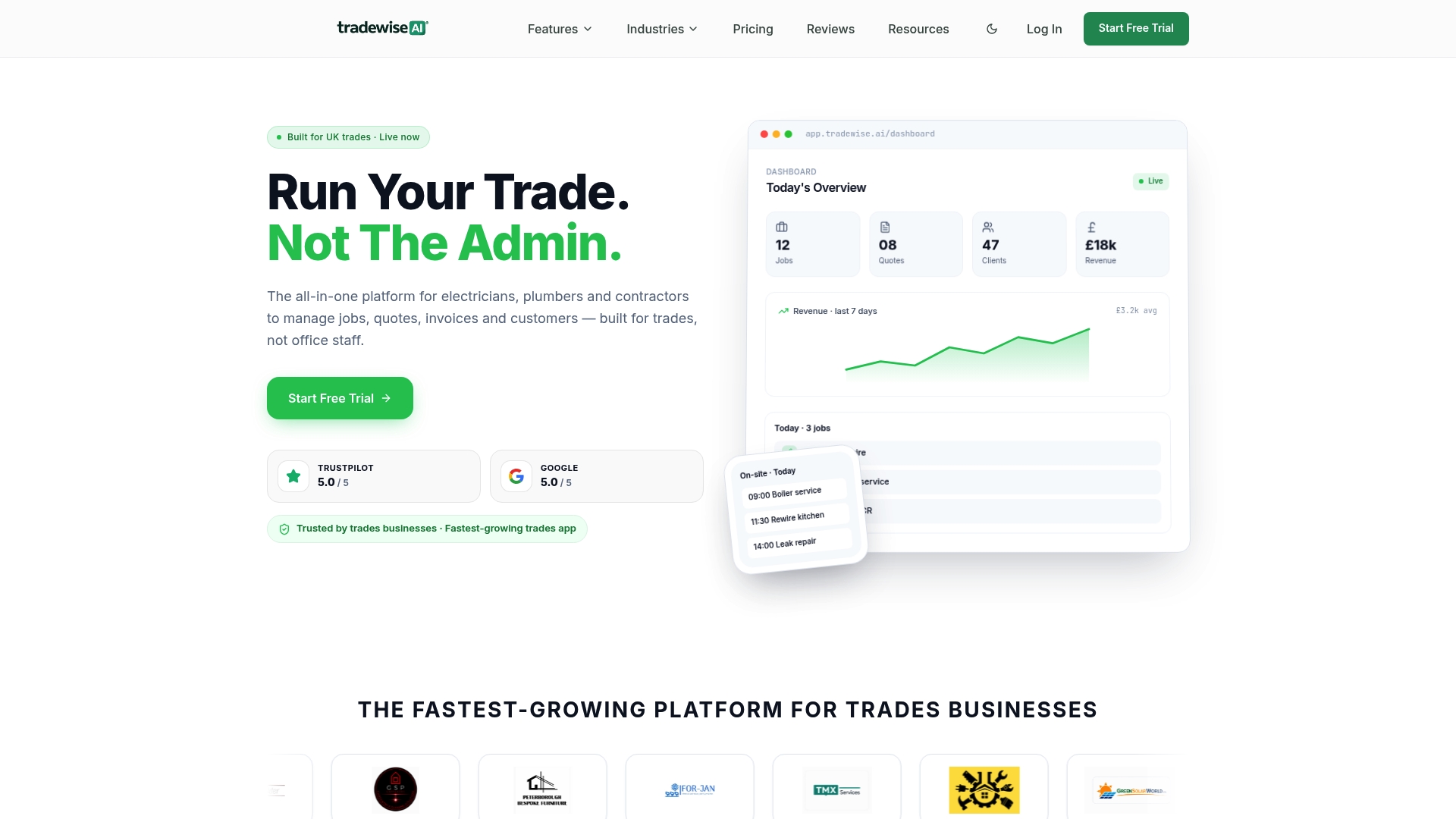
If you are a builder, electrician, or contractor looking to reduce admin, improve site visibility, and keep compliance evidence organised, Tradewisehq addresses those needs directly. The platform handles quotes, invoices, scheduling, and client communication in one place, so your team spends less time on paperwork and more time on the job. Explore what Tradewisehq can do for your construction business and see how AI-supported trade management works in practice.
FAQ
What is the role of AI in construction UK right now?
AI in UK construction currently focuses on document intelligence, automated reporting, and computer vision for safety and compliance monitoring. These three applications deliver the most measurable returns for UK contractors in 2026.
How does AI improve safety on UK building sites?
AI computer vision systems detect PPE violations in real time, achieving detection accuracy with mAP values around 0.8 when properly calibrated. Violation data is mapped against BIM zones to target safety briefings more precisely.
What are the biggest barriers to AI adoption in UK construction?
Fragmented data, security risks from silent AI features in software, and workforce skill gaps are the three primary barriers identified in a systematic review covering 2015 to 2025.
How does AI support building safety act compliance?
AI performs systematic word-level review of building control submissions, helping firms meet Gateway 2 evidence requirements efficiently. Professionals retain accountability by applying judgement after the AI completes its checks.
Where should a UK contractor start with AI?
Start with document intelligence, which delivers fast ROI and requires no hardware investment. Once that is working reliably, move to automated reporting, then consider computer vision for site safety monitoring.