

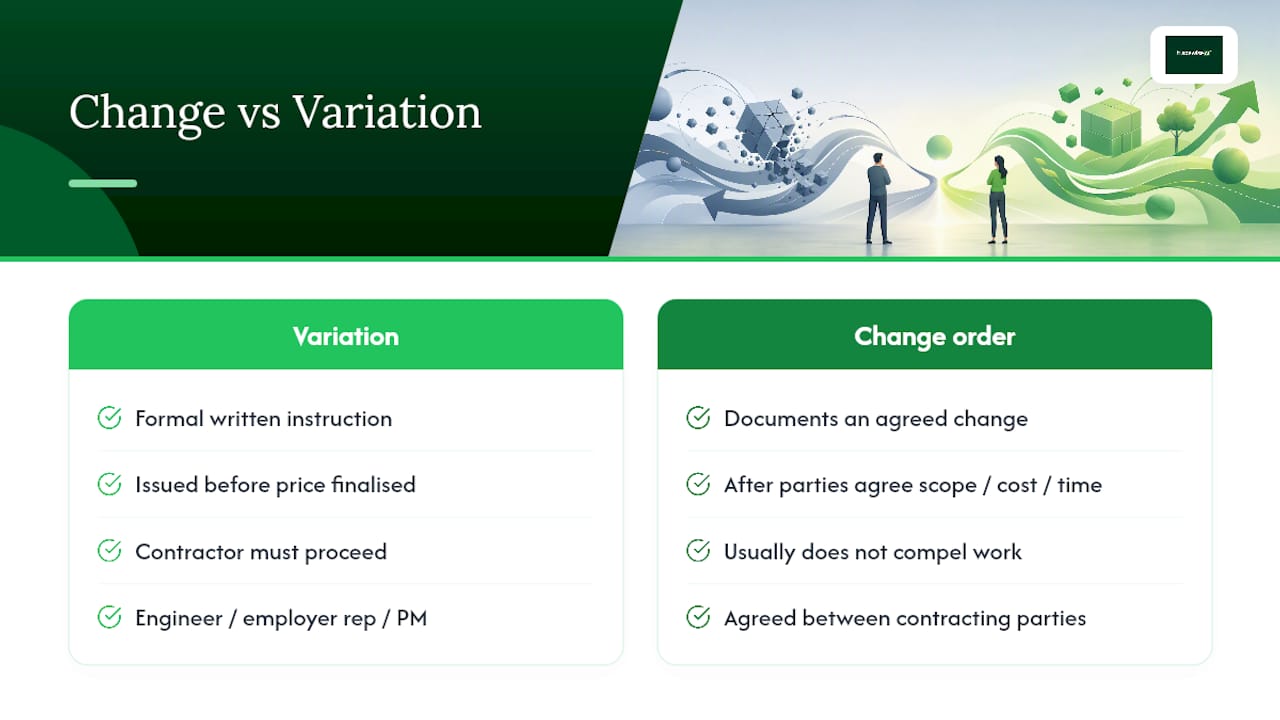
A variation order is usually the instrument that obliges a contractor to keep working before the price is settled. A change order is more often the record drawn up once both parties have already agreed the scope, cost and time. The label depends on the contract form you're using, but the practical risk sits in that gap between instruction and agreement.
Right now, do this:
- Open your contract and find the variation or change clause. Check exactly who is named as the authorised issuer.
- Confirm whether the clause forces you to proceed before valuation is agreed, or whether you can hold off.
This isn't just terminology. RICS and the CIOB both treat the instruction-versus-agreement distinction as central to valuation disputes, and a system like TradeWise exists precisely because most disputes trace back to a missing signature or an unrecorded date.
Key Takeaways
The core distinction is procedural: a variation order typically compels work to proceed before price is agreed, while a change order more often records a change already negotiated and accepted.
| Point | Details |
|---|---|
| Check the clause first | Identify who is named to issue instructions and whether work must proceed before valuation. |
| Record time at agreement | State the programme effect the moment an instruction is issued, not weeks later. |
| Build a defensible file | Attach daily records, photographs and invoices to every variation, not just the price. |
| Separate the stages | Keep requests, instructions and agreed orders clearly distinct in your paperwork. |
| Use a live register | Tools like TradeWise attach evidence and time-impact fields directly to the job record, reducing the admin risk of scattered files. |
Table of Contents
- Change order vs variation: definitions that actually matter
- What a variation or change order should contain
- Common reasons and types of variations you'll encounter
- Who can request, who can instruct, and can you refuse?
- The process from notice to agreed change order
- A worked example and sample wording you can adapt
- Best practices and pitfalls to avoid
- Where a trade management system fits into your variation process
- Frequently asked questions
- Sources
Change order vs variation: definitions that actually matter
A variation is any change to the scope, quality or timing of works described in the contract. A variation order is the formal, written instruction that authorises it, usually issued under a specific clause by a named party. A change order, by contrast, is more commonly the document produced after the parties have negotiated and accepted a change, capturing the agreed price and time position in one record.
Terminology shifts by contract form and geography:
- FIDIC and NEC contracts (common across UK and international infrastructure work) tend to use "variation" and "instruction".
- JCT contracts talk about "variations" too, but treat the valuation as a separate step governed by the contract's valuation rules.
- US-style contract administration leans on "change order" for the negotiated, signed document that closes out the change.
The label matters less than the mechanics. Check your contract's definitions clause and instruction clause together. That's where you'll find who can issue an instruction and what proceeding "under protest" actually costs you.
What a variation or change order should contain
A defensible variation or change order isn't a one-line email. It needs to stand up months later if a valuation dispute lands on a quantity surveyor's desk. At minimum, include:
- A clear description of the changed scope, referencing drawings or specification clauses.
- The reason for the change (design development, unforeseen condition, client request).
- The valuation method: contract rates, negotiated rates, or dayworks.
- The price adjustment, even if provisional.
- The programme or time effect, stated explicitly, not left blank.
- The name and title of the authorising party.
- Signatures or written acceptance from both sides.
- Attachments: priced bill of quantities lines, marked-up drawings, photographs.
When an instruction is urgent, you'll often "instruct now, value later" and rely on dayworks sheets and daily records to reconstruct cost afterwards. RICS's valuing change guidance sets out the measurement principles surveyors expect you to follow in either case.
Pro Tip: If you're billing late for an instructed change, your strongest evidence is boring: daily site records, dated photographs, and material delivery receipts filed the same week. Wait three months and half of it has vanished.
Common reasons and types of variations you'll encounter
Most variations trace back to a handful of recurring triggers: design refinements as drawings develop, unforeseen ground conditions, client-requested extras, new regulatory requirements, errors or omissions in the original contract documents, and sequencing changes driven by site access. They tend to fall into a few practical categories:
- Additions — extra work not in the original scope, like an added drainage run.
- Omissions — scope removed from the contract, which reduces value but can still trigger a claim if handled badly.
- Substitutions — swapping a specified material or system for another.
- Acceleration — compressing the programme, usually at extra cost.
- Dayworks and provisional sums — work priced on time and materials because it can't be measured in advance.
A substitution triggered by a supply shortage gets valued differently to an omission driven by a client cancelling a room fit-out. Treat them as distinct from the start.
Who can request, who can instruct, and can you refuse?
Contracts usually name a single authorised issuer, whether that's the engineer, the employer's agent, or a project manager. An instruction from anyone else, even a well-meaning site manager, carries real risk. Acting on a verbal instruction from an unauthorised source is one of the fastest ways to lose entitlement to payment.
A variation order issued under a standard form typically obliges you to continue working while valuation is disputed. Refusal is only realistic where the contract has no instruction clause at all, or where nothing written has been issued.
If an instruction arrives from an unclear source:
- Request written confirmation before starting substantive work.
- Issue a reservation-of-rights notice covering price and time.
- Record the date, time, and who gave the instruction.
The process from notice to agreed change order
The path from "someone mentions a change" to a signed, priced change order usually runs through five stages, and skipping one is where most disputes start.
- Capture the notice. Log the change as soon as it's raised, whether by an RFI, a site query, or a client request. Practitioner guidance notes that changes often begin life as a proposal and only later become a formal instruction, so the paper trail from request to instruction needs to stay intact.
- Issue a contractor variation request (CVR). Tag it clearly: is this a directive (work must proceed) or a proposal awaiting agreement?
- Price or reserve time. Use contract rates where they apply, negotiated rates where they don't, and dayworks for genuinely unmeasurable work. Where you can't price accurately yet, reserve your position on time in writing rather than leaving it silent.
- Obtain signatures. Both instruction and valuation need sign-off from the named authority, not an informal nod on site.
- Update the variation register. Every entry needs status, value, and time impact recorded against it.
The procedural fork that matters most is between a directive (often called a construction change directive in some forms), which compels you to keep working while price is unresolved, and a fully negotiated change order, agreed before work starts. Academic research into project cost overruns consistently flags directives with unresolved valuation as a recurring source of dispute.
Pro Tip: Whichever path you're on, record the time effect at the moment of agreement, not weeks later. This is the single habit that prevents the most expensive disputes on your project.
A worked example and sample wording you can adapt
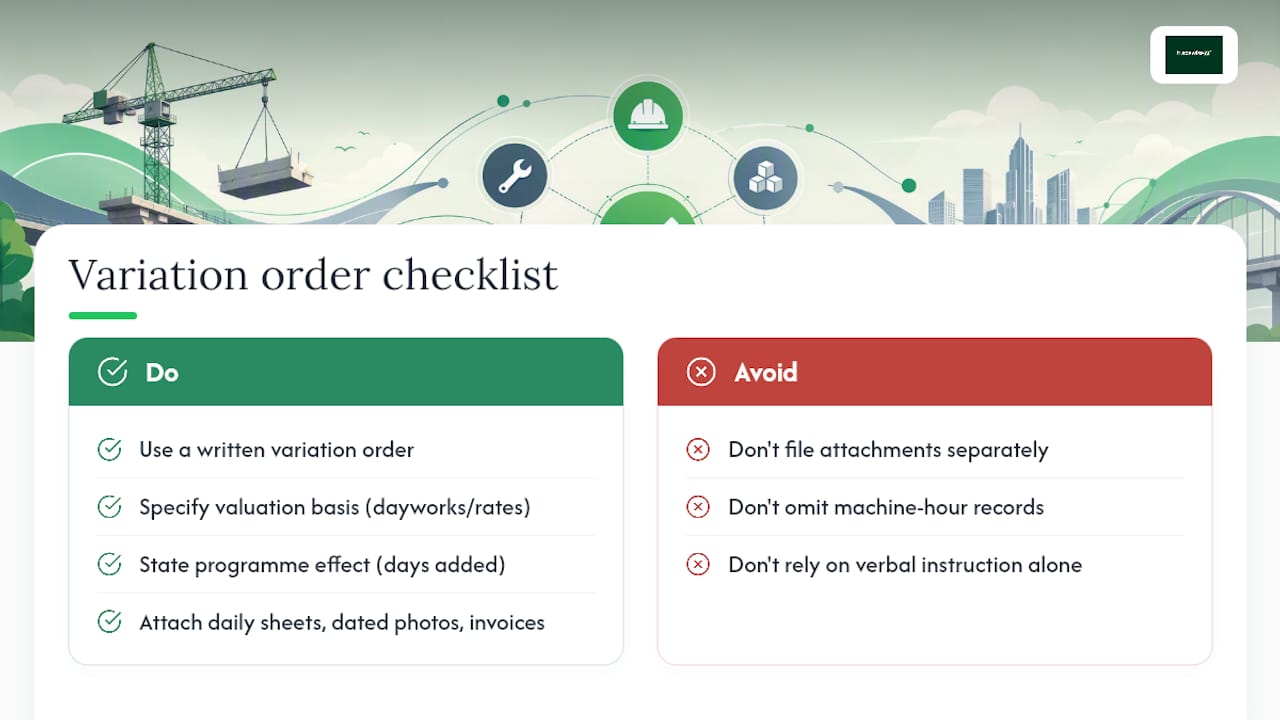
Picture this: an excavation crew hits solid rock two metres below the expected founding level. The engineer instructs the contractor to proceed using dayworks rates while a full valuation is prepared. Three weeks later, the quantity surveyor challenges the daywork sheets because nobody recorded machine hours against the actual excavation, only against the site generally.
A workable sample clause for your own order might read:
Variation Order No. [X] — Description: excavation of unforeseen rock strata between 2.0m and 2.8m below existing ground level, as instructed on-site on [date]. Valuation basis: dayworks, per attached rate schedule. Programme effect: 4 working days added to the critical path, confirmed at time of instruction. Authorised by: [name, title]. Attachments: daily allocation sheets, three dated photographs, plant hire invoice.
File the daily allocation sheets, dated photographs, and any material or plant invoices with the order itself, not in a separate folder you'll struggle to find later. Structured job sheets make this far easier to reconstruct months on.
Best practices and pitfalls to avoid
Keep a single, live variation register rather than scattering emails across inboxes. Use one template for every instruction so nothing is missing when it lands on a surveyor's desk. Price provisional sums early rather than waiting until they become urgent, and flag when cumulative variations start approaching any contractual ceiling on value.
The pitfalls that recur most:
- Acting on verbal instructions without written confirmation. Remedy: request confirmation immediately, and start your own written record regardless.
- Failing to reserve time at the point of instruction. Remedy: state a provisional time effect even if it's an estimate, and revise it later.
- Mixing up requests, instructions and agreements in the same document. Remedy: keep the three stages clearly labelled and dated.
- Weak recordkeeping. Remedy: daily reports and dated photographs, filed the same day. Good daily reporting habits make this close to automatic.
The time effect is where most disputes actually start
Practitioner analysis of JCT contract disputes points to a recurring pattern: time effects left "to be settled later" routinely turn into disputes and liquidated damages exposure months down the line.
Pro Tip: Add one line to every instruction you issue or receive: "Time effect: [X days / to be confirmed within 5 working days]." That single habit closes off the most common route to a dispute.
A contracts manager's first-person walk-through
I get the site call first, always. My next move is confirming written authority before anyone lifts a tool, not after. I get provisional pricing moving the same day, even if it's rough, and I issue a reservation on time immediately if the instruction is unclear. Work only starts if the variation clause genuinely compels it. Then I update the programme and register before the week is out, and I keep the client looped in throughout, because a surprised client at final account stage is worse than an early, honest conversation about cost.
Where a trade management system fits into your variation process
Paper trails are exactly where variation disputes get won or lost, and most contractors lose them not on substance but on missing evidence. A job and variation register built into a system like TradeWise attaches photographs, daywork sheets and time-impact notes directly to the job record the moment they're captured, rather than scattered across someone's phone gallery and a half-finished spreadsheet.

TradeWise lets your team log an instruction, attach evidence, and flag the time effect against the job in one place, so nothing depends on someone remembering to update a register three weeks later. That matters most on jobs running several concurrent variations, where cumulative cost and time exposure is easy to lose track of. If you're managing variations across multiple live jobs, start a trial with TradeWise and see how a live register changes your billing conversations at final account.
Frequently asked questions
What is the main difference between a change order and a variation order? A variation order typically instructs a change and often compels the contractor to proceed before price is finalised. A change order more commonly documents a change once both parties have already agreed scope, cost and time.
What is a variation order in construction? It's a formal, written instruction from an authorised party (often an engineer or employer's representative) that modifies the contracted scope, quality, or programme, with price and time adjusted under the contract's valuation rules.
Can a contractor refuse a change order or variation instruction? Generally only where the contract has no instruction clause, or nothing has been issued in writing. Under most standard forms, once a valid instruction is given, you're obliged to proceed while valuation is resolved.
Who is usually authorised to issue a variation order? The contract names this explicitly, commonly the engineer, employer's agent, or project manager. Instructions from anyone else carry real risk of non-payment.
Why does recording the time effect matter so much? Leaving programme impact unresolved at the point of instruction is one of the most common causes of later disputes and liquidated damages claims, according to practitioner guidance on JCT contract variations.
This article is general information, not a substitute for advice from a qualified lawyer. Consult a qualified legal professional about your own circumstances before acting on anything here.
Sources
- Valuing change (RICS guidance)
- Variations and change orders on construction projects (journal article)
- Change order in construction: meaning, process, pricing, types, and common risks