

Quoting errors are the quiet killers of construction profitability. They rarely announce themselves until a project is underway and the numbers stop adding up. The most common construction quoting errors UK contractors face include inaccurate material takeoffs, underestimated labour costs, missed scope changes buried in addenda, omitted overhead costs, and no structured review before submission. Tools such as ALM Estimating, ProcurePro, and Tradewisehq's TradeWise AI platform are increasingly used to catch these mistakes before they become expensive commitments.
Here is a quick reference of the ten errors that appear most frequently in UK bids:
- Inaccurate or incomplete material takeoffs
- Underestimating labour costs and productivity rates
- Missing scope changes and addenda
- Omitting overhead and indirect costs
- Bundling labour and materials as a single line item
- Skipping a structured final review
- Bidding without qualifying the lead
- Using outdated supplier price lists
- Applying a flat contingency percentage instead of risk-sizing
- Mismanaging subcontractor quotes and scope gaps
Table of Contents
- What common construction quoting errors actually cost you
- How to avoid these quoting errors before they reach the client
- What UK industry experts and TradeWise AI say about improving estimates
- Try Tradewisehq's TradeWise AI for more accurate quotes
- Key takeaways
What common construction quoting errors actually cost you
Understanding why these errors occur is more useful than simply listing them. Each one has a distinct cause and a predictable financial consequence.
1. Inaccurate material takeoffs
Takeoff errors are usually the first domino. They stem from working off superseded drawings, measuring manually without cross-checking, or applying a generic waste factor across every trade. Waste factors should be calculated specifically per trade and site condition rather than using a flat project rate. A plasterer working on a complex ceiling profile wastes material at a very different rate than one boarding a straight partition wall. Get the takeoff wrong and every downstream figure is built on sand.

2. Underestimating labour costs
Labour is where UK contractors bleed money most quietly. Productivity assumptions lifted from a previous project in a different region, or from a price book that hasn't been updated, rarely reflect reality on site. Regional wage variation across the UK is significant: a groundworker in central London commands a meaningfully different day rate than one in the East Midlands. Add employer's National Insurance contributions, holiday pay, and tool allowances, and the true cost of a worker on site is substantially higher than the headline hourly rate.

3. Missing scope changes hidden in addenda
A single missed addendum can turn a profitable bid into a loss-making project. Contractors often skim addenda rather than cross-referencing each change against the original drawings and their takeoff. A revised structural detail, a substituted specification, or an added drainage run can add tens of thousands of pounds to the actual scope while the bid price stays fixed. Reading addenda thoroughly and updating the estimate accordingly is not optional.
4. Omitting overhead and indirect costs
Failing to include operational overhead reduces profitability by making projects appear cheaper than they actually are. Office rent, insurance premiums, accounting fees, vehicle costs, software subscriptions, and management salaries all need to be recovered through project revenue. Estimators must calculate actual company overhead and apply it consistently across every bid, not just the larger ones where it feels more obvious.
5. Bundling labour and materials together
When labour and materials appear as a single combined line, there is no way to verify accuracy or identify which element caused an overrun after the fact. Separating labour (hours and burden rate) and materials (quantities and unit price) gives you a clear audit trail and makes post-project analysis genuinely useful. It also makes it far easier to spot a supplier quote that looks suspiciously low before you commit.
6. Skipping the final review
Introducing a structured review step catches errors before bids become financial commitments. Yet many estimators submit without one, particularly under deadline pressure. A review checklist should verify cost categories, confirm overhead has been applied, check that the margin floor has been met, and document all assumptions. Without this step, errors that would take five minutes to fix in the estimate can take months to recover from on site.
7. Bidding without qualifying the lead
Failing to properly qualify leads results in rushed quotes for projects that were never a good fit. Bidding on every job indiscriminately means spreading estimating resource thin, producing error-prone quotes, and winning work that strains capacity or falls outside your team's competencies. A contractor who wins a specialist fit-out contract without the right subcontractor relationships is setting up a cost overrun before the first nail goes in.
8. Using outdated supplier price lists
Material price changes within weeks make using current quotes essential for accurate bids. Timber, steel, insulation, and copper pipework have all seen significant price volatility in recent years. A supplier price list that is not up-to-date is a liability in a volatile market. Always request fresh quotes for materials that represent a significant proportion of the project value, and build in a price validity clause where the contract allows.
9. Applying a flat contingency percentage
A flat 5% or 10% contingency applied to every project regardless of complexity is not risk management. Risk-sizing contingencies by breaking down potential risks and assigning monetary values produces a far more accurate allowance. A groundworks package on a brownfield site carries very different risk exposure to a straightforward internal refurbishment. Treating them identically either leaves you exposed or prices you out of competitive work.
10. Mismanaging subcontractor quotes
Subcontractor quotes frequently omit scope elements, and comparing them at face value leads to cost surprises mid-project. Using bid equalisation to adjust quotes for missing inclusions prevents inaccurate comparisons and unexpected extras. If one groundworks quote excludes disposal of contaminated material and another includes it, the cheaper headline figure is not cheaper at all. Normalising each sub-bid for scope differences before selecting a figure is a discipline that pays for itself on every project. For more on managing subcontractor costs effectively, the process starts well before tender return.
How to avoid these quoting errors before they reach the client
Prevention is mostly about process, not talent. The estimators who produce consistently accurate bids are not necessarily more skilled than those who don't. They have better habits and better tools.
Scope definition and site visits
Never price from drawings alone. A site visit reveals ground conditions, access constraints, existing services, and neighbour sensitivities that no drawing communicates. Agree the scope in writing with the client before pricing, and flag any items that require a provisional sum or a specialist survey. Scope ambiguity is where disputes begin, and disputes are expensive regardless of who is right. Guidance on accurate building work quotes covers this in detail for UK contractors.
Segregate labour and materials from the start
Build your estimate template so that labour hours, burden rates, material quantities, and unit prices are always separate columns. This is not extra work; it is the structure that makes checking possible. When a project runs over, you will know within a week whether it is a labour productivity problem or a materials pricing issue.
Apply overhead consistently
Calculate your company's annual overhead as a percentage of turnover, then apply that percentage to every project estimate without exception. The temptation to skip it on smaller jobs, or to reduce it to win a bid, is how contractors end up busy and broke. UK VAT compliance adds another layer of complexity here, particularly under the construction VAT reverse charge rules, which affect how VAT is accounted for between contractors and subcontractors.
Verify supplier quotes before submission
For any material line that represents a significant portion of the project value, get a written quote with a validity period. Do not rely on price books or last month's invoice. If a supplier cannot provide a written quote in time for your tender return, use a conservative estimate and note the assumption clearly.
Use a pre-submission checklist
The lack of a mandatory review process is arguably the single most critical estimation error. A checklist does not need to be long. It needs to confirm: all cost categories are present, overhead has been applied, the margin floor has been met, all assumptions are documented, and the scope matches the latest drawings and addenda. Five minutes before submission can save five months of financial pain.
Qualify your leads
Contractors should strategically choose projects aligned with their capacity and competencies for sustainable profitability. Before committing estimating resource to a tender, ask whether you have the right subcontractor relationships, whether the programme suits your current workload, and whether the client has a realistic budget. Declining to bid is not losing work. It is protecting the quality of the bids you do submit.
Risk-size your contingency
Break the project into risk categories: ground conditions, weather exposure, specialist trades, programme dependencies. Assign a monetary value to each risk based on probability and impact. The total is your contingency. It will rarely be a round percentage, and that is the point.
Use digital tools to reduce manual error
Digital takeoff software reduces the transcription errors that plague manual measurement. Platforms that integrate takeoff, pricing, and bid management reduce the number of times a figure is re-entered by hand, which is where most arithmetic errors creep in. Construction scheduling software that links workforce planning to project timelines also helps estimators build more realistic labour cost assumptions from the outset.
Pro Tip: When applying contingency, resist the urge to add a single percentage at the end. Instead, list each identified risk, assign it a cost if it materialises, and multiply by your estimated probability. Sum those figures. The result is a contingency that reflects your actual risk exposure, not a guess dressed up as a number.
What UK industry experts and TradeWise AI say about improving estimates
The pattern that emerges from experienced UK estimators is consistent: the technical skills are rarely the problem. The process is.
Estimators who produce accurate bids tend to treat every quote as a system, not a one-off calculation. They use templates, checklists, and structured workflows that make errors visible before submission rather than after. They also know which projects to decline, which is a skill that takes time to develop but pays dividends quickly.
Tradewisehq's TradeWise AI platform is built around exactly this kind of systematic approach. Rather than replacing estimator judgment, it automates the repetitive elements of quoting, such as pulling material costs, generating itemised quote documents, and flagging missing cost categories, so that the estimator's attention goes where it matters most: scope interpretation, risk assessment, and client communication. For UK tradespeople managing multiple live projects simultaneously, the ability to generate and track quotes from a mobile device without losing accuracy is a practical advantage that compounds over time.
The role of digital quoting tools for UK builders has shifted from a nice-to-have to a practical necessity as project complexity and material price volatility have both increased. Contractors who still rely on spreadsheets and memory are not just slower; they are carrying more risk on every bid they submit.
Pro Tip: Before adopting any new quoting tool, map your current estimating process on paper first. Identify where errors have occurred in the past six months. The tool should solve those specific failure points, not just add features. TradeWise AI's mobile-first design is particularly effective for contractors who price jobs on site rather than in an office.
Try Tradewisehq's TradeWise AI for more accurate quotes
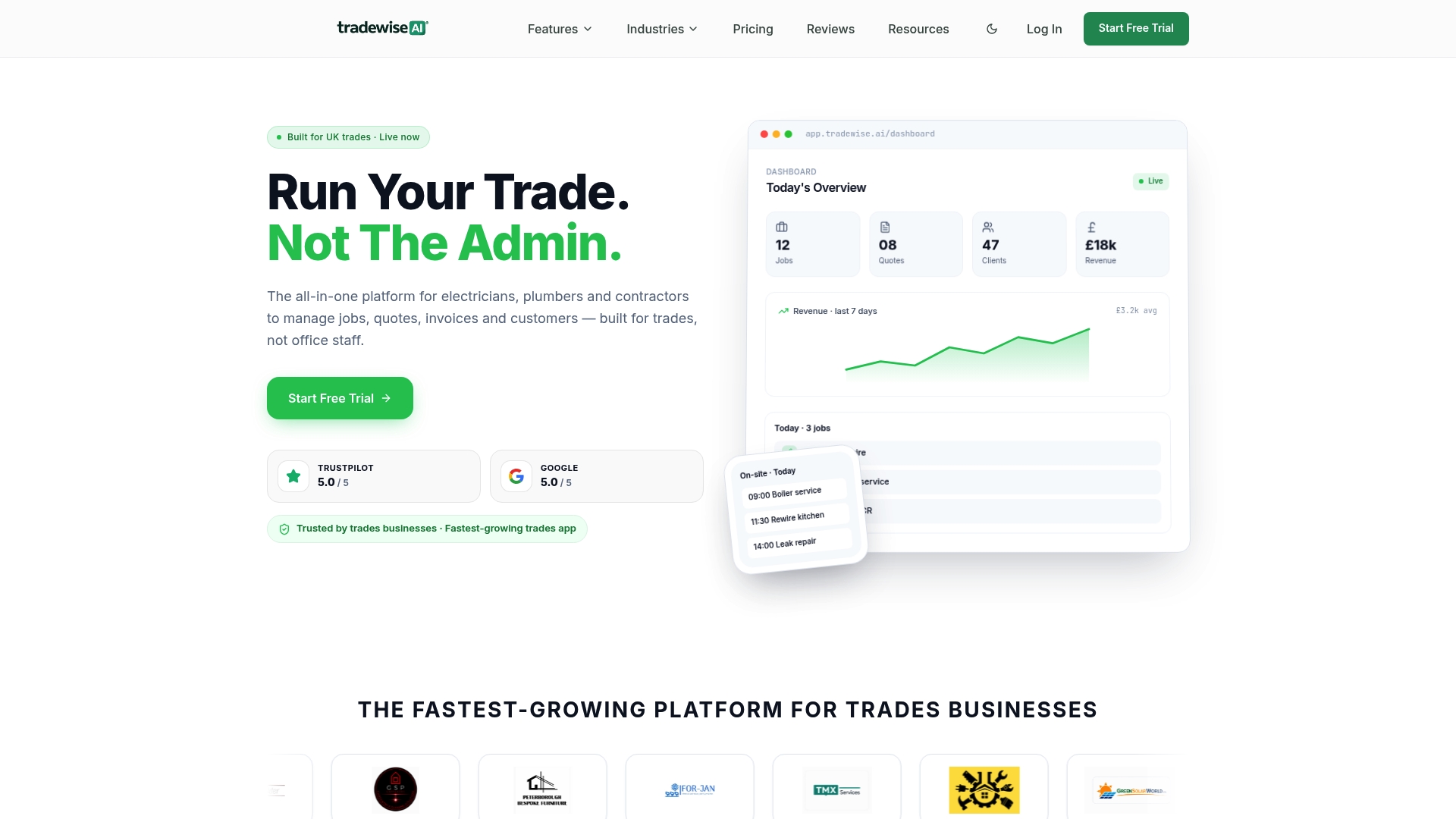
Construction estimate inaccuracies are not inevitable. With the right process and the right tools, UK contractors can produce bids that are both competitive and profitable. Tradewisehq's TradeWise AI platform brings quoting, scheduling, job management, and client communication into a single mobile-first system, reducing the manual steps where errors typically enter the process.
Whether you are a sole trader pricing domestic extensions or a regional contractor managing multiple commercial tenders, TradeWise AI adapts to your workflow and helps you quote with confidence.
Key takeaways
Accurate construction quotes require a combination of disciplined process, current pricing data, and a structured review before every submission.
| Point | Details |
|---|---|
| Separate labour and materials | Always price labour hours and material quantities as distinct line items to enable accurate cost control. |
| Apply overhead to every bid | Calculate your actual company overhead rate and apply it consistently, including on smaller projects. |
| Review before submission | A pre-submission checklist covering cost categories, overhead, margin, and assumptions catches errors before they become commitments. |
| Risk-size your contingency | Break down project risks individually and assign monetary values rather than applying a flat percentage. |
| Qualify leads before bidding | Only commit estimating resource to projects that match your capacity, competencies, and subcontractor relationships. |