

Digital quoting is the process of creating, sending, and tracking construction estimates through software rather than paper or spreadsheets. For UK builders, the role of digital quoting for builders goes well beyond document presentation. It enforces a structured sales process, reduces pricing errors, and gives you real-time visibility into every proposal in your pipeline. Digital proposals close 1.5 to 2 times more often than paper or email estimates on residential jobs. That single shift in method changes how you win work, manage clients, and run your business.
How does digital quoting improve close rates for builders?
The core sales advantage of digital quoting is not a polished PDF. It is the structured process that digital tools enforce. Presenting good-better-best pricing tiers and capturing an e-signature on-site compresses the sales cycle from 4–7 days to under one hour. That is the mechanism behind higher close rates, not the logo on the document.
Digital conversion rates sit between 32% and 48%, compared to 17%–22% for traditional paper or email methods. That gap represents real jobs won or lost every month. For a builder sending ten quotes a week, moving from a 20% close rate to a 35% close rate means three or four additional contracts without changing your marketing spend.

Good-better-best pricing works because it shifts the client's decision from "yes or no" to "which option." Clients who see three clearly priced tiers regularly choose the middle or premium option. This lifts average ticket size without any additional selling effort on your part.
Integrated financing options within a quote remove another common objection. When a client can see monthly payment options alongside the total price, the conversation moves forward faster. Builders who win more contracts in the UK consistently use this combination of tiered pricing and on-site sign-off.
Real-time quote status tracking shows you whether a quote is in draft, viewed, accepted, or declined. That visibility shifts your follow-up from guesswork to strategy. You know exactly which proposals need attention and when.
Pro Tip: When a client opens your quote multiple times within 24 hours, that is a strong buying signal. Quote open-tracking tells you the exact moment to call. Builders who act on that signal report significantly better close rates than those who follow a fixed follow-up schedule.
What practical benefits does digital quoting offer builders?
Speed is the first operational benefit that builders notice. 70% of homeowners report that same-day quote delivery positively affects their choice of contractor. Delays of 24–72 hours hand the job to a faster competitor. Digital tools let you build and send a quote within two hours of leaving a site visit.
Accuracy is the second benefit, and it compounds over time. Structured price books eliminate manual arithmetic errors. When your materials, labour rates, and margins are pre-loaded, every quote calculates correctly. You stop underpricing jobs because you forgot a line item, and you stop losing clients because a quote looked unprofessional.
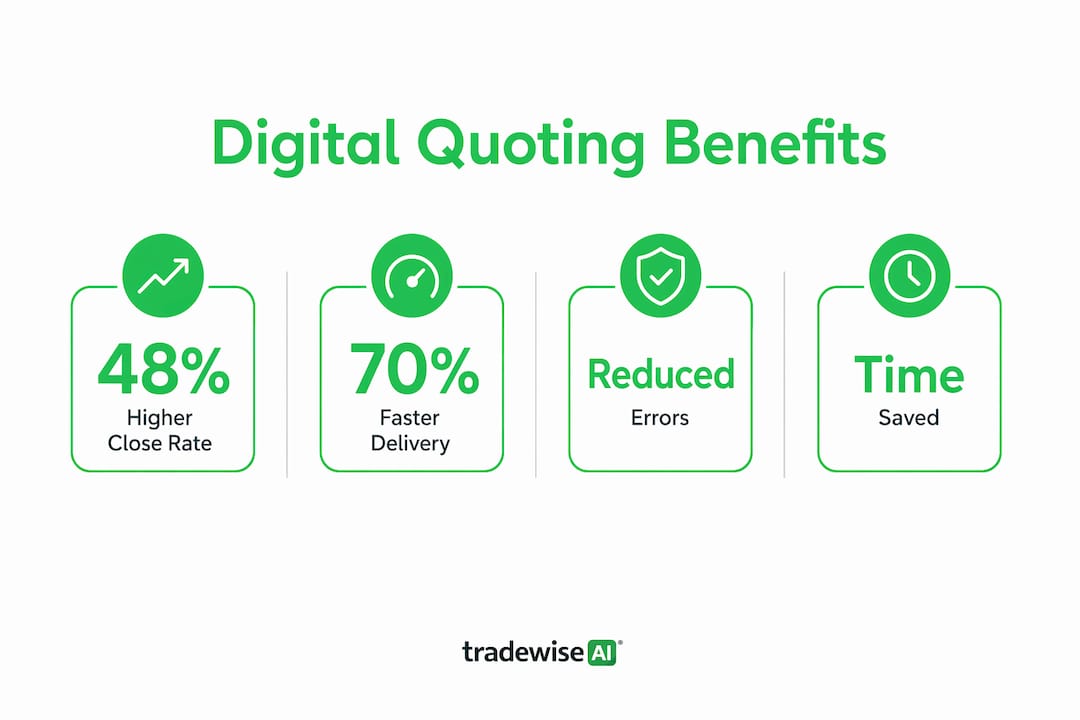
Templates and automation reduce the time spent on repetitive work. A loft conversion quote that once took three hours to build from scratch takes twenty minutes when you start from a well-built template. That time saving adds up across a full week of estimating.
Pro Tip: Build a template library organised by job type: extensions, loft conversions, kitchen fits, bathroom refits. Each template should include your standard line items, terms, and payment schedule. Customise the specifics for each client rather than rebuilding from zero.
The pipeline view in a digital quoting tool functions like a sales dashboard for your business. You can see the total value of open quotes, which ones are close to expiry, and which clients have gone quiet. That visibility lets you manage client relationships proactively rather than reacting when work dries up.
Automation in construction firms also reduces the risk of duplicate data entry. When a quote converts to a job, the client details, scope, and pricing flow directly into your job management system. You do not retype anything, and nothing gets lost in translation between your quoting and scheduling processes.
How can UK builders implement digital quoting effectively?
Start by assessing your current quoting volume and job types. A sole trader sending five quotes a week has different needs from a firm managing twenty concurrent projects. Entry-level quoting tools suit smaller operations, while integrated platforms that connect quoting, scheduling, and invoicing suit growing firms.
The implementation steps that deliver the fastest results are:
- Load your price book first. Enter your standard materials, labour rates, and margins before you send a single digital quote. This is the foundation of accuracy and speed.
- Adopt good-better-best pricing on every quote. Structure every proposal with three tiers from the first week. The habit builds quickly and the results show up in your close rate within a month.
- Add financing options to your quote template. Even if only one in five clients uses it, that client would otherwise have delayed or declined.
- Capture e-signatures on-site. Bring a tablet or phone to every site visit. Present the quote in person and ask for a decision before you leave.
- Integrate quoting with your job management and accounting tools. This is where job management software pays for itself. Accepted quotes trigger job creation, deposit requests, and scheduling automatically.
The maturity path for most UK builders runs from basic templates to full pipeline visibility over three to six months. Do not try to implement everything at once. Get the price book and templates right first, then layer in tracking and automation.
Pro Tip: Run your first digital quotes alongside your existing process for two weeks. Compare the time spent and the client responses. The contrast makes the case for full adoption far more convincingly than any article can.
Quoting building work accurately is a skill that digital tools support but do not replace. You still need sound knowledge of materials costs, labour productivity, and local market rates. The software handles the arithmetic and presentation. The judgement remains yours.
What future trends are shaping digital quoting for builders?
AI quoting tools represent the most significant shift in builder proposal software right now. These tools generate a first-draft estimate from job photos and learned job patterns. AI tools reduce administrative overhead by 25 minutes per quote and increase average ticket size through multi-tier pricing. A task that once took 30 minutes takes closer to 5 minutes with AI assistance.
The key limitation is accuracy. AI quoting tools provide a first-draft estimate based on photos and learned patterns, but they require human review and adjustment to meet compliance and site-specific conditions. The estimator's role shifts from manual measurement to validation and decision-making. That is a meaningful change in how builders spend their time, not an elimination of expertise.
Mobile quoting is the second major trend. Builders who can produce a quote on-site, on a phone or tablet, remove the delay between visit and proposal entirely. The client receives a professional document before the builder has left the driveway. That speed advantage is difficult for competitors using spreadsheets to match.
The data benefits of digital workflows are less visible but equally valuable. Implementing digital construction workflows drives win rate increases from 10% to 30%, with revenue growth reported between 30% and 700% within 1–1.5 years after digitisation. Those figures reflect the compounding effect of faster quoting, better close rates, and improved project management working together.
Quoting volume increases are another measurable outcome. Some builders go from 10 to 30 proposals per day after adopting digital workflows. That scale of output is impossible with manual methods and fundamentally changes the growth potential of a small firm.
Key takeaways
Digital quoting gives UK builders a measurable advantage in close rates, speed, and operational accuracy. The most effective approach combines good-better-best pricing, on-site e-signatures, and real-time pipeline tracking to win more work and reduce administrative waste.
| Point | Details |
|---|---|
| Higher close rates | Digital proposals close 1.5 to 2 times more often than paper estimates on residential jobs. |
| Speed wins jobs | 70% of homeowners say same-day delivery positively affects their contractor choice. |
| Structured pricing lifts revenue | Good-better-best tiers shift client decisions and increase average ticket size without extra selling. |
| AI reduces quoting time | AI tools cut 25 minutes per quote and turn a 30-minute task into a 5-minute one. |
| Integration removes duplication | Connecting quoting to job management eliminates duplicate data entry and accelerates scheduling. |
Why I think most builders underestimate what digital quoting actually does
Builders who resist digital quoting usually frame it as a technology preference. They say they prefer to keep things simple, or that their clients do not care about a polished document. I understand that instinct, but it misses the point entirely.
The document is not the product. The process is. When you sit in front of a client with three clearly priced options and a tablet ready for a signature, you are running a fundamentally different sales conversation. You are not leaving and hoping they call back. You are closing on the day. That shift in process is what the data reflects when it shows close rates nearly doubling.
The operational side surprised me more than the sales side. The time saved on repetitive quoting is real, but the bigger gain is the mental clarity that comes from a visible pipeline. Knowing exactly which quotes are open, which clients have gone quiet, and what the total value of pending work is changes how you plan your week. You stop reacting and start managing.
The builders I have seen struggle with implementation almost always try to do too much at once. They want the AI, the templates, the integration, and the analytics from day one. The ones who succeed start with a solid price book and one good template. Everything else follows naturally once the habit is in place.
Digital quoting is not a luxury for larger firms. For a sole trader or small team in the UK, it is one of the fastest ways to win more work without hiring more people.
— Mateusz
How Tradewisehq helps builders quote faster and win more work
Tradewisehq is built for exactly this kind of operation. It combines digital quoting and job management in one mobile-first platform designed for UK tradespeople and builders. You can build quotes from a structured price book, present good-better-best options to clients, capture e-signatures on-site, and watch the job flow directly into scheduling and invoicing without retyping a single detail.
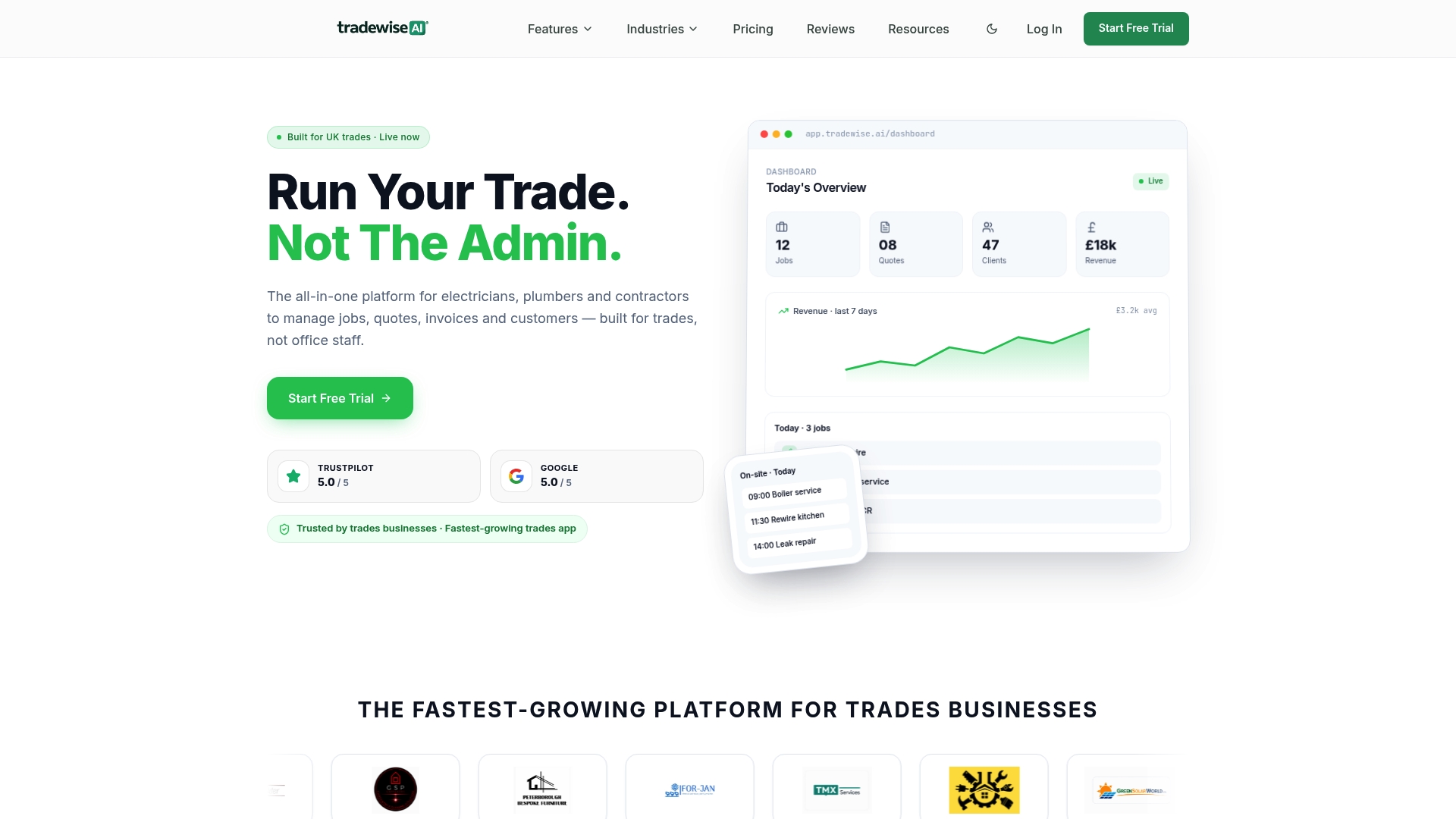
The real-time pipeline view shows every quote's status at a glance. AI tools inside the platform cut the time spent on each estimate significantly. For builders who want to send more proposals, close more jobs, and spend less time on admin, Tradewisehq brings every part of that process into one place. Visit Tradewisehq to see how it fits your workflow.
FAQ
What is digital quoting for builders?
Digital quoting is the process of creating and sending construction estimates through software rather than paper or email. It automates pricing calculations, formats proposals professionally, and tracks quote status in real time.
How much does digital quoting improve close rates?
Digital proposals close 1.5 to 2 times more often than paper estimates, with conversion rates of 32%–48% compared to 17%–22% for traditional methods. The improvement comes from structured pricing and on-site e-signatures, not just document appearance.
How quickly should a builder send a quote after a site visit?
Same-day delivery is the standard that wins jobs. Research shows 70% of homeowners say same-day quote delivery positively affects their choice of contractor, and delays of 24–72 hours risk losing the job to a faster competitor.
Do AI quoting tools replace the estimator's judgement?
AI tools generate a first-draft estimate from photos and job patterns but require human review for accuracy and compliance. The estimator's role shifts from manual measurement to validation, not elimination.
What is good-better-best pricing in a builder's quote?
Good-better-best pricing presents three clearly priced options within a single proposal. It shifts the client's decision from "yes or no" to "which option," and regularly results in clients choosing the middle or premium tier, increasing average job value.