
A builder's quote in the UK is a legally binding fixed price offer to carry out a defined scope of construction work for an agreed sum. Once you accept it, the price is locked. The builder cannot raise it unless you change the scope. This makes a quote fundamentally different from an estimate, which is an informed approximation with no legal obligation to hold the price. For any homeowner or property investor planning construction work, understanding what a builder's quote actually is protects your budget and your legal position before a single brick is laid.
What is a builder's quote in the UK and what must it include?
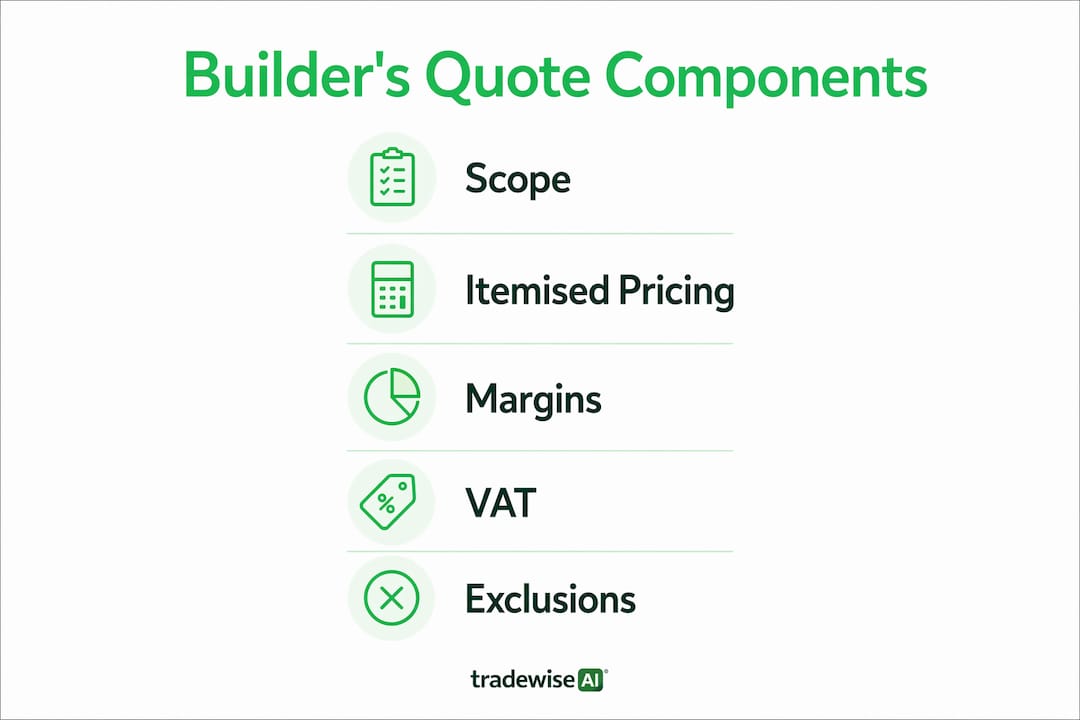
A professional builder's quote is more than a number on a page. It is a document that defines exactly what work will be done, at what cost, under what conditions, and by when. Every professional quote must contain a detailed scope of work, itemised pricing, VAT status, a list of exclusions, a payment schedule, and a validity period.
The scope of work is the foundation. It should name every task, specify materials, and state clearly what is not included. Vague phrases like "works as discussed" are a red flag. They invite scope creep and disputes once work begins.

Itemised pricing breaks the total cost into labour, materials, and preliminaries. Preliminaries are the site management costs that many homeowners overlook. These include skip hire, scaffolding, site insurance, and welfare facilities. Preliminaries typically represent 8–15% of total project costs. On a £60,000 project, that is £4,800 to £9,000 sitting in a line you might otherwise dismiss.
Builders also add a margin of 10–25% on materials to cover ordering, handling, and procurement risk. This is standard industry practice. What matters is that the quote specifies the materials clearly, including brand and grade, so you are not paying a premium for a vague term like "insulation."
VAT is where many homeowners get caught out. Builders with turnover above £90,000 must charge 20% VAT. On a £65,000 project, a missing VAT disclosure can add £13,000 to your final bill. The quote must either show VAT separately or state explicitly that the builder is not VAT registered.
Pro Tip: Always ask the builder to confirm their VAT registration number in writing. Cross-check it on the HMRC online VAT checker before signing anything.
Here is a summary of what a complete builder's quote must contain:
- Scope of work: Every task listed, with materials specified by brand or grade where relevant
- Exclusions: A clear list of what is not covered, such as building regulation fees or party wall surveyor costs
- Itemised pricing: Labour, materials, and preliminaries shown separately
- VAT status: Either VAT shown at 20% or a written statement that the builder is not VAT registered
- Payment schedule: Milestone-based payments, not time-based
- Validity period: The date by which you must accept the quote for the price to hold
Common omissions include building regulation fees and party wall surveyor costs, which can run to £700–£1,500 per neighbour. These costs are real and predictable. A builder who leaves them out is either inexperienced or hoping you will not notice.
How does a builder's quote differ from an estimate?
The distinction between a quote and an estimate is one of the most misunderstood points in UK construction. A quote is a fixed price offer. An estimate is an approximation. Estimates typically carry 10–20% leeway, meaning the final bill can legitimately exceed the figure given. A quote, once accepted, locks in the price and scope.
The confusion deepens because builders frequently use the two terms interchangeably. A document titled "estimate" may actually function as a binding quote if it contains a fixed price and a clear scope. Courts rule on the substance of the document, not its title. If the document reads like a fixed price offer, a judge will treat it as one.
"The primary risk with builder quotes is semantic confusion between 'quotes' and 'estimates'. Focus on the legal substance of the document to determine your rights, not the label at the top of the page."
This matters enormously for budgeting. If you accept what a builder calls an "estimate," you may have no legal recourse when the bill arrives 25% higher. Always check whether the document states a fixed total, defines the full scope, and includes a validity period. If it does, you likely have a binding quote regardless of what the builder calls it. For a deeper look at how builders price a job, the cost breakdown behind any figure is worth understanding before you compare documents.
How to read a builder's quote for UK construction projects
Reading a builder's quote properly takes about 30 minutes and can save you thousands. Most homeowners scan the total and sign. That is the single most expensive mistake you can make.
Follow this process when you receive a quote:
- Check the scope first. Read every line of the scope of work. If a task you discussed is missing, it is not included. Do not assume.
- Review the exclusions section. This is often the most important part of the document. Vague wording like "works as discussed" is not an exclusion. It is an open door to disputes.
- Examine the materials specification. Vague terms like "insulation" or "tiles" without brand, grade, or specification are red flags. You could end up with the cheapest option available.
- Check the VAT position. Confirm whether the total is inclusive or exclusive of VAT. If the builder is VAT registered, the 20% addition is significant.
- Scrutinise the payment schedule. Deposits of 10–25% upfront are reasonable. Paying more than a third before work begins is high risk. Payments should be tied to completed milestones, not calendar dates.
- Note the validity period. A quote is only valid until its expiry date. If you delay your decision, the price may change.
Pro Tip: Ask the builder to walk you through the exclusions section verbally. Builders who know their quotes well will do this without hesitation. Those who cannot explain their own exclusions are a warning sign.
The table below shows the key line items to check and what to look for in each:
| Quote line item | What to check |
|---|---|
| Scope of work | Every agreed task is listed; no vague phrases |
| Materials | Brand, grade, and specification stated clearly |
| Preliminaries | Skip hire, scaffolding, and insurance itemised |
| VAT | Shown separately or builder confirmed non-registered |
| Payment schedule | Milestone-based; deposit no more than 25% |
| Exclusions | Specific items listed, not general disclaimers |
| Validity period | Date stated; accept before expiry |
Understanding how to quote building work accurately from the builder's perspective also helps you spot where corners are being cut.
What common pitfalls should UK homeowners avoid?
Accepting the wrong quote costs homeowners money, time, and sometimes their relationship with a builder. These are the mistakes that cause the most damage.
- Accepting vague quotes. A quote without a detailed scope is not a quote. It is an invitation to dispute. Never accept a document that does not specify every task and material.
- Ignoring VAT. A builder with turnover above £90,000 must charge VAT. If the quote does not address VAT, ask directly. A £50,000 quote that excludes VAT becomes a £60,000 bill.
- Overlooking exclusions. Building regulation fees, party wall surveys, and structural engineer reports are frequently excluded. These are not optional costs. Budget for them separately.
- Accepting large upfront payments. Paying more than 25–30% before work starts gives you very little leverage if problems arise. Milestone-based payments protect you throughout the project.
- Missing the validity period. Quotes expire. If you accept a quote after its validity date, the builder is entitled to reprice. Always check the expiry date and act before it passes.
- Choosing the cheapest quote without comparing scope. Two quotes at different prices may cover entirely different scopes. A lower price that excludes preliminaries, VAT, or key tasks is not cheaper. It is incomplete.
Pro Tip: Get at least three quotes for any project above £5,000. Compare them line by line against the same scope, not just the total figure. A written contract based on the accepted quote is the next step.
How does understanding builder's quotes improve your budgeting?
A detailed builder's quote is the most reliable budgeting tool available before construction begins. It gives you price certainty, which no estimate can provide.
When you compare itemised quotes, you see exactly where money is going. One builder may price labour lower but materials higher. Another may include preliminaries that a third has left out entirely. Comparing totals without comparing line items produces a false picture of value.
Realistic budgeting also means accounting for costs outside the quote. Building regulation fees, party wall surveys, and structural engineer reports are common additions. Add a contingency of 10–15% on top of the accepted quote total to cover unforeseen conditions, particularly in older properties.
Clear communication with your builder before the quote is issued reduces surprises later. Agree the full scope in writing before asking for a price. Changes to scope after a quote is accepted trigger variation orders, which add cost and delay. The more precisely you define the work upfront, the more accurately the quote reflects the final bill.
A well-structured quote also forms the basis of your contract. Digital quoting tools used by professional builders produce documents that translate directly into contract terms, reducing ambiguity and protecting both parties.
Key takeaways
A builder's quote in the UK is a legally binding fixed price document, and treating it as anything less puts your budget and your legal rights at risk.
| Point | Details |
|---|---|
| Quote vs estimate | A quote is legally binding once accepted; an estimate carries 10–20% leeway and is not binding. |
| VAT disclosure | Builders over £90,000 turnover must charge 20% VAT; always confirm VAT status before accepting. |
| Preliminaries matter | Site costs like skip hire and scaffolding represent 8–15% of project costs and must appear in the quote. |
| Payment terms | Deposits of 10–25% are reasonable; never pay more than a third before work begins. |
| Read the exclusions | Vague exclusion wording causes scope creep; every excluded item must be named specifically. |
Why I always tell homeowners to read the exclusions first
Most people go straight to the total. I understand why. The number at the bottom feels like the answer. But after years of watching homeowners get stung by construction projects that went over budget, I am convinced the exclusions section is where the real story lives.
A builder who writes "works as discussed" in the exclusions section is not being lazy. They are leaving a door open. When the dispute comes, and it often does, that phrase becomes the battleground. I have seen projects balloon by 30% because a homeowner assumed groundworks were included when the quote said nothing of the sort.
The other thing I have noticed is that a well-structured quote tells you something about the builder before they lift a tool. A builder who takes the time to itemise preliminaries, specify materials by grade, and set out milestone payments is showing you how they think. That level of care in a document usually reflects the same care on site. A quote that is one page with a single total figure is a warning, not a bargain.
My honest advice: insist on a written, itemised quote for every project, no matter how small. Read the exclusions before you read the total. And if a builder cannot explain what they have excluded and why, find someone who can.
— Mateusz
How Tradewisehq helps builders produce quotes you can trust

Tradewisehq is an AI-powered trade management platform built for UK builders, electricians, plumbers, and contractors. It helps tradespeople produce clear, itemised quotes that include scope, materials, VAT, payment schedules, and exclusions, all in one place. For homeowners, that means receiving documents that are easier to read, compare, and act on. For builders, it means fewer disputes and faster approvals. If you work with a builder who uses Tradewisehq, you are more likely to receive a quote that meets the professional standard described in this article. Explore how the platform supports better quoting, contract management, and job tracking across every stage of a construction project.
FAQ
What is a builder's quote in the UK?
A builder's quote is a legally binding fixed price offer to carry out a defined scope of construction work. Once accepted, the builder cannot raise the price unless you change the agreed scope.
What is the difference between a builder's quote and an estimate?
A quote locks in the price and scope; an estimate is an approximation with 10–20% leeway and no legal obligation to hold the figure. Courts determine which applies based on the document's content, not its title.
Does a builder's quote include VAT?
Not always. Builders with annual turnover above £90,000 must charge 20% VAT, but some quotes show prices exclusive of VAT. Always confirm VAT status in writing before accepting any quote.
How long is a builder's quote valid for?
Most builder's quotes include a validity period, typically 30–90 days. After this date, the builder can reprice. Check the expiry date and accept before it passes to secure the quoted price.
What should I do if two builder's quotes have very different prices?
Compare them line by line against the same scope. A lower quote may exclude VAT, preliminaries, or key tasks. The cheapest total is not always the best value if the scope is incomplete.