

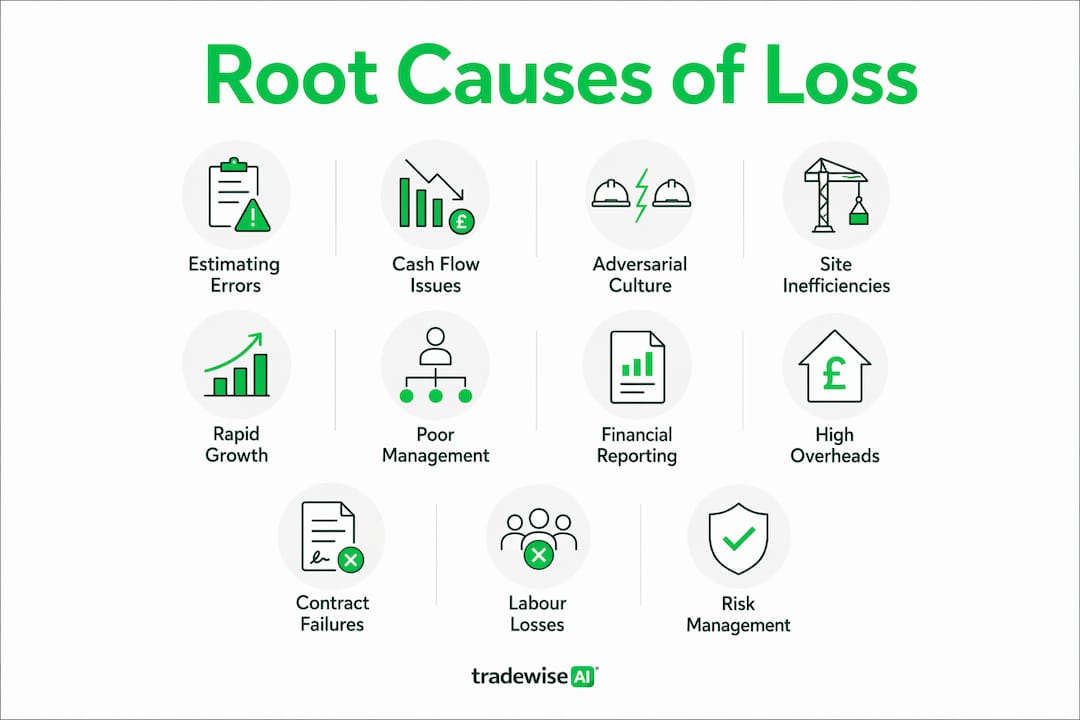
Construction firms lose money not because of one catastrophic event, but because a cluster of structural problems quietly drain margin on every project. Only 36% of construction businesses survive ten years; most firms started in 2011 had closed by 2021. Many had full order books and showed profit on paper. The problem was underneath: estimating errors, cash timing gaps, adversarial contracts, and site inefficiencies that compound until there is nothing left to absorb the next hit.
The core financial pitfalls in UK construction:
- Estimating errors and underbidding that lock in losses before a spade hits the ground
- Cash flow timing mismatches between when money goes out and when it comes in
- Adversarial procurement culture that treats claims as a margin recovery strategy
- Small site inefficiencies that aggregate into serious margin erosion
- Rapid growth that consumes working capital faster than profit can replenish it
- Poor project management leading to schedule overruns and cost blowouts
- Inadequate financial reporting that hides problems until they are too large to fix
- High overhead costs disconnected from project revenue
- Failure to enforce change orders and contract terms
- Labour productivity losses from poor workforce management
- Insufficient risk management with no contingency buffer
Why construction firms lose money: the 11 causes in detail
1. Estimating errors and underbidding
Many construction projects exceed budgets, often resulting in considerable overruns. Poor estimating is the starting gun for most of those failures. When a bid is too low, the firm is locked into a loss-making contract before a single worker arrives on site.
The deeper problem is structural. As the Institution of Civil Engineers' New Engineering Contract framework acknowledges, low-bid procurement actively rewards underbidding. Contractors submit a price they know is thin, then plan to recover margin through change orders and claims once the client is committed. It is a rational response to a broken system, not a failure of individual discipline. Good construction bid management discipline, including firm margin floors and bid/no-bid criteria, is the only reliable defence.
2. Cash flow and working capital challenges
Profit and cash are not the same thing. A firm can show healthy net income while its bank account runs dry, because construction has built-in timing mismatches between when costs hit and when payments arrive. Materials and labour go out weekly. Client payments arrive 60–90 days later, if at all.

Retainage compounds this. Standard retention holds a portion of every payment until project completion, locking up capital for months after the work is done. 82% of construction businesses that failed in 2023 cited cash flow problems as a primary cause.
Pro Tip: Produce a rolling 13-week cash flow forecast for every active project. It is the single tool most likely to surface a crisis before it becomes one.
3. Adversarial procurement and claims culture
The low-bid model does not just create estimating pressure. It poisons the entire project relationship. Once a contractor has underbid, every change in scope becomes a margin recovery opportunity. Claims stop being a last resort and become a planned revenue stream.
The result is inflated total project costs, adversarial relationships, and management time consumed by disputes rather than delivery. Owners who default to lowest-bid procurement rarely get the best price. They get the lowest number at tender, then pay the difference through change orders, delay claims, and the overhead of managing a financially stressed contractor.
4. Small site inefficiencies that accumulate
No single wasted hour breaks a construction firm. But small, frequent inefficiencies on site aggregate into serious margin erosion across a full project programme. Crews waiting on materials, unclear task sequencing, duplicated supervisory effort: each costs minutes, and minutes across a 40-person site across a 12-month project add up to weeks of lost productivity.
The same logic applies to insurance claims. Frequent small claims below the deductible threshold never trigger an insurance payout but steadily drain profit. This "death by a thousand claims" pattern often goes unnoticed until the cumulative damage is severe.
5. Rapid growth and overtrading risk
Growth feels like success. It often precedes failure. Working capital demands scale faster than profit when a firm takes on more projects, because mobilisation costs, retention holdbacks, and payment delays all multiply with revenue while retained earnings grow slowly. A firm growing from £3m to £5m in turnover may need £400,000 or more in additional working capital, but generate only a fraction of that in new profit.
The firms most at risk are those jumping from mid-size residential jobs to large commercial contracts without adjusting their financial structure. The estimating process, billing discipline, and cash reserves that worked at one scale do not automatically work at the next.
6. Poor project management and schedule overruns
'Project manager optimism bias' is a documented phenomenon: project managers tend to assume cost overruns will be recovered in the next phase. They rarely are. By the time a fading project is formally recognised as a loss, the damage is done and the options for recovery are limited.
Weak scheduling creates a cascade. A delayed phase pushes subcontractor mobilisation, which delays inspections, which delays billing, which delays cash. Each link in that chain costs money. Firms without tight programme controls and weekly cost-to-complete reviews are flying blind.
7. Inadequate financial reporting
Without job-level cost tracking, a firm has no idea which projects are profitable and which are bleeding. The Work in Progress (WIP) schedule is the most important financial report in construction. It shows the true position of every active project by comparing work completed against revenue billed. Firms that do not produce WIP reports monthly are routinely surprised by losses that were visible in the data months earlier.
Inaccurate or absent financial reporting also damages relationships with lenders and bonding companies. Banks and sureties rely on WIP schedules to assess financial health. A firm that cannot produce them loses access to the credit and bonding capacity it needs to win work. Tracking business performance as a contractor with consistent metrics is not optional at any scale.
8. High overhead costs not linked to project revenue
Office costs, vehicle fleets, software subscriptions, and management salaries continue regardless of whether projects are running profitably. When overhead is not allocated accurately to individual jobs, firms systematically underprice work and cannot identify which overhead lines are eating margin.
The fix is not cutting overhead indiscriminately. It is understanding exactly what each project costs to deliver, including its share of fixed costs, before the bid goes in.
9. Failure to enforce contract terms and change orders
Undocumented changes are one of the most common financial pitfalls in construction. Work gets agreed verbally on site, completed, and then either never invoiced or invoiced without proper cost analysis. The result is additional work delivered at little or no margin.
Formal contract management practices require every scope change to go through a written change order before work begins. Firms that treat this as bureaucracy rather than financial protection consistently leave money on the table.
10. Labour productivity losses
Workforce management problems show up in the numbers before they show up anywhere else. High turnover, inadequate supervision, and poor task allocation all reduce output per hour while keeping labour costs fixed. Bringing less experienced workers onto jobs they are not ready for drives up costs, slows programmes, and increases defect risk.
The UK construction sector faces a structural labour shortage, which makes workforce planning more critical, not less. Firms that invest in scheduling, training, and clear site communication protect their margins. Those that do not absorb the cost in every project they run.
11. Insufficient risk management and contingency planning
Most construction contracts are priced months before work starts. Material costs, labour rates, and site conditions can all move significantly in that window. Firms without contractual price adjustment clauses or adequate contingency reserves absorb those movements directly from profit.
A contingency of 3–5% sounds conservative until a subcontractor fails, a weather event delays the programme, or a supply chain disruption doubles lead times. Pricing your services accurately from the outset, with realistic risk allowances built in, is the foundation of sustainable margins.
How to prevent financial losses in UK construction
The firms that stay profitable share a few consistent habits. They track costs at job level, not just company level. They produce cash flow forecasts, not just P&L reports. They enforce change order discipline before work starts, not after. And they set margin floors and walk away from work that does not clear them.
Practical steps to protect financial health:
- Implement job costing on every project, reviewed weekly against the original budget
- Produce a 13-week cash flow forecast and update it as billing and payment cycles shift
- Enforce written change orders before any additional work begins
- Review WIP schedules monthly to catch fading projects before losses crystallise
- Set bid/no-bid criteria that account for project type, client payment history, and margin floor
- Allocate overhead accurately to each project in the estimating phase
- Build contingency into every bid, sized to the actual risk profile of the job
- Monitor labour productivity against planned output, not just hours worked
- Adopt digital tools for real-time job cost visibility and automated invoicing
The role of automation in construction is not about replacing skilled people. It is about giving them accurate, timely information so they can make better decisions before a problem becomes a crisis.
Key takeaways
Construction firms lose money primarily because cash flow timing mismatches, estimating errors, and adversarial procurement practices erode slim margins before corrective action is possible.
| Point | Details |
|---|---|
| Budget overruns are the norm | 85% of construction projects exceed budgets, with an average overrun of 28%. |
| Cash flow kills more than bad work | 82% of construction businesses that failed in 2023 cited cash flow problems as a primary cause. |
| Profit and cash are different | A firm can show net income while running out of operating cash due to retainage, slow payments, and timing gaps. |
| Small losses compound fast | Frequent small site inefficiencies and sub-deductible claims erode margins steadily and often go unnoticed. |
| Tradewisehq addresses root causes | Tradewisehq's job costing, scheduling, and invoicing tools give UK contractors real-time visibility to catch problems before they become losses. |
Tradewisehq gives UK contractors the financial visibility to stay profitable
The gap between a profitable firm and an insolvent one is usually not the quality of the work. It is whether the business has real-time visibility into job costs, cash position, and billing status before problems compound. That is exactly what Tradewisehq delivers.
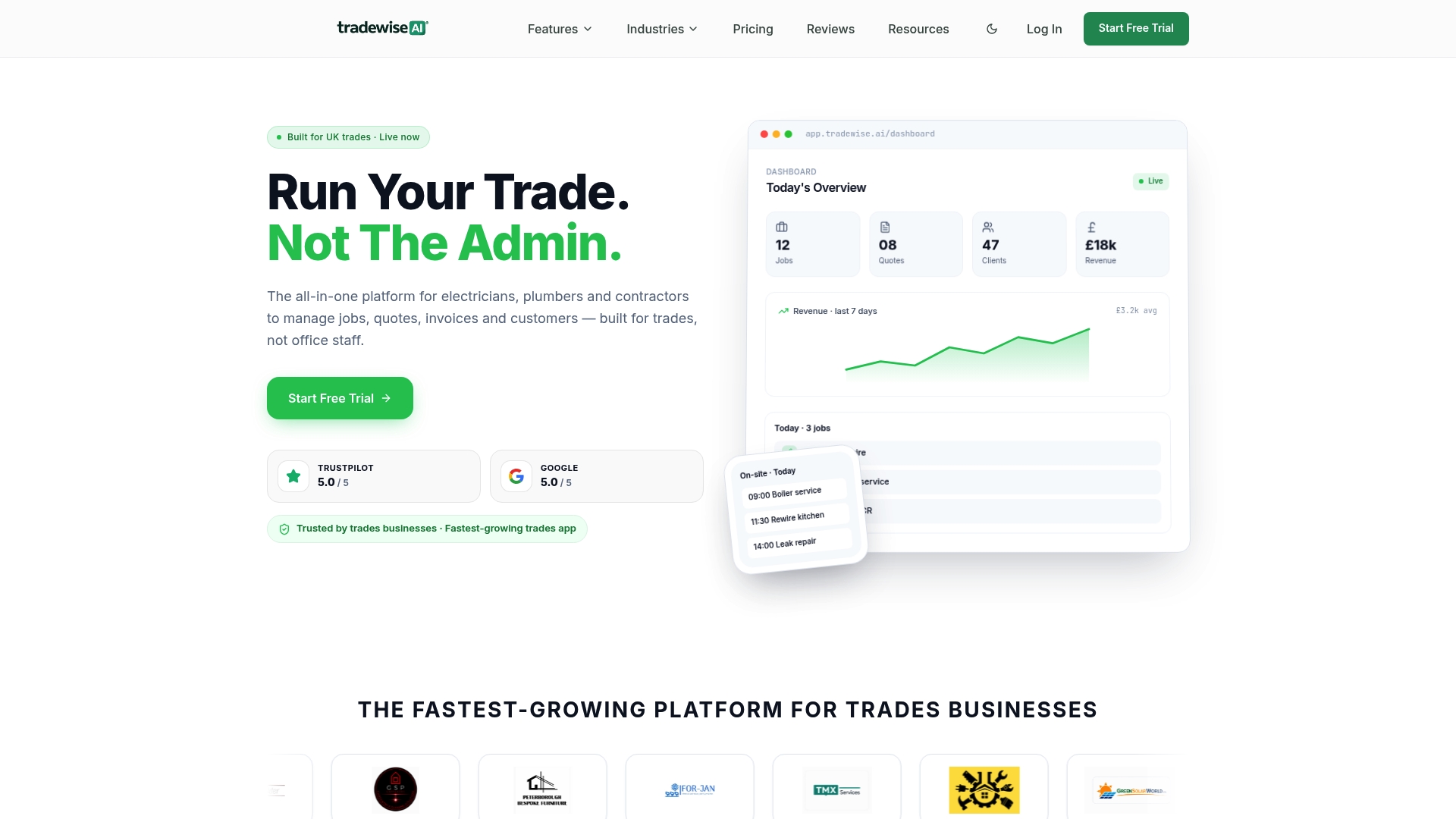
Tradewisehq is an AI-powered operating system built for UK tradespeople and contractors. It brings job costing, scheduling, invoicing, client communication, and workforce tracking into one mobile-first platform, so you are never making decisions based on last month's numbers. When a project starts fading, you see it in the data that week, not at year-end when the damage is done. Change order management is built in, so undocumented scope creep stops costing you margin. Cash flow forecasting runs alongside every active job, not as a separate spreadsheet exercise.
If your firm is running on gut feel and end-of-month reports, the financial pitfalls covered in this article are not hypothetical risks. They are already happening. Start with Tradewisehq and get the operational control your margins depend on.