

Construction quoting is complex because it stacks multiple volatile, interdependent inputs on top of inconsistent scope assumptions, and any one of those inputs can shift the final number substantially. Bid variance on identical project briefs can be significant, with scope differences accounting for a large portion of the spread. The problem is not that contractors are bad at maths. It is that the inputs themselves keep moving, and most quoting processes have no governance to catch the drift.
Three fastest wins if you are short on time:
- Tighten scope language before pricing anything. Vague drawings and "standard spec" wording are the single biggest source of assumption drift.
- Confirm subcontractor holds in writing, with an expiry date. Subcontractor costs typically represent 40–60% of total project cost, and verbal holds are unreliable at award stage.
- Publish an assumptions and exclusions annex with every quote. If a client disputes the price later, this is your evidence.
Table of Contents
- Why do construction quotes vary so much?
- How does your estimating method change the complexity?
- How do assumptions and exclusions drive the price gap?
- What operational failures turn complexity into real cost risk?
- Which UK-specific factors make quoting harder?
- What should a defensible UK construction quote include?
- When does estimating software actually help?
- Eight steps to reduce quoting complexity this week
- A worked example: how one assumption moves the total
- Managing change orders and contingencies within quotes
- How should you allocate risk in a construction quote?
- How do communication failures affect quote accuracy?
- How do you defend a quote during client negotiations?
- Key takeaways
- The part most contractors get wrong
- Quoting on site, not just in the office
- Further reading and useful UK sources
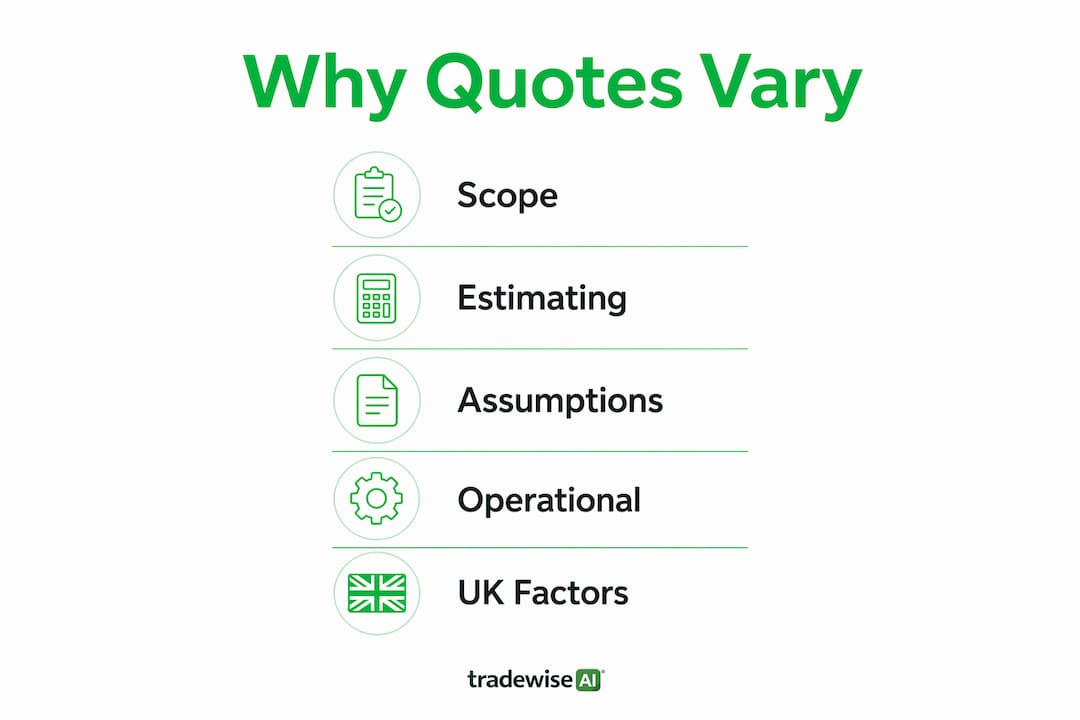
Why do construction quotes vary so much?
The short answer is that no two contractors read the same drawings identically, and there is no universal bid format to force alignment. The largest driver of bid variance is interpretation, not contractor quality. Standardising line-item naming and grouping reduces unexplained spreads more reliably than chasing lower unit rates.
Here are the discrete root causes:
- Scope ambiguity. Vague drawings and "standard spec" language allow each estimator to make different assumptions about finishes, interfaces, and responsibilities. Two contractors can price the same kitchen extension and differ by £15,000 before a single material price is checked.
- Material price volatility. Timber and steel prices have shown double-digit swings over months. A quote priced in January on last autumn's rates can be underwater by the time procurement happens.
- Subcontractor pricing shelf life. Since subcontractors form a significant portion of the cost, a quote is only as reliable as its subcontractor holds. Most specialist quotes carry a 30-day validity at best.
- Long-lead and specification uncertainty. Mechanical plant, bespoke joinery, and specialist glazing all carry pricing that expires before award on longer projects.
- Human and process factors. Version control failures, differing estimating templates, and missing site visits are common causes of inaccurate estimates that practitioners consistently flag.
- Commercial choices and risk appetite. Two contractors with identical costs can quote differently based on contingency levels, scheduling premiums, and how they price provisional works.
Pro Tip: Use a structured site walkthrough to clarify grey areas in the scope, not to achieve perfect measurements. Ambiguous items that go unresolved before pricing are the ones that generate post-award disputes.
How does your estimating method change the complexity?
The method you choose determines how many moving inputs you are managing simultaneously, and therefore how much complexity you are taking on.
- Detailed measure and estimate (unit-rate take-off). The most accurate method for fixed-price delivery. You measure every element, price it at current unit rates, and build up from first principles. Time-intensive (40–80 hours on a complex commercial project), but produces the most defensible number.
- Elemental cost planning. Groups costs by building element (substructure, superstructure, finishes). Useful for design-stage budgets and for checking that a detailed estimate is in the right ballpark.
- Parametric estimating. Uses cost-per-square-metre or cost-per-unit benchmarks. Fast and appropriate for early feasibility budgets, but the 0.6 rule heuristic and similar shortcuts are approximations, not substitutes for a detailed take-off on a fixed-price contract.
- Analogous (top-down) estimating. Benchmarks from comparable completed projects. Reasonable for ROM budgets; dangerous for competitive tenders where the client expects a binding price.
- Allowance-based lump sums. Common in smaller residential work. Fast, but highly vulnerable to assumption drift because the allowances are rarely itemised or verified.
The practical rule: use parametric or analogous methods for early budgets and feasibility, then invest in a detailed unit-rate take-off before committing to a fixed-price contract. The risk profile and procurement timeline should drive the choice, not convenience. For accurate building work quotes on competitively tendered UK projects, a detailed take-off is rarely optional.

How do assumptions and exclusions drive the price gap?
Scope differences account for approximately half of bid variance, and the 30–50% spread seen on identical briefs is almost entirely explained by what each contractor assumed rather than what they priced. That is not a small rounding error. On a £500,000 project, a 30% spread means one contractor has priced £150,000 more than another for the same scope on paper.
Common assumption classes that drive divergence:
- Material grade and specification. "Hardwood flooring" means different things to different estimators without a named product or grade.
- Existing-condition unknowns. Contractors who have not visited the site make different assumptions about access, ground conditions, and hidden services.
- Provisional works and temporary works. Whether shoring, scaffolding, or temporary drainage is included varies widely unless explicitly stated.
- Permit coordination and building control fees. Some contractors include these; others treat them as client-side costs.
- Warranty terms. A 12-month defects period and a 10-year structural warranty each carry different cost implications.
Pro Tip: Every quote should carry an assumptions and exclusions annex. List each assumption with a number, state what you have excluded and why, and include expiry dates for any supplier holds. This single document closes more post-award disputes than any contract clause.
Clients who focus only on the headline figure are comparing different scopes, not different prices. The lowest bid frequently hides omissions that convert into change orders after award.
What operational failures turn complexity into real cost risk?
Technical complexity is manageable. What converts it into actual margin loss is the everyday process failure that lets assumptions go stale, versions multiply, and supplier holds expire unnoticed.

Spreadsheet governance breaks down on complex projects not because of calculation errors but because of revision churn, assumptions drift, and vendor pricing that expires before award. Once a quote has three or more moving inputs — multiple revision cycles, long-lead items, multi-trade coordination — a spreadsheet has no mechanism to flag that a subcontractor's price from six weeks ago has expired.
Key operational failure modes:
- Version confusion. Multiple estimators working on different file versions, with no clear master. The wrong version gets submitted.
- Silent expiry of supplier pricing. No system to track hold periods means procurement discovers the price has changed after award.
- Single-estimator bottlenecks. One person holds all the knowledge. When they are off site or leave, the quote cannot be reviewed or updated.
- Lack of standard templates. Each estimator structures quotes differently, making internal review and client comparison harder.
- Verbal agreements during pre-bid clarifications. Scope changes discussed by phone that never make it into the written quote.
- Inconsistent exclusions lists. What one estimator excludes, another includes, with no standard to align them.
Good job costing practices start at the quoting stage, not after award. The two are the same process, just at different points in the project lifecycle.
Pro Tip: Set a rule: every quote version gets a date-stamped file name and a named owner. Every supplier hold must include an expiry date in writing. These two rules alone eliminate the most common governance failures.
Which UK-specific factors make quoting harder?
UK construction operates inside a regulatory and procurement environment that adds layers of cost uncertainty that do not appear in generic estimating guides.
- Planning conditions. Pre-commencement conditions attached to a planning consent can require surveys, reports, or approvals that add cost and programme time. Estimators who do not read the planning consent before pricing miss these.
- Listed building and conservation area constraints. Specified materials, approved contractors for certain works, and heritage officer sign-off all carry cost premiums that are difficult to parametrise.
- Party wall procedures. The Party Wall etc. Act 1996 requires formal notices and potentially surveyor fees on projects affecting shared boundaries. These are frequently omitted from quotes on residential extensions.
- Building control timings. Approved inspector or local authority building control sign-off affects programme and can trigger additional costs if inspections are delayed.
- Procurement format variance. Local authority tenders often require NEC or JCT contract forms with specific payment terms; private developers may use bespoke contracts. The payment terms affect cash flow and therefore pricing.
- Labour market tightness. Regional shortages in specialist trades (electricians, groundworkers, steelwork erectors) mean that a rate valid in one region may be uncompetitive in another.
- Material import and FX effects. UK construction relies on imported materials whose sterling cost moves with exchange rates. Timber, fixings, and specialist ironmongery are all exposed.
For HVAC and MEP scopes, shop drawing coordination requirements add another layer of pre-construction cost that is easy to underestimate at tender stage. Always check local authority portals and approved inspector guidance for pre-commencement conditions before finalising assumptions.
What should a defensible UK construction quote include?
A quote that cannot be audited cannot be defended. The checklist below covers the minimum fields a UK contractor should include on any competitively tendered project.
Quote checklist:
- Project identification: client name, site address, drawing numbers and revision levels
- Detailed scope description: what is included, trade by trade
- Named assumptions: at least five to ten, numbered and specific
- Exclusions list: explicit, not implied
- Named allowances: itemised with a description and a number (not "PC sum TBC")
- Supplier holds: named supplier, amount, and expiry date
- Provisional sums: clearly labelled and separated from firm prices
- Programme: start date assumption, duration, and key milestones
- Payment terms: stage payments or applications, retention, and final account process
- Validity period: the date the quote expires
- Approval signature block: client acceptance with date
Sample quote line-group structure:
| Line group | Fields to capture |
|---|---|
| Preliminaries | Site setup, welfare, management, insurance |
| Substructure | Groundworks, foundations, drainage (state ground-condition assumption) |
| Superstructure | Frame, floors, roof (state specification and drawing revision) |
| Finishes | Internal and external (state material grade and supplier hold) |
| Services | M&E, plumbing (state subcontractor name and hold expiry) |
| Provisional sums | Named items, amounts, and trigger conditions |
| Contingency | Percentage, basis, and what it covers |
| Exclusions | Numbered list |
| Assumptions | Numbered list with expiry dates where relevant |
Re-confirm long-lead pricing every four weeks on projects with a procurement timeline longer than three months. Store an assumptions register and require a handover snapshot when the quote is accepted, so the delivery team knows exactly what was priced. For a full breakdown of what a builder's quote should contain, the structure above is a practical starting point.
When does estimating software actually help?
Purpose-built estimating tools solve governance problems, not maths problems. The calculation in a spreadsheet is usually correct. What breaks is the process around it.
What software genuinely fixes:
- Central pricing library that updates unit rates from current supplier feeds
- Supplier hold tracking with expiry alerts
- Version control with a named owner and date stamp on every revision
- Consistent templates that force the same structure on every quote
- Audit trail showing who changed what and when
Where software does not replace expertise:
- Interpreting unusual existing-condition defects that require a surveyor's judgement
- Negotiating complex long-lead procurement where relationships and timing matter
- Certifying regulatory compliance, which requires a qualified professional regardless of what the software says
Pros and cons for a small to mid-sized contracting business:
- Pro: Reduces version-control failures and expired-hold surprises, the two most common margin leaks on complex projects.
- Pro: Faster quote updates when scope changes, because the pricing library is live rather than manually maintained.
- Con: Requires upfront time to build and maintain the pricing library. A stale library is as dangerous as a stale spreadsheet.
- Con: Does not eliminate the need for site visits, structured walkthroughs, or professional judgement on unusual scopes.
Tradewisehq is built for exactly this context: a mobile-first platform for UK trades that combines quoting, live workforce sync, materials price comparison, and approvals in one place. For contractors running multiple concurrent jobs, the ability to update a quote on site and push it to the client immediately closes the gap between what was priced and what was agreed. The role of digital quoting in modern UK contracting has shifted from a nice-to-have to a practical governance requirement on anything beyond a simple one-trade job.
Pro Tip: Before adopting any estimating tool, map your three most common quoting failure modes. If they are governance failures (version control, expired holds, missing exclusions), software will pay back quickly. If they are expertise failures (wrong take-off method, poor site assessment), process training comes first.
Eight steps to reduce quoting complexity this week
These are ordered by effort and payback. The first four require no software.
- Rewrite your scope template. Replace "standard spec" and "as per drawings" with named materials, grades, and drawing revision numbers. One afternoon; immediate effect on assumption alignment.
- Create a standard exclusions list. Fifteen to twenty items that your business never includes unless explicitly agreed. Attach it to every quote. Half a day to draft; permanent reduction in post-award disputes.
- Require itemised supplier holds with expiry dates. Email every subcontractor and supplier and ask them to confirm their hold period in writing. One hour per quote; eliminates the most common margin leak.
- Run a structured site walkthrough checklist. Five to ten standard questions about access, existing conditions, and grey-area scope items. Thirty minutes per site; reduces assumption drift before pricing starts.
- Use allowances correctly. An allowance is a named, numbered line item for a scope element that cannot yet be fully defined. It is not a rounding buffer. Replace all "PC sums TBC" with a named allowance and a realistic number.
- Set contingency rules by risk type. Low-risk, short-duration residential: 5%. Complex commercial or long-duration: 10–15%. Write the rule down and apply it consistently rather than adjusting by feel.
- Introduce a simple approval gate. Before any quote above a threshold value (set your own) is submitted, a second person reviews the assumptions and exclusions list. Thirty minutes; catches the errors that cost the most.
- Run a post-quote audit on every awarded job. Compare the quote assumptions to what actually happened. One hour per project; builds the institutional knowledge that makes future quotes more accurate.
Pro Tip: Steps 1–4 are free and can be done this week. Steps 5–8 require a small process investment but pay back on the first complex project where they prevent a change-order dispute.
A worked example: how one assumption moves the total
Same project, same scope, two contractors. A single-storey rear extension, £120,000 base cost. The only difference is how each contractor handles groundworks uncertainty.
| Line item | Contractor A | Contractor B |
|---|---|---|
| Groundworks (provisional sum) | — | Excluded (not mentioned) |
| Post-award groundworks actual | — | — (change order) |
Contractor B wins the job on headline price. The client believes they have saved £18,900. By the time groundworks are complete, the saving has disappeared entirely, and the client has been through a change-order process that damaged the relationship.
The fix is straightforward. Contractor A's approach is correct: name the provisional sum, label it clearly, and explain in the assumptions annex what triggers it and how it will be reconciled. A client who understands the quote structure will not be misled by the headline gap.
Pro Tip: When you include a provisional sum, write one sentence explaining what it covers and what would cause it to increase or decrease. This single sentence prevents the majority of post-award disputes on items with uncertain scope.
Managing change orders and contingencies within quotes
Change orders are not a sign that a quote was wrong. They are a sign that scope changed after the quote was agreed. The problem is when change orders arise from items that should have been in the original quote but were not.
The practical distinction matters: a change order for a client-requested addition is legitimate and billable. A change order because the estimator forgot to include scaffolding is a margin problem. Separating these two categories in your post-award tracking is the first step to reducing the second type.
Contingency sizing has shifted. The old 3–5% buffer that worked in stable markets is inadequate on projects with significant material exposure or durations longer than six months. Many experienced estimators now build 10–15% contingency into anything running longer than six months, and add escalation language directly into contracts. The key is to write down what the contingency covers. An undocumented contingency line is a liability in a change-order negotiation, not a safety net.
For informal variation capture, the rule is simple: nothing is agreed until it is in writing. Verbal scope changes discussed on site that are not confirmed by email or a formal instruction are the single most common source of disputed change orders on smaller residential projects.
How should you allocate risk in a construction quote?
Risk allocation in a quote is a commercial decision, not just a technical one. The question is not whether risk exists but who carries it and at what price.
The standard approach is to identify risk categories before pricing: ground condition risk, design development risk, third-party interface risk (party wall, utilities), procurement risk (long-lead items), and regulatory risk (planning conditions, building control). For each category, decide whether to include a named allowance, carry a contingency, or exclude the risk explicitly and note it in the assumptions annex.
Builders' risk and soft costs coverage is one mechanism for transferring certain categories of risk to an insurer rather than pricing them into the quote. Understanding what your policy covers before you price a project changes what you need to carry in contingency.
The practical test for any risk item: if it materialises, who pays? If the answer is unclear, the quote has not allocated the risk. Clarity here protects both contractor and client, and it is the foundation of a contract that does not generate disputes.
How do communication failures affect quote accuracy?
A quote is only as accurate as the information that went into it. When communication between client, designer, and contractor breaks down during the pre-bid period, the estimator fills the gaps with assumptions, and those assumptions diverge.
The most damaging communication failures are not the obvious ones. Clients who do not respond to pre-bid clarification requests force contractors to assume. Designers who issue revised drawings without a revision cloud leave estimators uncertain about what changed. Main contractors who do not share ground investigation reports with subcontractors create a situation where every sub prices a different ground-condition assumption.
Structured pre-bid clarification is the fix. Set a deadline for questions, require written responses, and issue a clarification log to all bidders simultaneously. This single process change reduces the assumption spread on a competitive tender more than any other intervention. It is also the basis for a fair comparison: if all bidders have answered the same questions, the headline price differences are real, not artefacts of different information.
How do you defend a quote during client negotiations?
The moment a client questions your price, the quality of your assumptions and exclusions annex determines whether the conversation is productive or adversarial.
A well-structured quote is its own defence. Walk the client through the line-item structure, explain the assumptions behind the largest cost centres, and show the named allowances and exclusions. If they want to reduce the price, the conversation becomes: which scope do you want to remove, or which risk do you want to carry yourself? That is a commercial negotiation, not a credibility challenge.
Where contractors lose these conversations is when the quote is a single headline number with no supporting structure. The client has no way to understand what is included, so they compare it to a lower number from a competitor who excluded half the scope. Standardising line-item naming and grouping, as noted earlier, reduces unexplained spreads and makes your quote directly comparable to others.
The practical rule for negotiations: never reduce a price without removing scope or transferring risk. A price reduction with no corresponding scope change is a margin reduction, and it sets a precedent for every future negotiation with that client.
Key takeaways
Construction quoting is complex because multiple volatile inputs, inconsistent scope assumptions, and weak governance processes combine to produce large, hard-to-defend price spreads that erode margin and generate post-award disputes.
| Point | Details |
|---|---|
| Bid variance is structural | Studies show 30–50% spreads on identical briefs; scope differences account for roughly half. |
| Subcontractor holds are critical | Subcontractor costs form 40–60% of total project cost; expired holds are the most common margin leak. |
| Assumptions and exclusions annex | Publishing a numbered annex with expiry dates is the single most effective way to make quotes defensible. |
| Governance beats calculation | Spreadsheet failures on complex projects are governance failures, not maths errors; version control and hold tracking matter most. |
| Tradewisehq for UK trades | Tradewisehq combines mobile quoting, materials price comparison, supplier hold tracking, and audit trails in one platform for UK contractors. |
The part most contractors get wrong
The conventional wisdom is that better quoting means more accurate take-offs. Spend more time measuring, get a better number. That is true up to a point, but it misses where most of the money actually goes.
The real problem is not measurement accuracy. It is the gap between what was assumed when the quote was written and what was discovered when the job started. That gap is almost never about a miscounted brick. It is about a ground-condition assumption that was never tested, a subcontractor hold that expired three weeks before award, or an exclusion that was obvious to the estimator but invisible to the client.
The contractors who consistently protect their margins are not the ones with the most sophisticated take-off software. They are the ones who have built a simple, repeatable process for documenting assumptions, confirming holds, and communicating exclusions clearly. A one-page assumptions annex and a rule about written supplier holds will do more for your margin than a new estimating platform if the underlying process is broken.
Small contractors are particularly exposed here. A single-estimator business has no second pair of eyes on the assumptions, no standard template to catch omissions, and no audit trail when a client disputes the scope six months later. The fix is not expensive. It is a checklist, a template, and a rule about version control. Start there.
Quoting on site, not just in the office
Tradewisehq gives UK trades a faster route from site visit to submitted quote, without the version-control failures that cost margin on complex jobs.
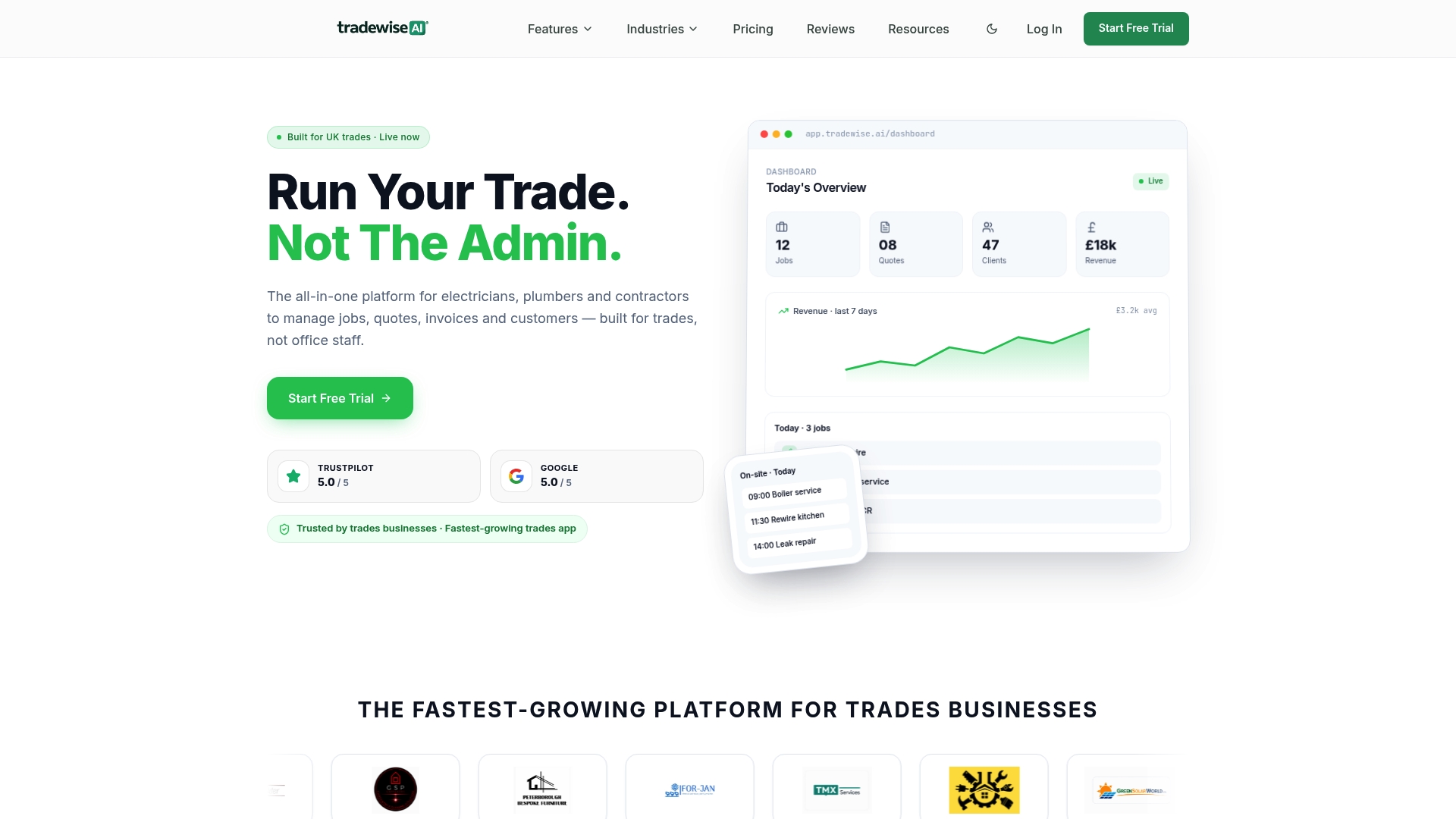
The platform combines mobile quoting, a live materials price comparison tool, supplier hold tracking with expiry alerts, and a built-in assumptions and exclusions template, all accessible from a phone on site. When a subcontractor updates their price, it flows through to the quote immediately. When a supplier hold is about to expire, the system flags it before procurement, not after award.
For UK electricians, plumbers, builders, and HVAC contractors running multiple concurrent jobs, Tradewisehq connects quoting to job management, scheduling, and client communication in one place. No separate spreadsheet. No version confusion. No missed expiry dates.
Start a 14-day free trial and see how much time your next complex quote actually takes when the governance is built in.
Further reading and useful UK sources
The sources below are a mix of research studies, practitioner guides, and practical references. Use them to go deeper on the areas most relevant to your business.
- Bid variance and scope differences — Research on why contractor bids vary on the same project, with data on the 30–50% spread and the role of scope assumptions. Research study.
- Spreadsheet failure modes on complex projects — Practitioner analysis of how governance breaks down on multi-revision, multi-trade quotes. Practitioner guide.
- Subcontractor cost dependency — Data on subcontractor cost share and material price volatility in construction quoting. Practitioner guide.
- Common estimating mistakes — Collated practitioner guidance on take-off errors, site visit omissions, and outdated pricing. Practitioner guide.
- Comparing contractor bids — Practical advice on line-by-line bid comparison and the role of structured walkthroughs. Practitioner guide.
- Tradewisehq quoting and job management — Product reference for UK trades combining mobile quoting, materials pricing, and workforce management. Product reference.
- Common construction quoting errors — Practical catalogue of quoting mistakes and how they erode margins for UK contractors. Practical template.
- Construction bid management guide — Templates and governance frameworks for UK bid management. Practical template.