

Remote construction site management is the practice of overseeing a building project's progress, workforce, compliance, and communication without being physically present on site every day. UK construction managers can do this effectively using real-time monitoring systems, AI-integrated project platforms, and pre-vetted remote specialist staff. The industry term for this approach is virtual site management, and it has moved from a contingency measure to a mainstream operating model. Tradewisehq and similar AI-powered platforms now give contractors the data visibility they need to make confident decisions from any location, while still meeting UK Building Regulations and ISO documentation standards.
How to manage a construction site remotely: the essential tools
The right technology stack is the foundation of effective remote construction management. Without it, managers are working from static reports that are already out of date by the time they arrive.
| Tool category | Primary function |
|---|---|
| AI-integrated geospatial platforms | 3D progress tracking, deviation detection against BIM models |
| IoT sensors and smart gates | Real-time equipment, vehicle, and access monitoring |
| Cloud-based document management | RFI handling, submittals, and version-controlled drawings |
| Drone survey tools | Site photography, point cloud capture, and aerial progress records |
| Mobile-first job management apps | Scheduling, workforce syncing, and client communication |
AI-integrated geospatial tools represent the most significant shift in remote site oversight. These platforms measure site progress with centimetre accuracy, replacing manual surveys that previously required five people working for five days with a single-person, one-day operation. That reduction in survey time directly reduces cost and eliminates the lag between what is happening on site and what managers can see.
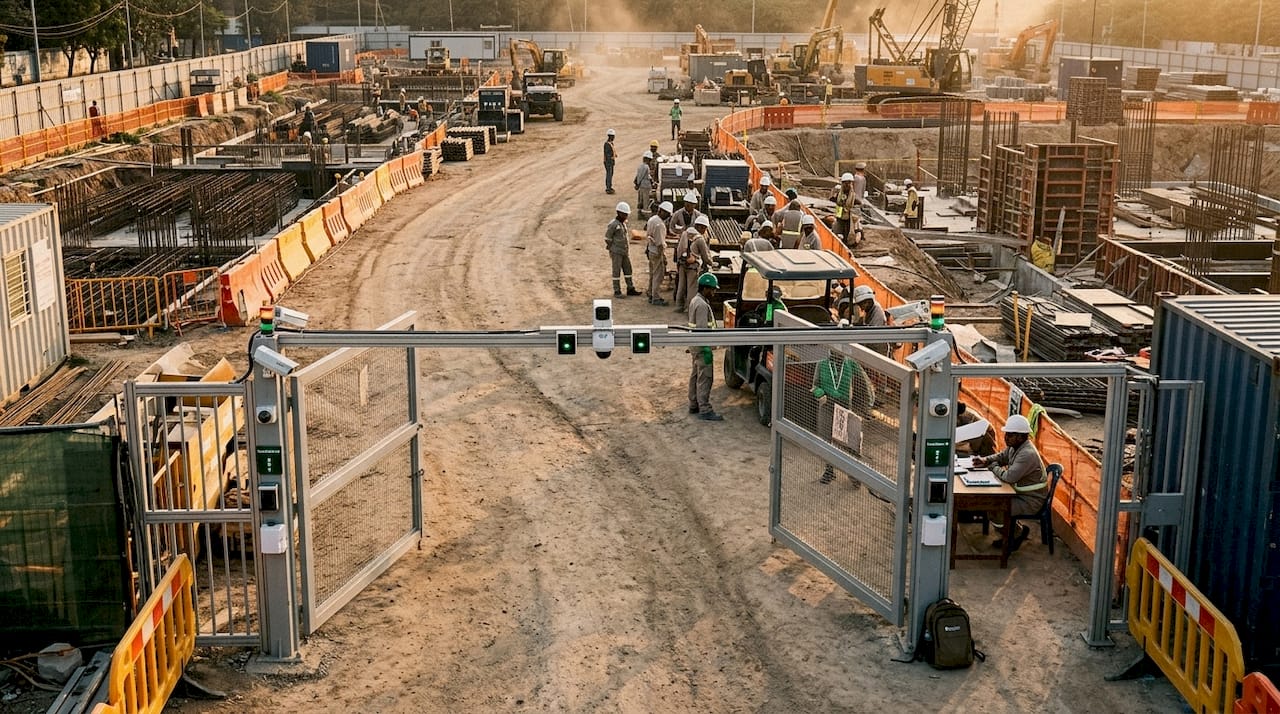
IoT sensors and smart gates add a second layer of real-time intelligence. Dashboards convert sensor data into live intelligence covering equipment location, vehicle movements, gate access events, and environmental site conditions. Managers monitoring multiple sites can view all of this in a single control panel rather than waiting for end-of-day reports.
Cloud-based document platforms handle RFIs, submittals, and drawing revisions in a shared environment where every change is timestamped and attributed. This removes the version-control problems that cause costly rework on UK projects. For managers overseeing multiple construction projects, centralised documentation is not optional. It is the only way to maintain audit trails that satisfy Building Safety Act requirements.
Pro Tip: Before selecting any remote monitoring platform, confirm it stores data within UK or EU servers and aligns with GDPR. Non-compliant data storage creates liability that no cost saving justifies.
How do you build a skilled remote support team?
Technology alone does not run a site. The people interpreting data, producing estimates, and coordinating documentation must be capable and available. Remote staffing models have made this far more accessible for UK contractors.
Contractors can reduce operational costs by up to 70–90% using remote support staff for documentation, estimating, and coordination compared to local onsite hiring. That is not a marginal saving. It means a contractor who previously employed one onshore document controller can fund a full remote team covering estimating, BIM coordination, and site administration for the same budget.
The roles that translate most effectively to remote working include:
- Estimators who produce takeoffs and cost plans using cloud-based quantity surveying tools
- Document controllers managing drawing registers, RFI logs, and submittal trackers
- BIM coordinators maintaining and updating 3D models as construction progresses
- Virtual project managers who monitor programme, flag delays, and coordinate between subcontractors
- Compliance administrators who track inspection records, RAMS documents, and regulatory submissions
Software fluency is the single most important hiring criterion for remote construction roles. Procore-fluent remote hires can run live takeoffs under supervision within 7–10 days of starting. That speed of contribution is only possible because they already know the platform. Hiring someone who needs to learn the software first adds weeks of unproductive time at the start of a project.
Onboarding remote staff well requires a structured first week. Assign a named onsite contact, share the project programme and drawing register on day one, and schedule daily check-ins for the first fortnight. After that, weekly structured calls are sufficient for most roles.
Pro Tip: Test communication style during the interview, not just technical skill. A remote estimator who writes unclear emails will create more problems than a slightly less experienced one who communicates precisely.
Step-by-step approach to implementing remote site monitoring
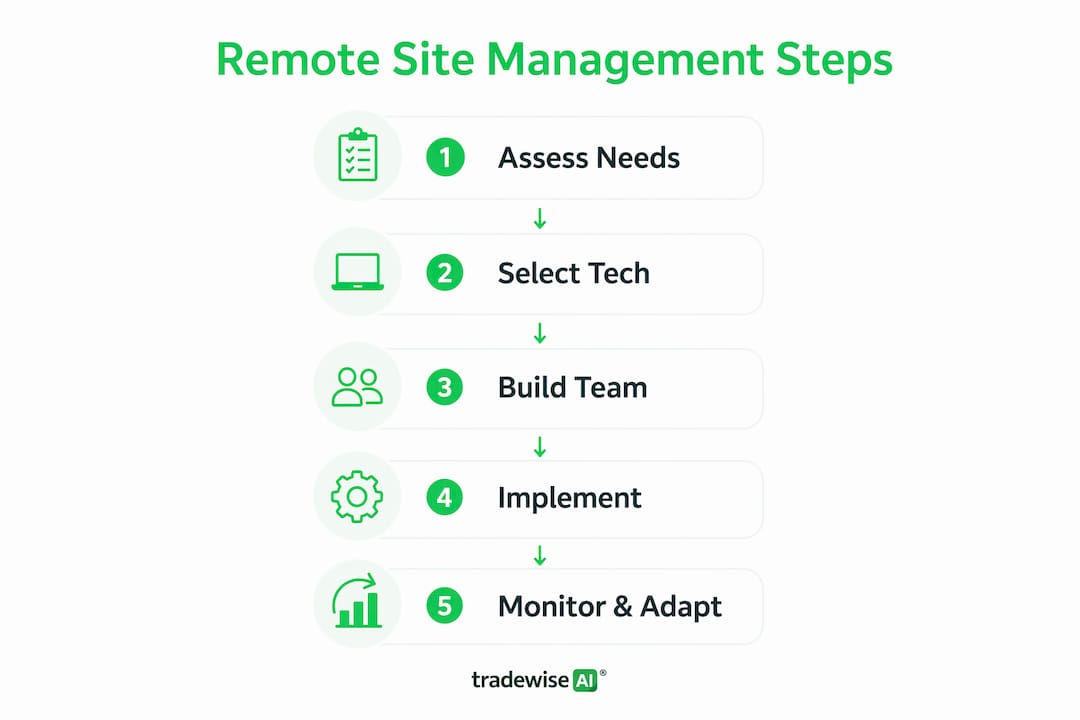
Transitioning to virtual site management works best as a phased process rather than an overnight switch. Attempting to go fully remote without establishing the right foundations causes the exact problems managers are trying to avoid.
- Audit your current tech stack. List every platform your team uses for drawings, scheduling, communication, and reporting. Identify gaps where data currently lives in email threads or paper files.
- Select a unified project platform. Choose one system that connects document management, programme tracking, and workforce communication. Fragmented tools create fragmented visibility.
- Install site monitoring hardware. Fit IoT sensors at key locations: plant entrances, material storage areas, and structural monitoring points. Connect smart gate systems to your central dashboard.
- Commission drone surveys at baseline. Capture a full point cloud of the site before work begins. This gives you a reference model against which all future progress scans are compared.
- Train onsite staff on digital reporting. Remote management fails when site operatives do not submit daily reports, photos, or inspection records. Training is not optional.
- Set a reporting cadence. Agree on daily photo uploads, weekly drone surveys, and fortnightly 3D model updates. Stick to the schedule.
Closing the 'reality gap' is the defining challenge of remote site management. Static reports cause project failure. Integrating 3D digital twins and drone-captured point clouds can reduce survey time by up to 80%, giving managers the spatial accuracy needed to catch deviations before they become defects.
Site security is a common concern for managers moving to remote oversight. Smart gate systems log every entry and exit with time stamps and vehicle registration data. CCTV feeds integrated into your project dashboard mean you can review footage without travelling to site. For high-value plant, GPS tracking devices provide location data that insurers increasingly require as a condition of cover.
Compliance workflows must be built into the remote management system from the start. AI copilots assist with compliance reporting, documentation accuracy, and team coordination, and they align data security with GDPR and ISO standards. Assign a named compliance lead within your remote team whose sole responsibility is maintaining inspection records and regulatory submissions.
What are the best practices for remote construction communication?
Poor communication is the most common reason remote site management fails. The technology works. The processes work. But if the right people are not talking to each other at the right times, decisions get delayed and errors compound.
Remote project managers familiar with current tools and methodologies improve communication, reduce errors, and keep projects on track through timely decision-making. The key is structure. Ad hoc communication creates noise. Structured communication creates clarity.
Effective remote communication for construction site oversight relies on:
- Daily stand-up calls between the remote project manager and the site foreman, capped at 15 minutes and focused on blockers only
- Live dashboard reviews twice weekly, where remote and onsite teams view the same data simultaneously
- Cloud-based RFI management so every query is logged, assigned, and tracked to resolution with no information lost in email chains
- Shared drawing registers with automatic notifications when a new revision is issued, preventing operatives from building to superseded drawings
- Weekly client updates generated directly from the project dashboard, reducing the time spent writing reports manually
Transparency is the operating principle that holds remote coordination together. When every team member, whether remote or onsite, works from the same live data, the gap between what managers think is happening and what is actually happening closes significantly. The role of AI tools in automating this data flow is growing rapidly, and UK contractors who adopt these workflows now will hold a measurable advantage within two to three years.
Pro Tip: Record all video calls and store them in the project folder. When a dispute arises about what was agreed in a meeting, the recording resolves it in minutes rather than weeks.
Key takeaways
Effective remote construction site management depends on combining real-time monitoring technology, software-fluent remote staff, and structured communication protocols to maintain full project visibility without daily physical presence.
| Point | Details |
|---|---|
| Technology is the foundation | IoT sensors, drone surveys, and AI geospatial tools give managers centimetre-level site visibility from any location. |
| Remote staffing cuts costs sharply | Contractors can reduce staffing costs by up to 70–90% using remote estimators, document controllers, and BIM coordinators. |
| Software fluency speeds onboarding | Hiring staff already proficient in platforms like Procore means they contribute within 7–10 days, not weeks. |
| Structured communication prevents errors | Daily stand-ups, shared dashboards, and cloud-based RFI logs keep remote and onsite teams aligned. |
| Compliance must be built in from day one | Assign a dedicated compliance lead and use AI-assisted reporting to meet GDPR, ISO, and UK Building Regulations requirements. |
The reality gap is the real problem nobody talks about
Most articles on remote site management focus on which tools to buy. That is the wrong starting point. The real question is whether your team will actually use those tools consistently enough to close the gap between what the data shows and what is happening on the ground.
I have seen contractors invest in drone survey subscriptions and IoT sensor networks, then revert to WhatsApp photos and phone calls within three weeks because nobody enforced the reporting cadence. The technology did not fail. The discipline did. Remote management is fundamentally a behavioural change before it is a technology change.
The other thing I would push back on is the assumption that remote oversight reduces control. Done properly, it increases it. A manager physically present on one site has limited visibility of what is happening on the other three sites they are responsible for. A manager with a live dashboard, a drone survey from this morning, and a software-fluent remote team has better information than most site managers who are physically present. The AI in construction conversation in the UK is still too focused on novelty. The contractors winning work in 2026 are the ones treating these tools as standard operating procedure, not as experiments.
The future of construction project oversight is not fully remote or fully onsite. It is a deliberate blend, where physical presence is reserved for the moments that genuinely require it, and digital systems handle everything that does not.
— Mateusz
How Tradewisehq supports remote construction management
UK contractors managing sites across multiple locations need a single platform that connects job scheduling, workforce tracking, client communication, and reporting without requiring separate tools for each function.
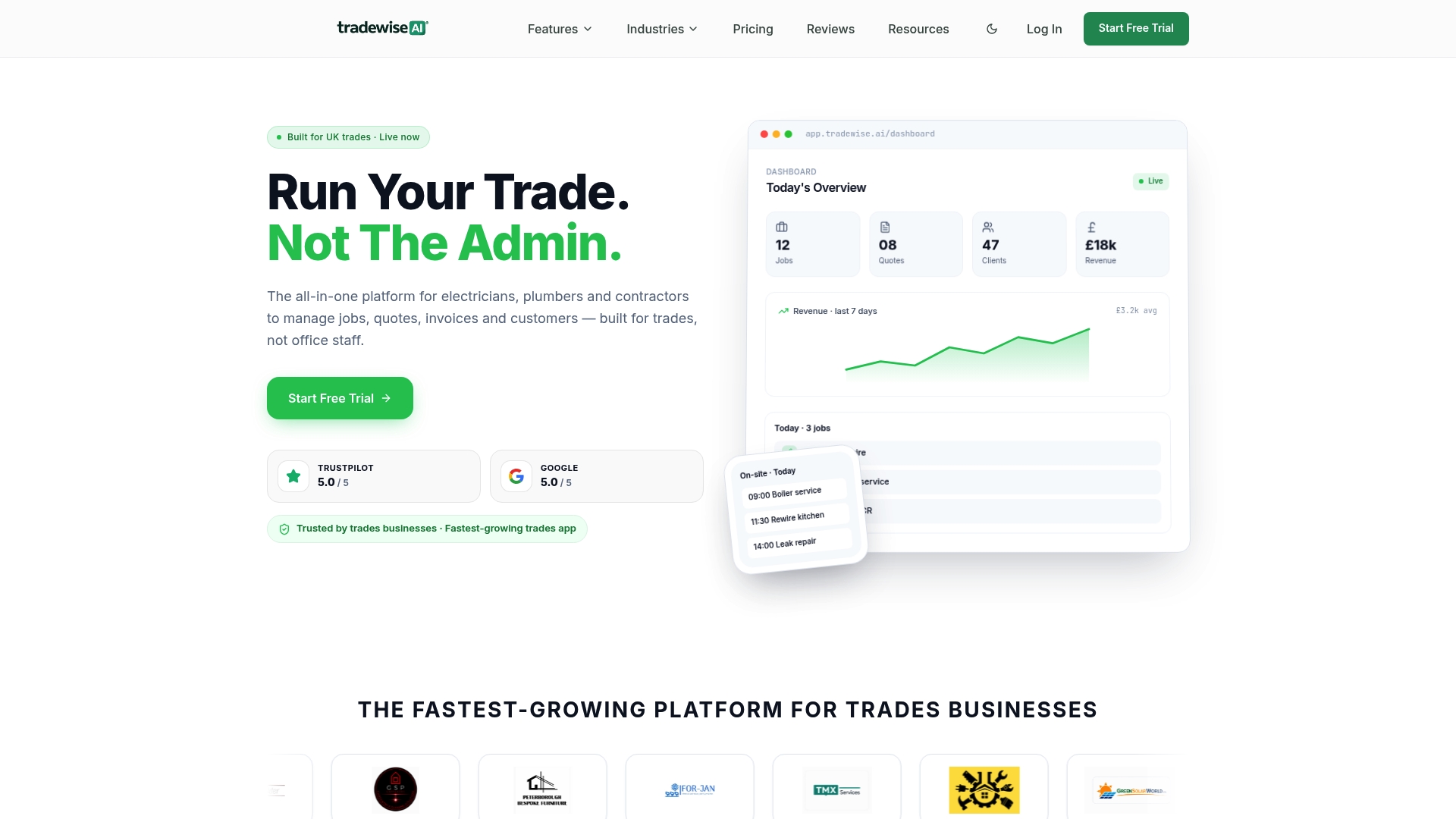
Tradewisehq is an AI-powered operating system built for tradespeople and contractors. It handles job management, staff scheduling, quotes, invoices, and client communication in one mobile-first platform. For managers overseeing remote site coordination, Tradewisehq provides live workforce syncing and automated reporting that keeps every stakeholder informed without manual updates. Whether you run a two-person electrical firm or a multi-site building contractor, the platform scales to your operation and reduces the administrative load that slows projects down.
FAQ
What does it mean to manage a construction site remotely?
Remote construction site management means overseeing a project's progress, workforce, compliance, and communication without being physically present on site every day. Managers use digital platforms, IoT sensors, drone surveys, and remote specialist staff to maintain full project visibility.
What tools are needed for remote site monitoring?
The core tools are AI-integrated geospatial platforms for progress tracking, IoT sensors for real-time equipment and access monitoring, cloud-based document management for RFIs and drawings, and a mobile-first job management app for workforce coordination.
How much can remote staffing save a UK contractor?
Contractors can reduce staffing costs by up to 70–90% by using remote support staff for estimating, document control, and BIM coordination compared to equivalent onshore hires.
How quickly can remote construction staff become productive?
Software-fluent remote hires, particularly those proficient in platforms like Procore, can run live takeoffs under supervision within 7–10 days of starting, significantly faster than staff who need platform training first.
How do you maintain compliance when managing a site remotely?
Assign a dedicated compliance lead within your remote team and use AI-assisted reporting tools that align with GDPR and ISO standards. Build inspection records, RAMS submissions, and regulatory documentation into your project platform from day one.