

Effective management of multiple construction sites is defined by three pillars: appointing capable site supervisors at each location, centralising data through digital tools, and applying portfolio-level resource planning. This is the recognised industry practice for multi-site construction management, and it replaces the outdated model of a single manager physically present across all locations. UK builders running two or more active projects simultaneously need structured delegation, consistent reporting formats, and a clear view of resources across every site. The strategies in this guide reflect 2026 best practices for builder site coordination in the UK.
How builders manage multiple sites through delegation
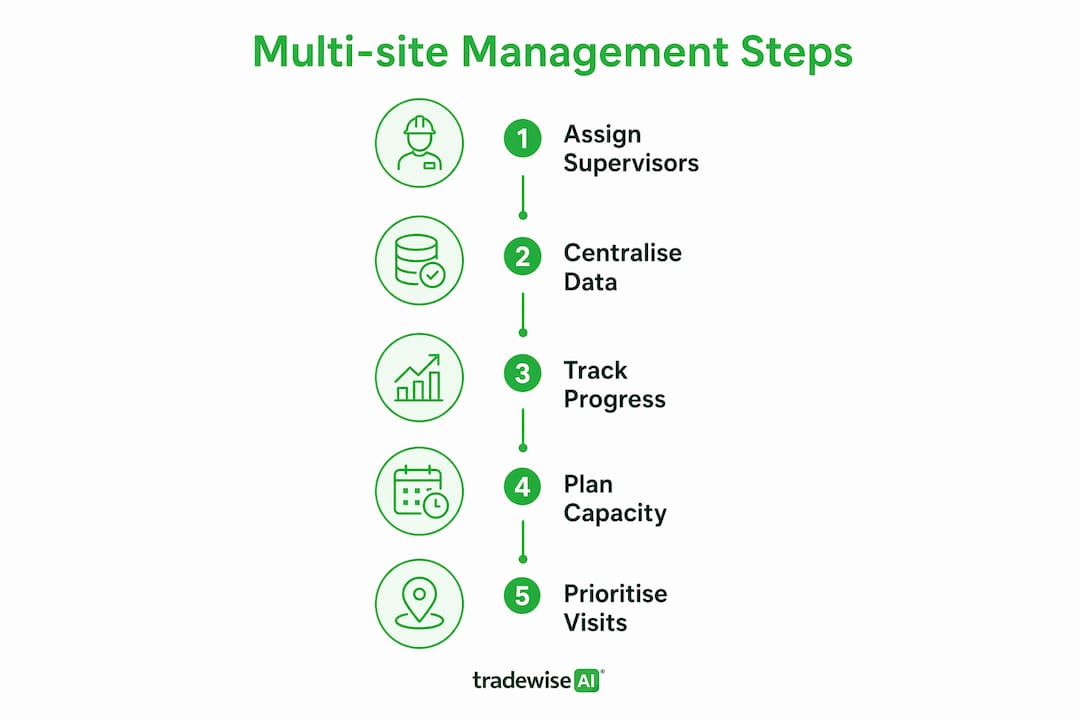
Designating a capable person in charge at each site is the single most critical operational requirement for multi-site builders. Without a trusted supervisor on the ground, a manager becomes a bottleneck, pulled in every direction and unable to make informed decisions remotely.
The site supervisor or foreman acts as the manager's proxy. Their responsibilities include daily briefings with the workforce, logging progress in site diaries, flagging issues before they escalate, and liaising with subcontractors. Understanding the full scope of this role is the starting point for any builder scaling beyond a single project.
Effective delegation follows a clear structure:
- Assign one named, accountable supervisor per site with defined authority to make day-to-day decisions.
- Set a fixed daily reporting time so the manager receives consistent updates without chasing.
- Hold a weekly video call with all site supervisors together to surface cross-site issues early.
- Use a shared digital log so the manager can review progress without visiting.
- Agree escalation criteria upfront: what decisions require manager sign-off versus supervisor authority.
Remote supervision replaces the need for constant physical presence. The manager's role shifts from doing to directing, which is the only way to run multiple projects without burning out or losing control.
Pro Tip: Give each site supervisor a one-page brief at project start covering scope, key milestones, subcontractor contacts, and escalation rules. It takes 30 minutes to write and saves hours of reactive calls each week.

What digital tools do builders use for multiple sites?
Successful builders stop managing by memory and phone calls, replacing them with digital workflows that deliver clear, consistent field data. The shift is not about technology for its own sake. It is about having a single source of truth across every active project.
The core features any multi-site management platform must cover are:
- Progress tracking: daily updates against the programme, visible to the manager in real time.
- Workforce attendance: who is on site, when they arrived, and which trade they are covering.
- Materials monitoring: what has been delivered, what is outstanding, and what is at risk of delay.
- Document storage: drawings, specifications, and inspection records accessible from any device.
- Communication logs: a record of instructions given and received, reducing disputes.
Centralised dashboards remove the need to ring each supervisor for a status update. The manager sees a live summary of all sites and can identify which project needs attention before a problem becomes a crisis.
| Feature | Benefit for multi-site managers |
|---|---|
| Live progress tracking | Spot delays across all sites without site visits |
| Digital attendance logs | Confirm workforce deployment at a glance |
| Centralised document storage | Consistent access to drawings and specs on every site |
| Automated daily reports | Reduce supervisor admin and standardise data formats |
| Portfolio dashboard | Single view of schedule, budget, and risk across all projects |
UK construction reporting standards require accurate, dated records for health and safety compliance, HMRC purposes, and contract disputes. A platform that generates these automatically reduces admin time and protects the business legally. Tradewisehq is built specifically for tradespeople and builders, combining job tracking, workforce syncing, and client communication in one mobile-first platform. Builders who want to understand why this matters in 2026 should read why job management software has become a baseline requirement, not a luxury.
Pro Tip: Standardise your daily report template across every site. When every supervisor fills in the same fields in the same order, you can scan five reports in five minutes instead of decoding five different formats.
How do you plan capacity across multiple construction projects?
High-performing construction firms use capacity planning models to map resources against projected demand, preventing scheduling conflicts before they occur. The alternative is reactive coordination: realising on a Monday morning that your electrician is booked on two sites at the same time.
Capacity planning at portfolio level means treating all active projects as a single system rather than separate jobs. The steps are straightforward:
- List every project and its current phase, from groundworks through to snagging.
- Map the trades and equipment each phase requires, with start and end dates.
- Overlay all projects on a single resource calendar to identify clashes.
- Resolve conflicts by adjusting programme dates, hiring additional resource, or resequencing phases.
- Review the resource calendar weekly as projects move forward or slip.
The most common conflicts involve specialist trades: groundworkers, structural steel erectors, and M&E contractors who work across multiple builders' projects simultaneously. Booking these trades at pre-construction stage, rather than when the phase arrives, is the single biggest scheduling improvement most UK builders can make.
Forecasting demand during pre-construction phases prevents project managers and trades from being double-booked at critical milestones. A shared capacity model that accounts for project phases prevents resource conflicts and increases operational efficiency across the whole portfolio.
Portfolio-level visibility summarises project status, schedule health, and risks across all active projects. Without it, a manager is making resource decisions based on incomplete information, which is how delays compound across sites.
When should builders prioritise site visits?
Risk-based site visitation prioritises manager presence on sites with the highest stakes rather than following a fixed rotation. Most builders mistakenly believe physical presence is the primary control lever. Expert managers use risk assessment to decide where their time delivers the most value.
The factors that should trigger a site visit include:
- A new subcontractor starting on site for the first time.
- A regulatory inspection or sign-off milestone approaching.
- Complex or technically demanding works beginning, such as structural alterations or deep excavations.
- A site supervisor flagging an issue they cannot resolve independently.
- A project falling more than two days behind programme without a clear recovery plan.
Three visitation models exist in practice. A fixed rotation visits each site on a set schedule regardless of what is happening. A phase-based model visits at the start and end of each major phase. A risk-based model visits when the risk profile changes. The risk-based model delivers the best return on a manager's time.
Pro Tip: Score each active site weekly on three factors: programme health, subcontractor risk, and upcoming inspections. Visit the highest-scoring site first. This takes ten minutes on a Friday and sets your priorities for the following week.
How do you maintain quality standards across multiple sites?
Standardised documentation and consistent quality standards prevent time lost on deciphering varied reports and keep subcontractors performing to the same level across every project. Without standardisation, quality becomes dependent on individual supervisors' habits rather than a repeatable system.
The core documents every site should use in identical formats are:
- Site diary: dated entries covering weather, workforce numbers, work completed, and any issues.
- Toolbox talk record: signed attendance sheet and topic covered, required for health and safety compliance.
- Inspection and snagging checklist: phase-specific quality checks completed before the next phase begins.
- Subcontractor sign-off sheet: confirmation that work meets specification before payment is authorised.
Digital checklists enforce these standards without relying on supervisors to remember every requirement. When a checklist is incomplete, the system flags it before the manager's daily review. This shifts quality control from reactive to preventive.
| Document | Purpose | Frequency |
|---|---|---|
| Site diary | Record daily progress and issues | Daily |
| Toolbox talk record | Confirm safety briefings took place | Weekly minimum |
| Inspection checklist | Verify quality at phase completion | Per phase |
| Subcontractor sign-off | Authorise payment on completion | Per package |
Builders who want a detailed framework for daily reporting can follow the UK site reporting guide to set up compliant, consistent records across all active projects.
Key takeaways
Multi-site construction management succeeds when builders combine trusted site supervisors, centralised digital data, and portfolio-level resource planning into one repeatable system.
| Point | Details |
|---|---|
| Delegate with structure | Appoint one accountable supervisor per site with clear authority and daily reporting duties. |
| Centralise your data | Use a single platform for progress, attendance, and materials to remove guesswork from remote oversight. |
| Plan capacity in advance | Map all trades and equipment across every project phase before conflicts arise, not after. |
| Visit based on risk | Prioritise sites with new subcontractors, complex works, or upcoming inspections over fixed rotations. |
| Standardise every document | Use identical site diaries, checklists, and sign-off sheets across all sites to maintain consistent quality. |
What I have learned from managing multiple sites
The biggest mistake I see UK builders make is treating each site as a separate job rather than part of a single portfolio. They hire a supervisor, hand over a set of drawings, and then manage by phone call and gut feel. When something goes wrong on site three, they are already firefighting on sites one and two.
The shift that changes everything is moving from reactive to proactive. That means building systems before you need them: standardised reports, a resource calendar, a risk scoring sheet. None of these take long to create. All of them save disproportionate amounts of time once they are in place.
Trust in your supervisors is non-negotiable, but trust is not the same as assumption. The best managers I have worked with verify through data rather than through presence. They know their sites are running well because the numbers tell them so, not because they drove past at 8AM.
Technology adoption is the area where most UK builders are still behind. The tools exist to give you a live view of every project from your phone. The builders who use them are not working harder than those who do not. They are working with far better information.
The goal is not to be everywhere. The goal is to know everything that matters, act on the right things, and trust the people you have put in place to handle the rest.
— Mateusz
Tradewisehq: built for builders running multiple projects
Running multiple sites means you cannot afford gaps in communication, reporting, or resource visibility. Tradewisehq is an AI-powered trade management platform built specifically for UK builders and contractors who need to oversee several projects at once.
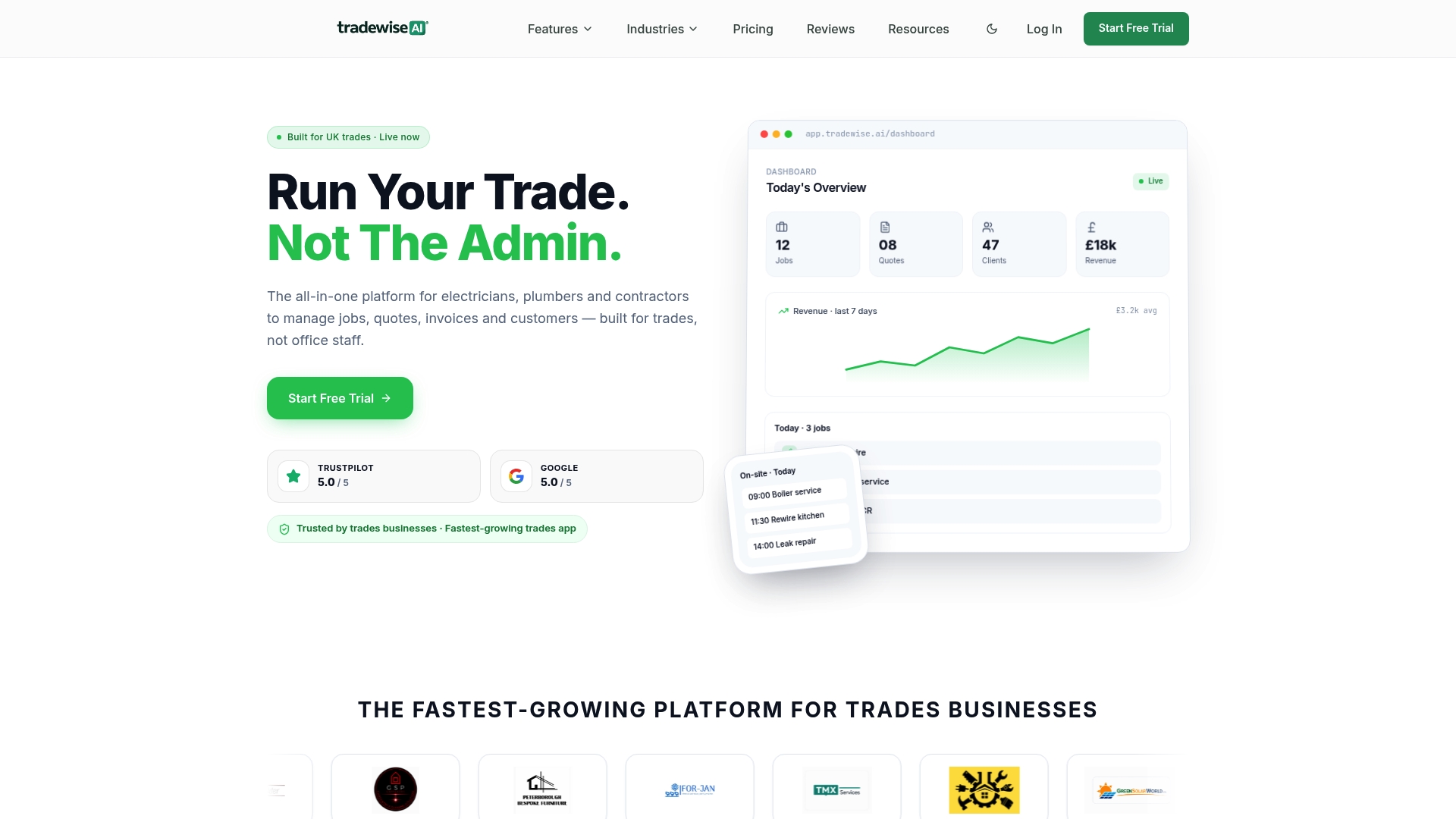
Tradewisehq centralises job tracking, workforce attendance, scheduling, quotes, invoices, and client communication in one mobile-first platform. Site supervisors log updates in the field, and managers see the full picture in real time without making a single phone call. For builders ready to move from reactive coordination to portfolio-level control, Tradewisehq trade management software is the practical next step.
FAQ
What is the most important factor in managing multiple construction sites?
Appointing a capable, accountable site supervisor at each location is the most critical factor. Remote supervision only works when there is a trusted person on the ground making day-to-day decisions.
How do builders avoid resource conflicts across multiple projects?
Builders avoid conflicts by mapping all trades and equipment against project phases on a shared resource calendar before work begins. Forecasting at pre-construction stage prevents double-booking specialist trades at critical milestones.
How often should a builder visit each site?
Visit frequency should be driven by risk, not routine. Sites with new subcontractors, complex works, or upcoming regulatory inspections require more frequent visits than stable, well-supervised projects in routine phases.
What documents should every construction site use?
Every site should maintain a daily site diary, weekly toolbox talk records, phase-specific inspection checklists, and subcontractor sign-off sheets. Uniform documentation across all sites reduces admin time and protects the business in disputes.
What digital features matter most for multi-site builders?
The most valuable features are live progress tracking, workforce attendance logs, materials monitoring, and a portfolio dashboard. These four functions give a manager a complete picture of all active sites without requiring a physical visit.