

A plant manager in UK construction is the person who owns the full lifecycle of heavy machinery and fleet across projects, from sourcing and mobilisation through to maintenance, compliance, and eventual disposal. If something with an engine or a lifting mechanism is on your site, the plant manager is accountable for its availability, condition, cost, and legal status.
Three things define the role:
- Operational: mobilising and demobilising plant, scheduling equipment across projects, and keeping machines available when site teams need them.
- Commercial: making buy versus hire decisions, negotiating rental agreements, managing supplier relationships, and owning the plant department's budget.
- Compliance: satisfying HSE requirements, meeting PUWER and LOLER obligations, and maintaining the statutory records that prove every machine is safe to operate.
Table of Contents
- What does a construction plant manager actually do day to day?
- What are the UK legal and safety obligations for plant managers?
- How do plant managers handle buy versus hire decisions?
- How do you move from reactive repairs to planned fleet maintenance?
- What do plant managers need to know about moving large equipment?
- How does a plant manager differ from a site manager or operations manager?
- What skills and KPIs define strong plant management performance?
- How do you qualify and progress into a plant manager role in the UK?
- Which digital tools help trades businesses manage plant effectively?
- Key takeaways
- The part most trades owners get wrong about plant management
- Tradewisehq helps trades businesses get plant admin under control
- Useful sources and further reading
What does a construction plant manager actually do day to day?
The plant manager role covers a wider range of tasks than most people outside the industry expect. On any given week, that means sourcing hired plant for an upcoming project, chasing a service record for a machine already on site, and forecasting which assets will be needed three months out.
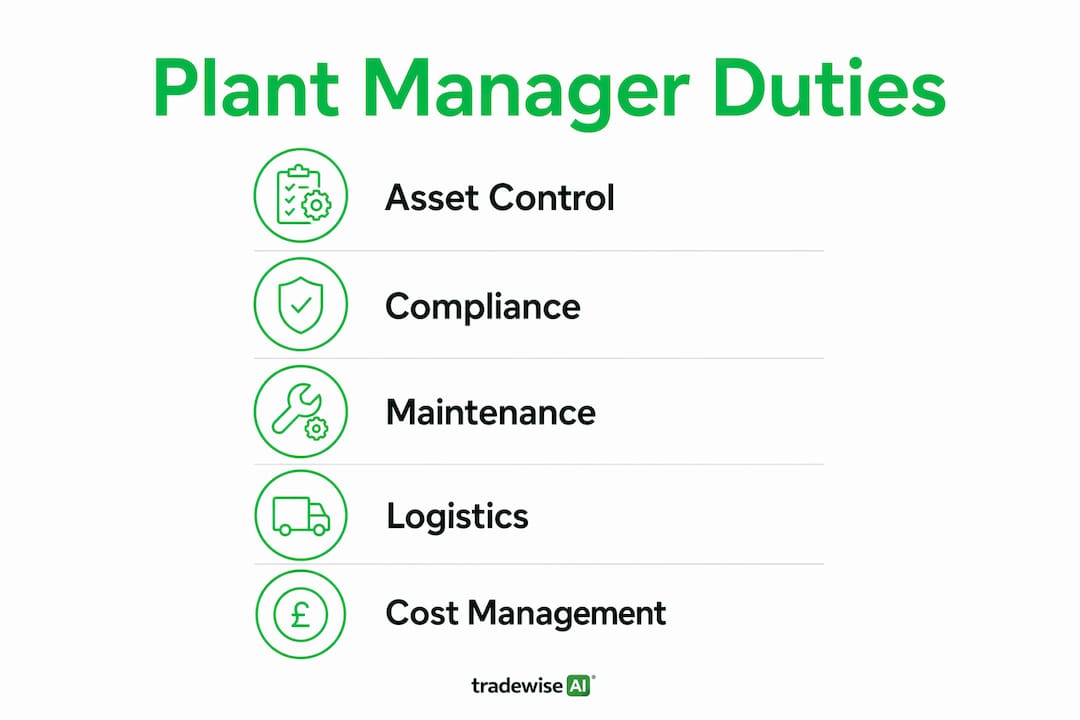
Mobilisation is one of the most demanding parts of the job. Getting cranes, excavators, and temporary facilities delivered, installed, and commissioned on time requires coordinating with hauliers, site managers, and project programmes simultaneously. Demobilisation carries equal risk: removal, disposal, and final statutory checks all need to happen in the right order to avoid compliance gaps.
Beyond mobilisation, the day-to-day work includes maintaining plant registers, managing fuel cards, keeping insurance documents current, and making sure service records are complete and accessible. Procurement sits here too: forecasting fleet requirements, managing spare-parts inventory, and deciding whether to extend a hire or return a machine early.
Pro Tip: Build a simple plant register in a spreadsheet or mobile app from day one. Recording asset ID, hire dates, service intervals, and inspection due dates in one place saves hours of searching when an auditor or HSE inspector arrives.
What are the UK legal and safety obligations for plant managers?
The legal framework is specific and non-negotiable. Two sets of regulations sit at the centre of a plant manager's compliance duties.
PUWER (Provision and Use of Work Equipment Regulations 1998) requires that all work equipment is suitable for its intended use, properly maintained, and inspected by a competent person. LOLER (Lifting Operations and Lifting Equipment Regulations 1998) adds a layer of statutory examination for any equipment used for lifting, including excavators used for lifting duties, telehandlers, and cranes. LOLER examinations must be carried out at defined intervals by a competent person independent of the operator, and the written reports must be retained.
Key compliance tasks include:
- Daily pre-use checks by operators, recorded and signed off.
- Periodic inspections under PUWER at intervals determined by risk assessment.
- Statutory LOLER thorough examinations every six or twelve months depending on equipment type.
- Retention of all examination reports, service records, and defect notices.
Competence schemes matter here too. The CPCS (Construction Plant Competence Scheme) and NPORS (National Plant Operators Registration Scheme) both provide card-based evidence that operators are trained and assessed. A plant manager needs to verify that every operator on their fleet holds the correct card for the machine they are running. CSCS cards cover broader site access; CPCS and NPORS are the plant-specific standards.
Pro Tip: Keep a compliance site safety checklist tied to each asset, not only to the site as a whole. When a machine moves between projects, its inspection history travels with it.
How do plant managers handle buy versus hire decisions?
This is where the role earns its commercial weight. The decision to buy or hire a piece of plant is not simply about the day rate; it turns on utilisation, capital availability, maintenance burden, and how long the asset will actually be needed.

| Factor | Buy | Hire |
|---|---|---|
| Utilisation threshold | High (typically above 60% of available hours) | Low or project-specific use |
| Capital requirement | High upfront; asset on balance sheet | Operating cost; no capital tied up |
| Maintenance responsibility | Owner bears all costs and risk | Hire company handles major repairs |
| Flexibility | Fixed asset; disposal risk at end of life | Return when no longer needed |
| Tax/finance | Capital allowances available; finance options | Hire costs fully deductible as operating expense |
Rental agreements need active management. Negotiating hire contracts for favourable breakdown response times, replacement guarantees, and off-hire notice periods directly affects both cost and site productivity. A plant manager who lets hire agreements roll without review will consistently overpay.
P&L ownership means the plant manager feeds cost data into tenders and project programmes, not just reports after the fact. When a project team is pricing a job, the plant manager's utilisation data and hire rate benchmarks determine whether the plant allowance in the tender is realistic.
How do you move from reactive repairs to planned fleet maintenance?
Reactive maintenance, fixing things when they break, is the most expensive way to run a fleet. Unplanned downtime stalls site programmes, triggers hire costs for replacement machines, and often means paying premium rates for emergency repairs.
A planned preventative maintenance (PPM) cycle addresses this. Service intervals are set by manufacturer guidance and adjusted for actual operating hours, tracked either manually or through telematics. Spare parts for high-wear items are stocked in advance. Defects found during daily checks are logged and scheduled for repair before they become failures.
Telematics takes PPM further. GPS and engine-hour data from fleet-tracking hardware feed directly into maintenance scheduling, flagging when a machine is approaching a service interval without anyone needing to check manually. Continuous improvement through data reduces unplanned downtime and lowers the lifetime cost of ownership.
Key metrics to track:
- Availability: percentage of scheduled hours the machine is ready to work.
- Utilisation: percentage of available hours the machine is actually working.
- Mean time between failures (MTBF): average operating time between unplanned breakdowns.
- Maintenance cost per hour: total maintenance spend divided by operating hours.
What do plant managers need to know about moving large equipment?
Transporting heavy plant between sites is a compliance exercise as much as a logistics one. Abnormal loads (vehicles or loads exceeding standard width, height, or weight limits) require permits from National Highways and, depending on the route, police notification or escort. The Bouygues Construction UK plant lead role illustrates how major civil projects now require dedicated coordination of road, rail, and sea transport for large-scale equipment deployment.
Practical points for any firm moving large plant:
- Book specialist hauliers early; lead times for low-loaders and abnormal-load escorts can run to several weeks.
- Confirm site access routes in advance: bridge weight limits, overhead cables, and turning circles catch firms out regularly.
- Check insurance covers the load in transit and on the haulier's vehicle, not just on site.
- Plan offloading: crane availability, ground conditions, and banksman arrangements need to be confirmed before the lorry arrives.
Pro Tip: For materials management and plant deliveries on the same project, align transport windows with the project programme to avoid clashes at the site gate.
How does a plant manager differ from a site manager or operations manager?
The boundaries matter because gaps in accountability cost money and create safety risk.
A plant manager owns the asset: its availability, condition, cost, and compliance. A site manager owns the delivery of work on site. An operations manager owns the efficiency of processes across the business. These are three distinct accountabilities, and confusing them is how plant costs spiral unnoticed.
The site manager focuses on programme, labour, and overall site delivery. They need plant to be available; they do not own the decision about whether to buy or hire it, or whether to repair or replace it. The operations manager focuses on process efficiency across the business. The plant manager sits between these roles as the asset specialist: responsible for what the machines cost, whether they are legal, and whether they are ready to work.
A plant operator runs the machine under the plant manager's asset regime. The operator's competence card (CPCS or NPORS) is the plant manager's responsibility to verify; the operator's daily check sheet feeds the plant manager's maintenance records.
What skills and KPIs define strong plant management performance?
| KPI | Definition | Why it matters |
|---|---|---|
| Availability | Ready hours ÷ scheduled hours | Shows whether the fleet is fit for purpose |
| Utilisation | Working hours ÷ available hours | Reveals idle assets and informs buy/hire decisions |
| MTBF | Operating hours between unplanned failures | Tracks reliability and maintenance effectiveness |
| Maintenance cost per hour | Total maintenance spend ÷ operating hours | Benchmarks efficiency and flags deteriorating assets |
| Cost per utilisation hour | Total fleet cost ÷ working hours | The commercial headline for tenders and P&L reporting |
Skills-wise, employers such as Holcim UK look for mechanical understanding, budget control, KPI reporting, and the ability to lead site teams safely. Supplier negotiation and planning ability matter equally. A plant manager who can read a maintenance cost trend and translate it into a repair-versus-replace recommendation is worth considerably more than one who simply books services when the calendar says so.
How do you qualify and progress into a plant manager role in the UK?
Most plant managers in the UK come up through the operator route: CPCS or NPORS card, site experience, then a supervisory step before taking on asset management responsibility. The CITB supports training through apprenticeships and short courses; SMSTS (Site Management Safety Training Scheme) and IOSH Managing Safely are common additions for anyone moving into a management position.
Key qualifications and routes:
- CPCS or NPORS card: the baseline for plant operators and the competence evidence plant managers must verify across their fleet.
- CSCS card: required for site access; the level depends on the individual's qualifications and role.
- SMSTS: standard for site-level management; relevant when the plant manager also carries site safety responsibilities.
- On-the-job progression: operator to plant supervisor to plant manager, with commercial training (budgeting, hire negotiation, P&L) typically acquired through employer mentoring or short business courses.
For smaller firms, a dedicated plant manager is often unnecessary. A senior foreman or the business owner can carry the function, provided they have the right competence cards verified, a basic asset register in place, and a clear maintenance schedule.
Which digital tools help trades businesses manage plant effectively?
The gap between a spreadsheet and a proper asset management system is smaller than most small firms think, and the gains are immediate.
- Telematics hardware: GPS trackers and engine-hour monitors fitted to owned plant feed utilisation data and maintenance triggers automatically. Entry-level units are affordable for firms with even a handful of machines.
- Fleet and asset registers: a central record of every owned and hired asset, with service history, inspection dates, and hire agreement details. This replaces the folder of paper certificates that goes missing when someone leaves.
- Maintenance scheduling software: automated reminders for service intervals and LOLER examinations mean nothing falls through the gaps between projects.
- Job management platforms: linking plant scheduling to job scheduling means site teams and plant managers work from the same programme, reducing the double-booking and idle-time problems that come from separate systems.
For live job tracking and asset management in one place, mobile-first platforms built for trades businesses offer the fastest route from spreadsheets to structured records. The practical advice from firms that have made this transition is to start with an asset register and service reminders, then add telematics once the basics are working.
Pro Tip: Before trialling any software, list the five plant-related tasks that cost you the most time each week. A good platform should eliminate at least three of them within the first month.
Key takeaways
A plant manager in UK construction owns the full asset lifecycle: availability, compliance, cost, and logistics, making the role central to both site delivery and commercial performance.
| Point | Details |
|---|---|
| Core remit | Plant managers own asset availability, condition, cost, and compliance from mobilisation to disposal. |
| Compliance baseline | PUWER and LOLER set statutory inspection and record-keeping duties; CPCS/NPORS cards must be verified for every operator. |
| Commercial weight | Buy versus hire decisions, rental negotiation, and P&L ownership sit with the plant manager, not the site manager. |
| Maintenance priority | Shifting from reactive to planned preventative maintenance, tracked by availability and MTBF, reduces cost and downtime. |
| Tradewisehq for smaller firms | Tradewisehq's asset registers, maintenance reminders, and job scheduling replace fragmented spreadsheets for trades businesses managing plant. |
The part most trades owners get wrong about plant management
The conventional view treats plant management as a technical job: someone who knows engines and keeps machines running. That framing misses the half of the role that actually determines whether a project makes money.
The commercial side, buy versus hire analysis, rental contract negotiation, feeding accurate plant costs into tenders, is where most small trades businesses leak money quietly. A digger sitting idle on hire costs the same whether it is working or not. An owner who does not track utilisation has no idea how much idle time they are paying for, and no evidence to challenge a hire company's invoice.
The other underrated point is that mobilisation and demobilisation are the highest-risk moments in the plant lifecycle, both for compliance and for schedule. Most firms plan the delivery carefully and then improvise the removal. That is where statutory checks get missed and where disputes with hire companies about damage or off-hire dates tend to start.
For a small trades business, the realistic starting point is not a dedicated plant manager. It is one person, often the owner or a senior foreman, who takes clear ownership of the asset register, the inspection schedule, and the hire costs. A mobile app that centralises those three things costs less per month than a single day of unplanned downtime.
Tradewisehq helps trades businesses get plant admin under control
Running plant management alongside jobs, staff, and client work is where small trades businesses feel the pressure most. Tradewisehq is built for exactly that situation: a mobile-first platform that brings asset registers, maintenance reminders, job scheduling, and supplier records into one place, so nothing falls through the gaps between projects.
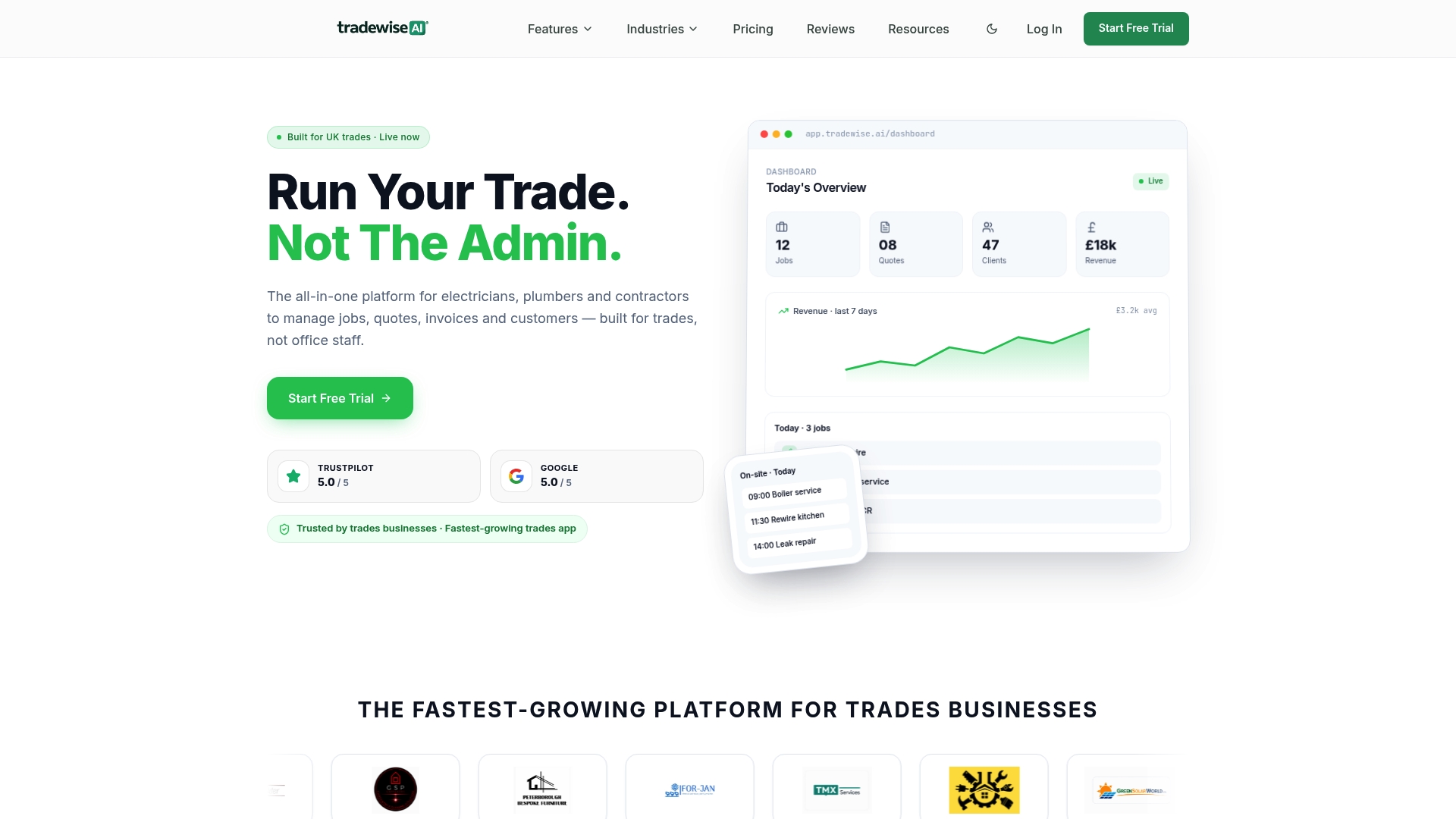
Where a plant manager on a large civil project uses enterprise fleet software, a builder, HVAC contractor, or electrical firm with a handful of machines needs something lighter and faster to set up. Tradewisehq connects your plant scheduling directly to your job management, so your site teams and your asset records stay in sync without a second system. Maintenance reminders go out automatically; hire agreement details sit alongside the job they belong to.
Start a 14-day free trial and see how much admin you can cut in the first week.
Useful sources and further reading
- Health and Safety Executive (HSE): primary source for PUWER and LOLER regulations, inspection requirements, and enforcement guidance.
- CITB: covers apprenticeships, SMSTS, and industry training standards for construction plant and management roles.
- CPCS (Construction Plant Competence Scheme): the main card scheme for plant operators in the UK; plant managers use this to verify operator competence.
- Go Construct: industry career resource with a detailed plant manager job description covering duties, skills, and progression routes.
- Bouygues Construction UK: example of a plant lead role on a major infrastructure programme, showing the scale and logistics complexity at the top end of the discipline.
- Holcim UK: industry employer job description emphasising continuous improvement, KPI reporting, and commercial awareness as core plant manager requirements.
- Nationwide Maintenance: practical reference for preventive maintenance contracts and commercial maintenance standards across construction and facilities.