

Set expectations early, put them in writing, and keep a predictable communication rhythm. That is the short answer. Do those three things consistently and the vast majority of disputes, late-night texts, and painful final walk-throughs simply do not happen.
Your one-line action plan: Before work starts, hold a pre-start meeting, issue a plain-English contract with a payment schedule, and agree a weekly update format with the client.
The four elements every job needs in writing from day one:
- Scope: exactly what is included and, critically, what is not
- Cost: the full quoted price, allowances, provisional sums, and the contingency percentage
- Timeline: a realistic range with named milestones, not a single optimistic date
- Change process: how variations are requested, priced, approved, and recorded
Pro Tip: Write the exclusions list before you write the inclusions. Clients remember what you promised; they forget what you said was out of scope. A clear exclusions section on the quote prevents more arguments than any other single document.
Table of Contents
- Why managing client expectations changes project outcomes
- What expectation gaps do builders encounter most often?
- How to lay the groundwork before you start
- What to tell clients, when to tell it, and how to record it
- How to handle variations so cost and schedule impacts are clear
- How to produce realistic timelines and transparent cost estimates
- Practical templates and scripts builders use to keep things consistent
- What is the UK dispute-resolution path when problems escalate?
- Key takeaways
- What actually separates builders who avoid disputes from those who don't
- Tradewisehq keeps your client communication consistent, job after job
- Useful UK resources for builders
Why managing client expectations changes project outcomes
Poor expectation management, not poor workmanship, is the leading cause of lost referrals and client dissatisfaction in residential construction. NAHB analysis and industry surveys consistently point to weak communication and a lack of process transparency as the primary drivers of unhappy clients, not defective brickwork or missed tolerances.
The cost of that gap is concrete. Industry surveys referenced by NAHB identify hidden costs and unexpected upgrades as a common top pain point during new-build or remodelling projects. That is not a quality complaint. It is a communication failure.
Consider a typical scenario. A builder quotes a kitchen extension at £48,000. The client hears "£48,000 finished." The builder means "£48,000 before provisional sums for kitchen units, tiles, and sanitaryware." Six weeks in, the client receives a revised figure of £61,000 and feels deceived. The builder has done nothing wrong technically, but the relationship is broken. Recovering it costs time, goodwill, and often a solicitor's letter. Preventing it costs one paragraph on the original quote.
Structured expectation-setting also reduces warranty claims and improves satisfaction scores, according to industry case studies cited by NAHB. The builders who invest in the process up front spend less time managing complaints and more time winning referrals.
What expectation gaps do builders encounter most often?
The same four gaps appear on almost every troubled job. Recognising them in advance is half the fix.
-
Timeline fantasy. The client heard your best-case figure; you meant your probable-case range. Fix: always quote a window ("10–14 weeks from groundworks") and explain what can shift it. Never give a single completion date without caveats.
-
Hidden costs. Provisional sums, allowances, and VAT are invisible to most clients until the invoice arrives. Fix: itemise every allowance on the quote with a plain-English note: "Kitchen unit allowance: £6,000. If your chosen units exceed this, the difference is added to the contract sum."
-
Communication style and response times. Clients who do not hear from you assume the worst. Consistent weekly updates cut unplanned client interactions dramatically, according to Bokka Group analysis cited in industry research. Fix: agree a named day and format for updates at the pre-start meeting.
-
Extras and variations. A client asks a subcontractor to "just move that socket while you're there." Three weeks later they dispute the charge because nobody told them it would cost extra. Fix: a strict no-verbal-approval rule for any work outside the original scope.
Pro Tip: When a client raises a concern, acknowledge it before you respond to it. Validating client emotions, saying "I understand why that's frustrating" before explaining the technical position, de-escalates tension and keeps the conversation solution-focused. Jumping straight to your defence reads as dismissive, even when you are right.
How to lay the groundwork before you start
The pre-start meeting is the single most effective prevention tool available to a builder, according to FMB guidance. Nothing else comes close. Walking a client through the contract, payment schedule, and timeline before a single tool is unpacked creates alignment that carries through the whole job.
What a professional quote must include
A quote is not just a price. It is the first expectation-setting document the client receives. At minimum it should contain:
- Full scope description with a numbered list of deliverables
- Explicit exclusions (groundworks, landscaping, kitchen appliances, decoration — whatever is not in your price)
- Allowances and provisional sums, each with a named figure and a plain-English explanation
- Payment schedule: deposit, stage payments tied to milestones, and the final retention or completion payment
- Validity period and the basis for any price variation (materials escalation)
- Your contact details and the name of the site manager
FMB guidance stresses that contracts should be short and plain-English, not long legal documents. A client who reads and understands the contract is a client who cannot later claim they did not know the rules.
Running the pre-start meeting
Hold it on site if possible, two to five days before work begins. Cover these points in order:
- Walk through the contract page by page. Stop at every clause the client might misread.
- Confirm the payment schedule dates and the trigger events for each payment.
- Name the single point of contact on your side and agree how the client should reach them (phone for urgent site issues, email for everything else).
- Explain the variation process: no verbal approvals, all changes in writing before work proceeds.
- Hand over a short "what to expect" document covering weather delays, material lead times, and typical decision points (tile selections, fixture choices, structural sign-offs).
- Agree the weekly update day and format.
Pro Tip: Give clients a pre-project planning roadmap at this stage. A simple one-page milestone list in plain English, showing selections, permits, rough-ins, inspections, and handover, removes the mystery from the build sequence and reduces the "what's happening this week?" calls significantly.
What to tell clients, when to tell it, and how to record it
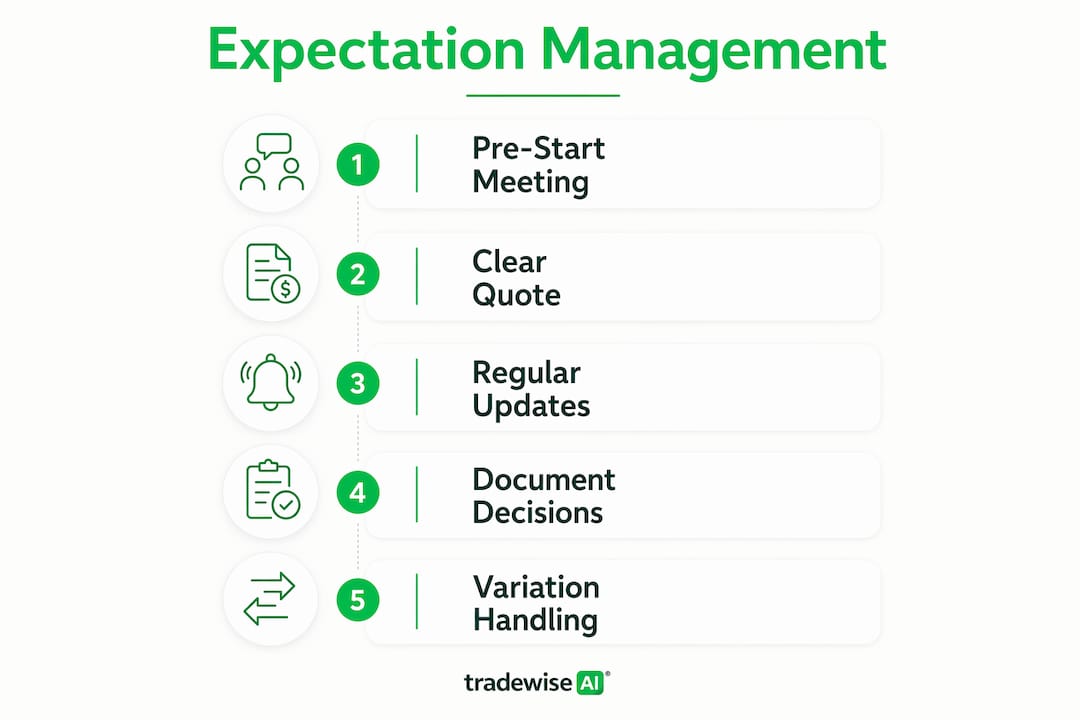
A predictable communication rhythm is the single biggest trust-builder on a live job. Clients who know when they will hear from you stop chasing you. The recommended pattern is a weekly written update plus a milestone sign-off at each defined stage.

The weekly update template
Send every Friday. Keep it short. Include:
- Progress this week: what was completed (be specific: "first-fix electrics to ground floor complete")
- Plan for next week: what trades are on site and what they will finish
- Decisions needed: any selections or approvals the client must make before work can continue, with a deadline
- Budget note: any cost movement since the last update, even if minor
- Site access or logistics: anything the client needs to know about access, deliveries, or noise
Logging decisions and storing records
Every client conversation that involves a decision, a change, or a complaint needs a written record. The construction client communication best practices that protect builders in disputes are simple: log it, date it, and store it somewhere both parties can access.
Practical record-keeping steps:
- After any phone call or site meeting, send a follow-up email summarising what was discussed and agreed. Subject line: "Summary: site meeting [date]."
- Photograph work at each stage, particularly before covering up structural or services work.
- Store signed variation forms, payment receipts, and correspondence in a single project folder (cloud-based or physical, but consistent).
- Never rely on text messages as the sole record of a decision. Confirm by email.
Experienced builders routinely log every client conversation and require written sign-off for changes. That habit protects them when memory diverges months later.
How to handle variations so cost and schedule impacts are clear
The single rule: no work proceeds without an approved variation form. No exceptions, no "I'll sort the paperwork later," no verbal agreements on site. This one discipline prevents more disputes than any other.
What a variation form must include
- Description of the change: what is being added, removed, or altered
- Cause: client request, unforeseen condition, design change, or supplier issue
- Cost impact: the net addition or reduction to the contract sum, including VAT
- Programme impact: the number of working days added to or removed from the schedule
- Client signature and date
- Builder representative signature and date
Phrasing that gets sign-off without drama
When a client raises an on-site request, use this script: "Happy to look at that. Because it's outside the original scope, I'll put it through our change process so you have the cost and any schedule effect in writing before we go ahead. I'll have something with you by [specific day]."
That phrasing does three things: it acknowledges the request, it signals professionalism, and it buys time to price it properly. Never quote verbally on the spot for anything beyond a trivial item.
For urgent on-site requests where work genuinely cannot wait, note the request in writing immediately (a dated site diary entry or a WhatsApp message to yourself), carry out the minimum necessary work, and follow up with a formal variation form within 24 hours. Do not let the paperwork slip past 48 hours or the client will assume the work was included in the original price.
How to produce realistic timelines and transparent cost estimates
Always quote with clear allowances and a contingency percentage. That is the top-level rule, and departing from it is where most budget disputes begin.
Contingency guidelines vary by project type, generally increasing for more complex or older projects due to higher risks of unforeseen issues. It is good practice to state any contingency clearly on the quote and explain that unused contingency is not charged, helping clients understand the reason for the buffer.
Explaining provisional sums and allowances
A provisional sum is an estimated cost for work that cannot be fully defined at the time of quoting. An allowance is a budget figure for a client-selected item (tiles, sanitaryware, kitchen units). Both must appear on the quote with their figures and a note explaining that the final cost depends on conditions or selections.
Sample client-facing wording: "Provisional sum for drainage connection: £1,200. This figure is based on standard connection depth. If the drain is deeper than 600mm, additional excavation costs will apply and will be agreed with you before work proceeds."
Staged payments and why they reduce disputes
Tie every payment to a defined milestone, not a calendar date. A builder job deposit policy that links payments to progress gives the client visible proof of value before each invoice lands. A typical structure for a £60,000 extension:
Typical staged payments correlate with construction milestones, such as contract signing, foundations, superstructure, first fix, and practical completion, with amounts proportionate to the work completed at each stage.
Clients who understand why they are paying at each stage rarely dispute invoices. Clients who receive a large invoice with no clear milestone trigger often do.
Practical templates and scripts builders use to keep things consistent
Standardise on four core documents and use them on every job without exception. Consistency is what separates a professional operation from one that reinvents the wheel each time.
| Template | Purpose | Minimum fields |
|---|---|---|
| Quote / tender document | Sets scope, price, exclusions, and payment terms | Scope, exclusions, allowances, provisional sums, payment schedule, validity period |
| Pre-start checklist | Confirms all pre-work actions are complete | Contract signed, deposit received, planning permission confirmed, site access agreed, contacts named |
| Variation form | Documents and prices any change to scope | Description, cause, cost impact, programme impact, client signature, date |
| Weekly progress report | Maintains communication rhythm | Progress this week, plan next week, decisions needed, budget note, site logistics |
Short scripts for common interactions
Introducing the variation process at pre-start: "If anything changes during the build, we'll put it through our variation process. You'll always see the cost and any schedule effect in writing before we go ahead. Nothing extra gets built without your sign-off."
Requesting milestone sign-off: "Foundations are complete and inspected. I'm attaching the stage payment invoice for £12,000. Once that's settled, we'll move straight into the superstructure. Let me know if you'd like to come and see the work before we proceed."
Delivering bad news: Lead with what happened, why it matters, what you are doing about it, and what decision the client needs to make. Keep it factual and calm. Clients can handle bad news; they cannot handle silence.
Store templates in a shared cloud folder (Google Drive or Microsoft OneDrive work well for most small firms) or within your project management software. Printed packs are fine as a backup but should never be the primary record. For builders managing multiple sites, consistent template use across jobs is what keeps standards from drifting when you are not on every site every day.
What is the UK dispute-resolution path when problems escalate?
The recommended path in the UK is: consult the contract, attempt informal negotiation, move to mediation if negotiation fails, and treat arbitration or litigation as a last resort. UK construction dispute practice emphasises the contract as the starting point for every escalation.
Six immediate actions when a dispute looks likely
- Stop non-essential work in the disputed area to prevent the situation worsening.
- Gather evidence immediately: photographs, signed variation forms, payment records, and a written chronology of events.
- Arrange a face-to-face meeting. FMB guidance is explicit: handle sensitive disputes in person, not by text or email. Body language and tone matter.
- Log a full chronology of the dispute: dates, conversations, decisions, and any instructions given or received.
- Check your contract's dispute clause before making any commitments. Most well-drafted contracts require informal negotiation before any formal action.
- Seek FMB guidance if you are a member. The FMB offers dispute support and can advise on mediation services appropriate for the scale of the claim.
What to record on site
Photograph everything before covering it up. Date every site diary entry. Keep copies of all signed documents off site. If a client makes a verbal complaint, follow up the same day with an email: "Further to our conversation this morning, I understand your concern is [X]. Here is what we are doing: [Y]." That email becomes your evidence.
Pro Tip: If you need to apologise, choose your words carefully. "I am sorry this happened" expresses genuine empathy without admitting legal liability. "I am sorry we got that wrong" may be read as an admission of fault in a formal dispute. The distinction matters if the matter reaches a solicitor.
Key takeaways
Builders who set expectations in writing before work starts, maintain a weekly communication rhythm, and follow a strict variation sign-off process resolve disputes faster and lose fewer referrals to poor client experience.
| Point | Details |
|---|---|
| Start with a pre-start meeting | Walk the client through the contract, payment schedule, and timeline before any work begins. |
| Quote with allowances and contingency | Name every provisional sum and include a contingency percentage (5–20% depending on project type). |
| Use a weekly update every Friday | Consistent updates cut unplanned client contact and reduce anxiety throughout the build. |
| No variation proceeds without written sign-off | Use a standard variation form with cost, programme impact, and client signature on every change. |
| Tradewisehq supports the whole process | Tradewisehq automates communication logs, variation approvals, and weekly update prompts in one mobile-first platform. |
What actually separates builders who avoid disputes from those who don't
The conventional wisdom says disputes happen because of bad clients. After looking closely at how the most complaint-free builders operate, the pattern is different. The builders who rarely face escalated disputes are not necessarily better at the physical work. They are better at one thing: they never let a client fill in a blank themselves.
Every gap in communication is a space the client fills with their own assumption, and that assumption is almost always more expensive, faster, and more perfect than reality. A client who has not heard from you in ten days has not concluded that everything is fine. They have concluded that something is wrong and you are hiding it.
The builders who get this right treat communication as a deliverable, the same way they treat a roof or a floor screed. It goes on the programme. It has a named person responsible for it. It gets checked.
The dos and don'ts that matter most:
Do: send the weekly update even when there is nothing dramatic to report. "Quiet week, plastering continues, no decisions needed from you" takes 90 seconds and prevents three phone calls.
Do: hand the client a one-page "what to expect" document at pre-start. Weather delays, material lead times, the sequence of trades, what dust and noise to expect. Clients who understand the process do not panic when it happens.
Don't: price variations verbally on site. Ever. The number you say in the moment is never the number the client remembers, and it is never the number that covers your actual costs.
Don't: apologise in a way that admits liability. Empathy and legal admission are not the same thing. Learn the difference before you need it.
Tradewisehq keeps your client communication consistent, job after job
The hardest part of managing client expectations is not knowing what to do. It is doing it consistently across every job, every week, without things slipping when you are stretched across multiple sites.
Tradewisehq is built for exactly that. It is an AI-powered operating system for builders and contractors that puts your quotes, variation forms, communication logs, and weekly update prompts in one mobile-first platform. Instead of chasing paper trails or relying on memory, your team gets automated reminders when a client approval is overdue, a digital record of every signed variation, and a communication history that is always up to date. The job management features mean you can run the expectation-management process described in this guide without adding administrative hours to your week. If you want to see how a digital workflow compares to manual admin, the table below shows where the time goes.
| Task | Manual admin | Digital job management |
|---|---|---|
| Variation sign-off | Paper form, chased by phone | Sent digitally, signed and logged automatically |
| Weekly client update | Written from scratch each Friday | Prompted and templated within the platform |
| Payment schedule tracking | Spreadsheet or diary | Milestone-triggered invoices with client visibility |
| Dispute evidence | Scattered emails and photos | Centralised, date-stamped, exportable |
Start with Tradewisehq and see how much of the admin that currently falls through the cracks can be handled before it becomes a problem.
Useful UK resources for builders
The three resources worth bookmarking, each for a different stage of the job:
-
Federation of Master Builders (FMB): The go-to for pre-start contract guidance, dispute support, and plain-English contract templates. If you are an FMB member, use their model contracts as the basis for your own. If you are not a member, their publicly available guidance on pre-start meetings and dispute prevention is still worth reading before every large job.
-
Fine Homebuilding — construction contract advice: Attorney and mediator Dean Kilgore's breakdown of the six contract elements every builder-client agreement needs, from scope and budget to change process and dispute resolution. Particularly useful when drafting or reviewing your own contract clauses.
-
Navilot project planning: A practical resource for pre-project discovery and roadmapping. Useful when you want to give clients a structured view of the project sequence before the contract is signed, which reduces scope creep and timeline misunderstandings from the outset.
For ongoing guidance on written contracts for UK builders and construction contract management, the Tradewisehq blog covers both topics in depth with UK-specific examples.
This article provides general information for builders and construction professionals. It is not legal advice. For contract disputes or formal legal proceedings, consult a solicitor or contact the FMB for member support.