

Builder daily workflow best practices are proven time-saving routines that help UK builders complete essential tasks within 10 minutes daily, improving project efficiency and protecting margins. The industry term for this discipline is construction workflow management, and it covers everything from daily logs to task prioritisation on site. Builders who follow structured daily routines consistently outperform those who rely on memory and habit alone. This guide covers the specific techniques, tools, and habits that make the difference on UK construction sites in 2026.
1. What makes a daily workflow effective for builders?
An effective daily workflow for builders rests on three qualities: speed, simplicity, and repeatability. If your routine takes longer than 10 minutes, it will not get done consistently. That is the single most important constraint to design around.
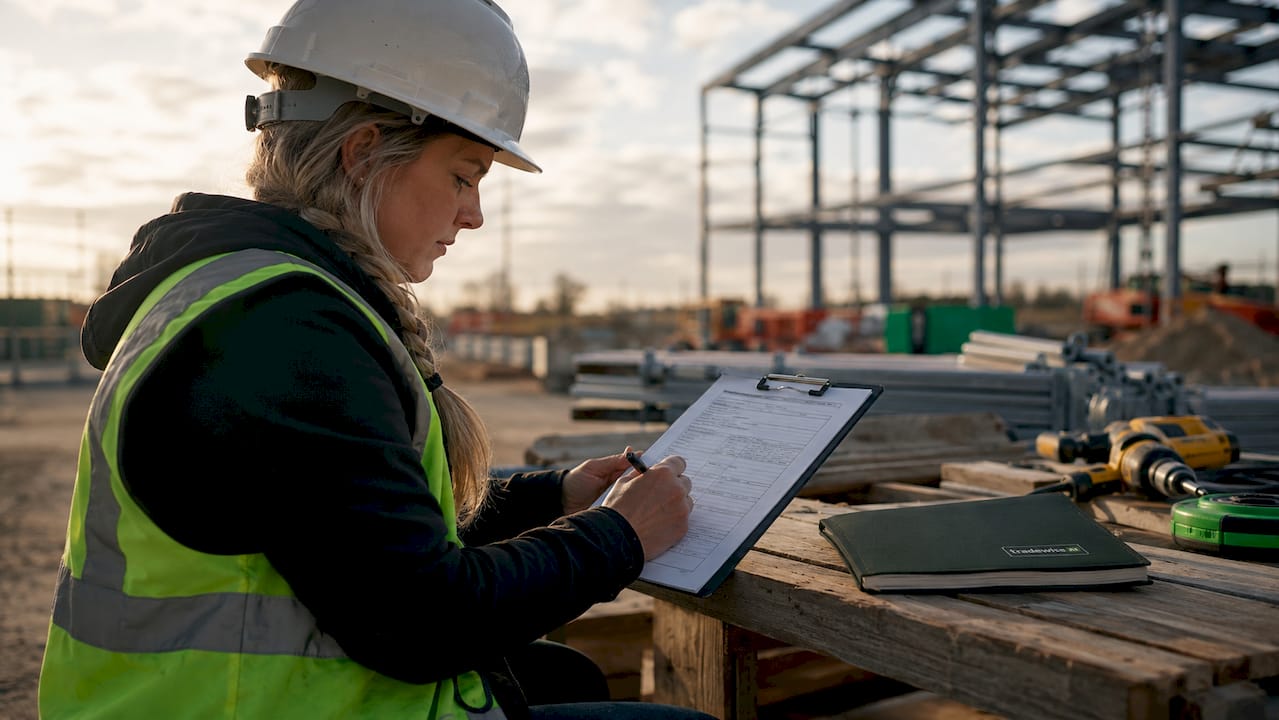
Standardisation is the foundation. A daily log with exactly four essential fields, completed in under 90 seconds, gets filled out far more reliably than a lengthy form. The four fields are: site date, crew present, hours worked, and weather. Everything else is optional unless an incident occurs.
Prioritise exactly three tasks per day. Decision fatigue is real, and it hits builders hard when they are managing multiple trades, deliveries, and client calls simultaneously. Committing to three priority tasks each morning removes the paralysis of a 20-item to-do list.
Habit stacking makes routines automatic. Anchoring new routines to existing triggers, such as arriving on site or making your first brew, removes the need for willpower. On a busy day, willpower runs out by 9am. A trigger-based habit does not.
Pro Tip: Write your three priority tasks before you leave the van each morning. The physical act of writing them down takes 60 seconds and sets your focus for the entire day.
2. How to optimise daily logs for speed and accuracy
Daily logs are the backbone of construction project workflow, yet most builders abandon them within weeks because the format demands too much. The fix is radical simplicity.
The four core fields, site date, crew present, hours worked, and weather, can be completed in under 90 seconds. That is the target. Anything that pushes beyond that threshold is a candidate for removal or automation.
- Avoid narrative entries by default. Lengthy written descriptions invite procrastination. Use incident mode only when something unusual happens, such as a delivery failure, a safety near-miss, or unexpected ground conditions.
- Take three photos every day. Progress, preparatory work, and any unexpected condition. Three daily photos take roughly 45 seconds to capture and upload, yet they dramatically improve the evidential quality of your records.
- Complete logs on site, not at home. Real-time field reports are six times more legally defensible than retroactive weekly summaries. Details fade fast. A log written at 4:30pm is worth far more than one written on Sunday evening.
- Digital tools cut reporting time by around half. Pre-filled fields, auto-populated dates, and photo uploads with geotags remove the friction that kills compliance.
Pro Tip: Set a recurring alarm for 4:15pm labelled "Log before you leave." Completing the log on site, while the day is fresh, takes a fraction of the time it takes to reconstruct it later.
Logs that lack context about delays or site impacts fail both operationally and legally. A two-line entry that records a concrete pour delay and its cause is worth more than three paragraphs of general commentary.
3. What daily task management strategies work best on site?
Task management on a construction site is fundamentally different from office-based work. Interruptions are constant, priorities shift with deliveries and subcontractors, and the physical environment makes sustained focus difficult. The strategies that work account for these realities.
- Limit your priority list to three items. Committing to exactly three tasks per day reduces decision fatigue and increases the likelihood of completion. A list of ten tasks is a wish. A list of three is a plan.
- Batch your communication checks. Checking messages twice daily, once mid-morning and once after lunch, protects your focus during the hours when physical work demands your full attention. Constant notifications fragment concentration and slow progress.
- Use time blocking to protect deep work. A task list is a wish, but a calendar is reality. Blocking 90-minute intervals for specific tasks, such as inspections, subcontractor coordination, or client calls, prevents the day from dissolving into reactive firefighting.
- Separate planning from doing. Spend five minutes at the start of each day reviewing the schedule and assigning your three priorities. Do not mix planning and execution, as switching between the two modes costs time and mental energy.
Pro Tip: Use a job management app to assign tasks the night before. Arriving on site with a pre-set plan removes the morning scramble and gets the crew moving faster.
The builders who manage multiple projects without burning out are not working harder. They are working within a structure that makes decisions in advance, so the day runs on rails rather than improvisation.
4. How technology enhances builder daily workflows
Technology does not replace good habits. It makes good habits easier to maintain. The right digital tools remove friction from the parts of the day that builders find most tedious: logging, scheduling, and communication.
Mobile apps designed for on-site daily reporting offer pre-filled fields, automatic date and location stamps, and one-tap photo uploads. These features reduce the time cost of compliance to the point where there is no credible excuse not to log. Cloud-based dashboards give project managers real-time visibility across multiple sites without requiring phone calls or chased emails.
Workforce scheduling tools integrated with job management software mean that crew assignments and calendar changes propagate instantly to everyone on the team. A subcontractor rescheduled on Tuesday morning knows about it before they leave home. That single feature eliminates a category of site-day waste that most builders accept as unavoidable.
Audit-ready records are a direct product of consistent digital logging. When a dispute arises over delays or variations, a timestamped, geotagged daily log with photos is a far stronger defence than a handwritten notebook. Audit-ready daily reports protect project margins and reduce the cost of disputes, which on UK construction projects can run to significant sums.
The practical threshold for technology adoption is low. A mobile-first platform that handles daily logs, job tracking, and scheduling in one place is sufficient for most small to medium building firms. The goal is fewer apps, not more.
5. Building site organisation that supports daily routines
Physical site organisation directly affects how well daily workflow routines hold up under pressure. A disorganised site creates constant micro-interruptions that erode the structure you have built into your day.
The most effective builders treat site layout as a workflow decision, not just a logistics one. Materials stored in a logical sequence reduce the number of trips and decisions made during the working day. A clear end-of-day reset routine, where tools are returned, waste is cleared, and the next day's materials are staged, means the morning starts with momentum rather than searching.
Job sheets are a practical tool for maintaining site organisation across a team. When every operative arrives knowing their specific tasks for the day, the site runs with less verbal coordination and fewer bottlenecks. The job sheet is the physical expression of the three-priority rule applied at team level.
Subcontractor coordination is one of the most common sources of daily disruption. Builders who manage subcontractors through a shared digital platform, rather than text messages and phone calls, report fewer missed arrivals and fewer material conflicts. The platform creates a shared reality that everyone works from.
Key takeaways
The most effective builder daily workflow combines a 90-second log, three priority tasks, and habit-stacked routines that require no willpower to maintain.
| Point | Details |
|---|---|
| Keep logs under 90 seconds | Use four core fields only: site date, crew present, hours worked, and weather. |
| Limit daily priorities to three | Three tasks per day reduces decision fatigue and increases completion rates. |
| Log in real time on site | Field-completed logs are six times more legally defensible than retroactive entries. |
| Anchor routines to site triggers | Habit stacking removes reliance on willpower during high-pressure days. |
| Use technology to cut admin time | Digital tools reduce daily reporting time by around half, making compliance sustainable. |
Why most builders get daily workflows wrong
I have spoken with dozens of builders across the UK who tried daily logging systems and abandoned them within a fortnight. The reason is almost always the same: the system asked for too much.
The instinct when designing a workflow is to capture everything. Every material delivery, every conversation with the client, every hour worked by every operative. That instinct is understandable, and it is also the fastest way to guarantee that nothing gets recorded at all. When a log feels like a burden, it gets skipped. When it gets skipped twice, the habit is broken. When the habit is broken, the whole system collapses.
The builders I have seen maintain consistent daily routines are not the most disciplined ones. They are the ones who made the routine so small that skipping it felt stranger than doing it. Four fields. Three photos. Three tasks. That is the entire system on a normal day. Incident mode exists for the days when something actually goes wrong.
The other mistake I see regularly is treating the daily log as a reporting tool for management, rather than a protection tool for the builder. A timestamped record of a delayed concrete pour, with a photo and a one-line note, has saved more than one UK builder from an unjustified penalty deduction. That is not paperwork. That is insurance.
Start with the smallest possible version of your workflow and add to it only when you have maintained the habit for 30 consecutive working days. Perfection on day one is the enemy of consistency on day 100.
— Mateusz
How Tradewisehq supports your daily workflow on site
Tradewisehq is an AI-powered platform built specifically for tradespeople and builders. It handles daily logs, job scheduling, workforce coordination, quotes, and client communication from a single mobile app.

Builders using Tradewisehq complete their daily logs in under two minutes, with pre-filled fields, automatic photo uploads, and real-time job tracking built in. The platform syncs crew schedules live, so every operative and subcontractor works from the same up-to-date plan. If you want to reduce your daily admin and build a workflow that actually holds up under site pressure, Tradewisehq trade management software is worth a look.
FAQ
How long should a builder's daily workflow take?
An effective daily workflow takes no more than 10 minutes. Digital tools reduce daily reporting time by around half, making consistent compliance realistic even on busy sites.
What should a construction daily log include?
A daily log needs four fields: site date, crew present, hours worked, and weather. Additional detail is only required when an incident or unusual event occurs.
Why are real-time logs more valuable than weekly summaries?
Real-time field logs are six times more legally defensible than retroactive entries. Details about weather, delays, and site conditions are captured accurately when recorded immediately.
How many tasks should a builder prioritise each day?
Commit to exactly three priority tasks per day. This reduces decision fatigue and significantly increases the likelihood that the most important work gets completed.
What is habit stacking and how does it help builders?
Habit stacking means anchoring a new routine to an existing trigger, such as arriving on site or finishing a morning brew. It makes daily workflows automatic, removing the need for willpower on high-pressure days.